Saturday, October 31, 2015

Cutting For Stone

Cutting for StoneCutting for Stone by Abraham Verghese

I thought this book was really interesting. I really enjoyed all the medical detail and the history of Ethiopia. I also really liked the characterization and the growth the characters experienced through their trials. I continue to be horrified by female circumcision/genital mutilation, and was absolutely sick to learn about vesiculovaginal fistula which is caused by young girls being given as brides, she then becomes pregnant and are physically unable to deliver the child who dies and rots in the womb, leaving her with a hole between the bladder and vagina so that the urine constantly leaked causing infection and horrible odor. (424) I think we in American really can't fathom what a life of such poverty looks like.

There were lots of interesting themes in the story. My favorite one was about choosing what kind of life you are going to live:

"Why must I do what is hardest?"
"Because, Marion, you are an instrument of God. Don't leave the instrument sitting in its case, my son. Play! Leave no part of your instrument unexplored. Why settle for 'The Three Blind Mice' when you can play the 'Gloria'?". .
"But I can't dream of playing Bach, the 'Gloria'."
"No, not Bach's 'Gloria.' Yours! Your 'Gloria' lives within you. The greatest sin is not finding it, ignoring what God made possible in you" (7).

"I hope one day you see this as clearly as I did in Kerchele. Everything you see and do and touch, every seed you sow, or don't sow, becomes part of your destiny. . .The key to your happiness is to own your slippers (from an Ethiopian folk tale about Abu Kassem who held onto his tattered old slippers past any reasonable use, but then every effort to get rid of them ended in disaster), own who you are, own how you look, own your family, own the talents you have, and own the ones you don't. If you keep saying your slippers aren't yours, then you'll die searching, you'll die bitter, always feeling you were promised more. Not only our actions, but also our omissions, become our destiny" (351).

There were themes about the relationship between father and son, brothers, and young love. There was the theme of forgiveness and themes of loss, particularly of parents.

There was the theme of where your home is, who "your people" are:
"Her skills were so rare, so needed for the poorest of the poor, and even at times in the royal palace, that she felt valued. Wasn't that the definition of home? Now where you are from, but where you are wanted?" (95)

The contrast between life in Ethiopia and life in America was. . .sickening? We really are such a wasteful and spoiled country. We expect to have what we want. We take for granted the luxuries of our lives. I was especially intrigued at the assertion that Ethiopians go to the doctor expecting to die, but happy when they don't die. In America, on the other hand, "death or the possibility of it always seemed to come as a surprise, as if we took it for granted that we were immortal, and that death was just an option" (486).

The more I think about it, the more I liked it. My primary complaint is that it seemed longer than it needed to be. He gave lots of background information about the characters in the beginning while I wondered where this story was going. I was at least 100 pages into the book before I was very interested. There is more description than there really needs to be, in my opinion. But overall, it was really interesting, I learned a lot, and it made me think.

Friday, October 30, 2015

The Boston Girl

The Boston GirlThe Boston Girl by Anita Diamant

This was a great story to make a four-hour car ride fly right by.  I love the way the author chose to tell Addie's story, as if she were answering her granddaughter's question "How did I get to be the woman I am today?"

I was captured by her initial answer "It started in that library, in the reading club.  That's where I started to be my own person" (11).

I loved the way we saw the passing of history, the big changes in society through Addie's eyes and experiences, even as there was a definite "feminist" flavor through her narrative.  I loved the role education played in Addie's growth, and (as a journalism major myself) I was tickled by the editing of her first newspaper article:  "Mort moved my ending to the beginning, took out all the adjectives, cut the whole thing in half, and made it one hundred percent better" (191).

I could relate to her descriptions of close friendships as there are certain people with whom I too "feel I understand myself better after we spend time together" (111) or I can share thoughts and experiences with and "telling (her) about those things made them seem lighter and less terrible" (287).  I am so thankful for the "Filomenas" in my life.

Addie certainly had her share of difficult times in her life.  I love reading a good book which examines people--who they are, why they do what they do--and this was one of these books.  Her relationship with her mother was especially sad as she never felt loved or accepted by her mom.  "Mameh had changed the least.  She cleaned and cooked and complained.  She wouldn't touch Betty's washing machine; she said it ruined the clothes and didn't get them as clean as she got them with her washboard, and then she groaned about how doing the laundry was killing her back" (234).  Oh, may I not be this person, always critical and complaining!  And she left behind an irreparable scar on her daughter's spirit, even after the mother had died:  "When they lowered the coffin into the ground, I remember thinking, She won't be able to make me feel like there's something wrong with me anymore.  But when the first clump of dirt hit the coffin, I realized that I would never stop wanting my mother to tell me that I was all right and that's when I started to cry" (276).  See how valuable it is to read books, even just a fiction novel?  Here is a perfect example of what NOT to be as a mother.

Monday, October 19, 2015

Ancient Egypt, Our Solar System, and Kindergarten Crafts

I haven't been blogging about school much lately--maybe because we've been schooling instead!  We are having a busy year with it being Tyrell's first year, Easton and Kiana in third and second grades respectively, and Destry trying to finish strong with his senior year (with little Miss Aryana, 18 months, keeping her finger in every pie).  We have once again formed a small coop with some friends to share some learning experiences together.

Because we are studying Ancient Egypt for history this year, we are having fun getting together for some hands-on activities to reinforce what we're learning.  We made salt dough maps of Egypt, a fun model of Egypt (with an overflowing Nile River and growing grass!), Egyptian sailboats and papyrus boats, and Egyptian toys like dolls and throwing sticks. 


We are using Jeanie Fulbright's science book to study astronomy and the kids have lots of fun doing the experiments and projects with their friends.  So far they have enjoyed making a model of the solar system, learning about the sun, and making models of Mercury.

Tyrell loves being "big enough" to get in on some coop classes.  They are having all kinds of fun learning about different letters and themes, reading books and making crafts centered around that theme.


This is a very busy season, but a good season.  I'm trying to enjoy each day with these young ones, knowing that the years fly by so quickly.

Sunday, October 18, 2015

Inside the O'Briens

Inside the O'BriensInside the O'Briens by Lisa Genova

This book was incredible--very well-written, wonderful characterization, and informative, all at the same time.

I bawled until I nearly sobbed.

Huntington's disease, an inherited neurodegenerative disease, sounds absolutely horrid. Terrifying.

I really liked Still Alice by Lisa Genova, and Left Neglected was also quite good. But Inside the O'Briens was an out-of-the-ballpark home-run.

My poor husband reminded me more than once, as I presented my tear-stained cheeks to him when he interrupted my reading, that the O'Briens "aren't even real people", but Genova made Joe, Rosie, JJ, Meghan, Katie and Patrick real to me. Genova is a Harvard-educated neuroscientist, so I enjoy reading her very informative books, but I appreciate even more the way she paints the picture of who the people are behind the disease and the many ways it affects them and their families.

Inside the O'Briens shows us how a man receives the news that he will lose control of his body, experience uncontrollable movements of his body and face and extreme mood swings, progressively lose the ability to speak clearly, swallow, formulate words at all, or walk, all while retaining comprehension, memory, and awareness. He would be literally trapped inside his body, unable to provide for his wife, express his love, or even control himself from hurting those he loves. At the same time, she helps us experience the emotions of his loving wife as she comes to terms with her future of watching the deterioration of the man she loves. We see the various responses of the children first to the news of his disease, and then to the shock that they have a 50% chance of inheriting the same disease. Meanwhile, she paints the picture of a family with all the normal family dynamics--tensions between mother and daughter, or between sisters, or a wild-running sibling, or the developing relationships of young adults. And she does it all with beautifully phrased words, such as the following examples of her figurative language:

"The air in the house is a thick swamp, today's heat and humidity already elbowing in on what was trapped inside yesterday" (3).

"The wind feel like an angry woman who won't shut up--relentless, caustic, making an already uncomfortable situation kiss the feet of unbearable" (232).

She also slips astute observations throughout the book, my favorite of which is this rumination about the television:

"The room does feel strange, oppressive even, with the TV off. In fact, Katie can't remember ever being in this room without it on. It's as if they're missing their fifth sibling, the one who never shuts up and demands all the attention" (119).

I loved this reassurance from Katie's boyfriend. I love the way he acknowledges what she's experiencing and offers to hold her hand and go through it with her.

"I know what you're going through is terrifying and unfair and really hard. But you have to go through it. Right now, you're just standing still. You're sinking in it. Let me hold your hand and go through it with you" (255).

And these two quotes really stood out to me as I considered what it would be like to have Huntington's disease in the family.
"We don't know anyone else with HD. You're the only example we have. We're going to learn how to live and die with HD from you, Dad" (273).
"To the uneducated or unloving eye, Joe is horrifying, unacceptable, and then invisible" (212).

I didn't agree with every choice the characters made, of course, so I would recommend this book to a more mature reader. Some of the characters make immoral choices, although there is no explicit detail, and there is a lot of discussion of yoga and its worldview, as well as some serious discussion of suicide. But this is still a wonderfully-written book, very interesting and informative, and I must heartily recommend it.


Wednesday, October 14, 2015

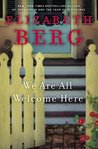
We Are All Welcome Here

We Are All Welcome HereWe Are All Welcome Here by Elizabeth Berg

Oh, we have to love us some Elizabeth Berg!  Her characterization never disappoints. One of the reasons I read, as I've said many times before, is because people are fascinating.

Berg takes the idea of a woman being paralyzed by polio, abandoned by her husband, and raising her daughter alone and makes it a study of the human will to not just survive, but overcome and thrive.  I was captivated by Paige's attitude after surviving polio:

"Anyway, what I believe is that what happened to me, revealed me. . .it made me know how I really feel about important things.  I mean, whatever the diagnosis is, isn't the issue.  The issue is the way the person who has it looks at it. Understand? I know that polio made me be my best self.  It's funny, it seems like people need obstacles to bring out their finest qualities" (143).

Diana, the daughter who grows up taking care of her mother as her mother teaches her about life, learns many lessons in this "coming of age" story.  Interestingly, the story is set during the Civil Rights movement and Diana comes to realize that her Black caregiver and other Black people are also limited by their circumstances.

"We're all trapped,' my mother said.  'We're all trapped in a body with limitations, even the most able-bodied among us! And we're all guided by minds with limitations of their own.  You want to know my philosophy?  It's this:  Our job, regardless of our bodily circumstances, is to rise above what holds us down, and to help others do the same" (158).

I liked this story because it made me wonder how I would respond to a similar situation (could I be so positive?!) and it made me appreciate the way I am able to move about freely, doing whatever I want without being dependent on others.  It made me better appreciate the ways I can interact with my children.  As a disclaimer, it did have a little more immorality than Berg usually does, but it's not explicit.

Sunday, October 4, 2015

The Unlikely Pilgrimage of Harold Fry

The Unlikely Pilgrimage of Harold FryThe Unlikely Pilgrimage of Harold Fry by Rachel Joyce
My rating: 4 of 5 stars

I enjoyed this story as Harold and Maureen grow individually and as a couple.  It made me sad in the beginning to see their lives so empty, to see the apathy that had taken over their marriage.  I think that would be a scary and hopeless place to be.  It was interesting to see their reflections on how they had lived their lives, both in their individual choices and their marital choices.  I think we can learn so much about ourselves by examining others, whether in real life or in fiction.

As I've talked with good friends before, we don't want to live a life that we look back upon with regret--especially regret for opportunities not taken.

--"Harold thought of all the things in life he'd let go.  The small smiles.  The offers of a drink.  The people he had passed over and over again, at work or on the street, without lifting his head" (17).
--"The regrets about all she had let go flooded her.  Where had all that enterprise gone?  All that energy?  Why had she never traveled?  Or had more sex when she could?  She had bleached and annihilated every waking moment of the last twenty years.  Anything, rather than feel.  Anything, rather than meet Harold's eye and say the unspeakable.  It was not a life, if lived without love" (147).

Their marriage was so saddening.  If I remember right, they had been married 47 years, but they hadn't been intentional with their marriage and it had withered up and died through the stresses of life and tragedy.  I was especially convicted by the first quote below.  Can Alan always expect my help or encouragement when he shares something with me?  Sometimes I can be too much of a "realist"--a dream killer.

--"Maureen would only give voice to the truth he was doing his best to avoid.  The days when he might expect her help or her encouragement, or whatever it was he still wanted, were long since gone" (29).
--"The reason she had stayed with Harold all these years was not David.  It wasn't even because she felt sorry for her husband.  She had stayed because, however lonely she was with Harold, the world without him would be even more desolate" (115).
--"He wanted to stay, talking to Maureen, but the silence and the distance, which they had nursed for twenty years, had grown to such a point that even cliches were empty, and they hurt" (121).
--"In that one glance they had made a pact that would oblige them for the rest of their lives to say only what they did not mean, and to wrench apart what they most loved" (304).

I was intrigued by Harold's observations as he learned more about people.  He had always felt like he was different from everyone else, but his pilgrimage taught him how very alike we all are.  This is one of the reasons I read, and one of the reasons I liked this book--learning about people.  People are so INTERESTING!
--"People were buying milk, or filling their cars with petrol, or even posting letters.  And what no one else knew was the appalling weight of the thing they were carrying inside.  The inhuman effort it took sometimes to be normal, and a part of things that appeared both easy and everyday.  The loneliness of that" (89).

I think the following quotes is the key theme of this novel.  Neither Harold nor Maureen had any hope.  As a Christian myself, I of course noticed their lack of faith in the Lord and the hope that brings.  How different their lives could have been!
--"He felt such hope, he was giddy with it.  If he kept looking at the things that were bigger than himself, he knew he would make it" (108).

Finally, I was intrigued by the following quote.  How often do we think we are doing something different, making a change, but we are still just the same, not growing, doing the same things, but calling it something different.  Hmmmm. . .
--"Beginnings could happen more than once, or in different ways.  You could think you were starting something afresh, when actually what you were doing was carrying on as before" (156).

Saturday, October 3, 2015

Go Set a Watchman


Go Set a WatchmanGo Set a Watchman by Harper Lee

In a nutshell, I expected it to be horrible--it was ok. As Lee showed us in TKAM (and tells us in Watchman),

"Integrity, humor, and patience were the three words for Atticus Finch. . .His private character was his public character. His code was simple New Testament ethic, its rewards were the respect and devotion of all who knew him. Even his enemies loved him, because Atticus never acknowledged that they were his enemies" (114).

But this is not the same Atticus you knew and loved. Is he now revealed to be who Lee intended him to be all along, Scout had just described him from her youthful, worshipful eyes in TKAM? Or should we consider him with respect to his time period and think he did the best anyone could then. One wonders.

"I mean I grew up right here in your house, and I never knew what was in your mind. I only heard what you said" (247).

Not a great book, but it's worth reading if you love TKAM as I do.