Monday, August 31, 2015

Secret Shopper, Covert Congregant

You know how there are people whose job it is to pose as a shopper and evaluate a store for their customer service, displays, cleanliness, pricing, etc.?

I'm thinking it would be interesting to do this for church congregations.  I've thought this for a long time, and especially so since we moved to a different state (and thus a different congregation) about 3 1/2 years ago.  I'm something of an anthropologist anyway--I love to study humans and try to figure out what makes them tick.  Wouldn't it be valuable for the leaders of a congregation to have someone come in "from outside" to evaluate their congregation?  Sometimes we are just too close to a situation to see what's right in front of our faces, we're in a rut, we have preconceived ideas.  But a fresh perspective can be very revealing of both strengths and weaknesses.

I was talking with a friend of mine not long ago who is traveling all over the United States with her husband's job these days.  She was talking about something similar, about how she comes into a city for a short time (from several weeks to a few months) and they visit various churches trying to find a place they can worship, serve, and get plugged in while they are there.  She commented how they can quickly learn much about a congregation in just a few visits, and how hard it is to find a "healthy church."

Intrigued, I asked her what they're looking for in a "healthy" church.  She responded with the following criteria, which I am expanding on slightly:
  • They are in the Word.  The sermons are based on the Word and liberally sprinkled with Scripture.  They aren't just about fluff and entertainment, jokes and TV clips.
  • They are loving and welcoming. They welcome visitors and don't leave visitors with a sense that the congregation itself is close, but that there is no room for anyone else.
  • They are serving, both one another and the community.
  • They are outward focused.  They have a strong core of who they are as a congregation, and then they serve outward, doing stuff that's not "program-y" but that meets needs in the area.
  • It's their family.  Not that they are exclusive, as mentioned above, (or all biologically related) but that they see one another as their family.
  • You sense that they WANT to be there, they aren't just checking a box.
  • They practice hospitality.
Don't you wonder what a "covert congregant" would observe in your congregation?

Friday, August 28, 2015

Summer Watermelon Editing

The previous owners of our property raised amazing melons in this sandy soil--cantaloupe and watermelon--so we decided to raise some as well.  We had fun cutting it a new way like some new friends showed us.  And you know the children love the watermelon.  It's such a classic summer food, and along with sweet corn, it's the kind of food we seem to find necessary to take adorable pictures of children eating.

But you know a crazy thing. . .I subconsciously only took pictures of my white children eating the watermelon.
I am part of an online group which discusses transracial adoption, and the black people have been very vocal about us white adoptive parents not perpetuating stereotypes by dressing our black children in monkey or watermelon clothes, or taking pictures of our black children eating watermelon (especially on the rind) or fried chicken.

I have mixed feelings about this, and am still processing it (although I obviously have internalized it to some degree as I don't remember consciously choosing not to take pictures of Kiana or Tyrell with the watermelon--I only noticed it when looking back through the pictures).  Mostly I think it's sad that the innocence of childhood is tainted by ugly racial slurs and stereotypes.

I never thought of these sorts of things with my first three children.  Briana wore an adorable little summer dress with a watermelon collar.  I called Destry a monkey all the time as he climbed constantly--trees, the swingset, up on the roof. . .Adorable little monkey clothes were all the rage when Easton was a baby, so I have many pictures of him wearing monkey clothes.  We even had a monkey dress-up costume!  We love fried chicken and eat it frequently (hey, we raise our own chickens and frying it is the yummiest way to eat it) and watermelon is probably my favorite fruit, so most of my kids will look back on pictures of their childhood to see themselves making a mess eating such things.

But now I hesitate to take these pictures.  Just one of many things that never even crossed our minds when we adopted black children. . .

Thursday, August 27, 2015

The Hardest Peace

The Hardest Peace: Expecting Grace in the Midst of Life's HardThe Hardest Peace: Expecting Grace in the Midst of Life's Hard by Kara Tippetts

My sister-in-law (who's not quite the reader I am) read this one and wouldn't stop talking about it, so I had to give it a chance.  The author of the book died from breast cancer at a young age leaving behind her husband and four young children.  She treated her disease as a lesson, as "life's hard", and she appears to have learned her lessons well.

One of the primary lessons she learned was very convicting to me as well.  We would all prefer that our lives be easy, that our borders would be enlarged and we be kept from harm and pain, but Kara came to "grieve (her) own thirst for comfort, ease, plenty without pain" (64).  We tend to grow the most when life is hard, yet we still want our lives to be easy.  "What if our journey was intimately planned to be hard, and that story is the good story?  What if the glow of prosperity isn't a glow at all but a unique stink?  What if suffering isn't to be avoided but received and embraced?" (66)  I also thought it was a good point that "We want suffering to be like pregnancy--we have a season, and it's over, and there is a tidy moral to the story" (97).  Sometimes suffering is like that, and we can look back when it's over and be thankful for the lessons we learned.  But sometimes it just isn't that tidy.  Yet God's grace is sufficient.

Two other lessons she learned were also particularly good in my mind.  She learned humility as she went from being a doer, a giver, a go-to girl, a mentor, to being the one in need.  A hard lesson indeed.  Then she learned to appreciate and enjoy the moments, to be thankful for each moment, each mundane moment, she had with her family.  "Our family had lived as immortal beings, thinking these precious moments would never cease.  We lived not knowing their significant importance" (116).  Oh, how guilty I am of this!  Sometimes I even wish the moments away, counting the hours until Alan gets home from work or until that planned outing, that break, with a girlfriend.

I enjoyed her writing style, and my favorite part was her liberal sprinkling of quotes throughout her story.  Since I borrowed the book, I just have to record a few of my favorite quotes.

"To be alive is to be broken.  And to be broken is to stand in need of grace.  Honesty keeps us in touch with our neediness and the truth that we are saved sinners.  There is a beautiful transparency to honest disciples who never wear a false face and do not pretend to be anything but who they are."  --Brennan Manning, The Ragamuffin Gospel

"He who does not long to know more of Christ, knows nothing of Him yet." --Charles Spurgeon, Morning by Morning

"My child, the troubles and temptations of your life are beginning and may be many, but you can overcome and outlive them all if you learn to feel the strength and tenderness of your Heavenly Father."  --Louisa May Alcott, Little Women

"Disclose rather than be exposed.  We will be exposed anyway when we see Jesus face-to-face.  We might as well do it now."  --Ed Welch, "Disclose or be Exposed", Christianity.com

"Then the Shepherd smiled more comfortingly than ever before, laid both hands on her head and said, "Be strong, yea, be strong and fear not."  Then He continued, "Much-Afraid, don't ever allow yourself to begin trying to picture what it will be like.  Believe Me, when you get in the places which you dread you will find that they are as different as possible from what you have imagined, just as was the case when you were actually ascending the precipice.  I must warn you that I see your enemies lurking among the trees ahead, and if you ever let Craven Fear begin painting a picture on the screen of your imagination, you will walk with fear and trembling and agony, where no fear is."  --Hanna Hurnard, Hinds' Feet on High Places

Saturday, August 22, 2015

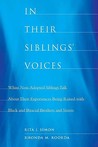
In Their Siblings' Voices

In Their Siblings' Voices: White Non-Adopted Siblings Talk about Their Experiences Being Raised with Black and Biracial Brothers and SistersIn Their Siblings' Voices: White Non-Adopted Siblings Talk about Their Experiences Being Raised with Black and Biracial Brothers and Sisters by Rita James Simon

I found this book very interesting.  I have wondered what our two oldest (biological) children would say 20 years down the road about us having adopted their younger siblings, so this peek into the thoughts of men and women whose parents adopted black siblings intrigued me.

There are many who take the stance that white people should not adopt black children because they are unable to teach them how to survive in a racist society nor can they help them retain their black identity.  Some black people even say transracial adoption is a form of genocide as it is a "creation of a race of children with African faces and European minds" (12).  The authors of this book have set out to interview adult transracial adoptees, their adoptive parents, and their siblings to see what effect transracial adoption has had on their lives.  For the most part the responses were positive, with most participants saying both black and white members of the families were more comfortable across racial lines than people whose lives have not been touched by adoption.

One thing that stood out to me was the importance of not trying to be "colorblind".  Saying we don't see color, or don't even see our son or daughter as a black person, really robs our children of the opportunity to fully embrace their full identity and heritage.  Being black is not something to be embarrassed about or ashamed of--we needn't whisper the word or be uncomfortable with this aspect of who they are.  I was glad to read this as it's given me words to articulate my thoughts when someone says something like "I don't even see him/her as black anymore--they're just (their name)."   As one adoptive sister summarized "I don't think "color-blind" is the goal and I don't think it's realistic either.  I don't think it is true that you don't see their color.  Certainly you get beyond the point where their color is their most salient characteristic and you see just simply who they are and the person who you love, but race is always there.  It isn't something we should pretend isn't there" (166).

I was also glad to read how open-minded the siblings were as a result of growing up in a home with adopted siblings.  Several of them expressed an interest in knowing all kinds of people rather than isolating themselves from people who are different from them.  "I'm around me twenty-four hours a day, you know what I mean?  I don't need to be around me, I need to be around people who are different than I am" (68).

There are two other books in this series and I look forward to reading them.

Wednesday, August 19, 2015

Dumbing Us Down

Dumbing Us Down: The Hidden Curriculum of Compulsory SchoolingDumbing Us Down: The Hidden Curriculum of Compulsory Schooling by John Taylor Gatto

Absolutely outstanding!  Must read!  I have been hearing about this book in all of my 14 years of home education and can't believe I waited so long to read it.

John Gatto is an award-winning public school teacher who insightfully hones in on the invisible lessons the public educational system is teaching the children of this country:  confusion, class position, indifference, emotional dependence, intellectual dependence, conditional self-esteem, and acceptance of surveillance.

Gatto's book, as summarized in the introduction by David Albert, contends that "schools are not failing.  On the contrary, they are spectacularly successful in doing precisely what they are intended to do, and what they have been intended to do since their inception. . .ensure a docile, malleable workforce to meet the growing, changing demands of corporate capitalism. . .a workforce that will not rebel, that will be physically, intellectually, and emotionally dependent upon corporate institutions for their incomes, self-esteem, and stimulation, and that will learn to find social meaning in their lives solely in the production and consumption of material goods" (xxii).

Gatto decries the loss of community (which has been replaced by networks), the separation of young from old, the removal of children from families, the idea of the "professionalization of teaching which preempts the teaching function which belongs to everyone" (16), the lack of free time for children to think, explore, and learn to serve.  He proclaims a need for self-knowledge so that "they'll also become self-teachers--and only self-teaching has any lasting value" (31), and a need for men to teach boys to grow up.  He realized himself, and knows children need to learn the same lesson, that we need something to do that is meaningful, that isn't absurd, that results in more than "a new abstract number in my bankbook" (40).  "Discovering meaning for yourself as well as discovering satisfying purpose for yourself, is a big part of what education is.  How this can be done by locking children away from the world is beyond me" (62).

Gatto claimed schools began from a fear of the poor, a fear of immigrants and Catholics, and a fear of freed Black slaves between the mid 1800s and the early 1900s, as well as a desire by capitalists to produce a compliant workforce.  I thought this was an interesting perspective I had never before heard.

I am very intrigued by the correlation between Ken Kesey's One Flew Over the Cuckoo's Nest and the messages of this book.  Gatto wrote a Monarch Notes guide to this classic novel, and I think I'm going to have to read the novel and Gattos' guide together as I continue to ponder these thoughts.


Wednesday, August 12, 2015

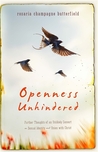
Openness Unhindered

Openness Unhindered: Further Thoughts of an Unlikely Convert on Sexual Identity and Union with ChristOpenness Unhindered: Further Thoughts of an Unlikely Convert on Sexual Identity and Union with Christ by Rosaria Champagne Butterfield

As usual, Rosaria Butterfield's writing is very enjoyable.  Her first book, The Secret Thoughts of an Unlikely Convert, was one of my favorite books the year I read it (for her writing style and the thoughts she prompted).  But I didn't enjoy this one as much.  This book was a lot more of her personal experience and understanding of her "union with Christ".  I must admit there is much I didn't agree with in it as she is loudly calvinist in her belief system.

Having said that, there were still several things I liked about the book, which made it worth reading in my estimation.

1)  I really appreciate her intellectualism, especially as she analyzes the current LGBT movement.  I think she is very astute in her dialogue about how christians should interact with people experiencing same-sex attraction, particularly christians who struggle with unwanted attraction.  I like the care she takes with words--words have meaning!--as we navigate the culture around us.  I also really appreciate her understanding of worldview--both the Freud/Marx/Darwin-influenced worldview and theistic worldview.  For example, her examination of the origin of the concept of "sexual orientation" was fascinating, enlightening, and a little sickening as I realize how thoroughly the worldview has infiltrated our culture.  I like the way she took an intellectual approach to the Bible reading it through multiple times, analyzing the literary genres, its canonicity, etc. as she dissected its claims and finally couldn't deny its Truth.

2)  I was fascinated at her examination of root causes for the sin of homosexuality, particularly her assertion that homosexuality, as all sin, is rooted in pride and our desire to put ourselves on the throne rather than submitting to God.

3)  She had some really interesting analysis of the difference between admitting sin and confessing sin, and also great discussions of repentance and the difference between being tempted and sinning.

4)  I think my favorite chapter was the one entitled community, as she expounds on what biblical hospitality is and the community we should be building in our homes and with our church family.  She has many good thoughts in this area and paints a beautiful picture of a community where everyone has a place and belongs, no one is lonely, people are able to share their struggles and temptations, and God is glorified.

I liked her first book a lot better, but there were some good points to ponder in this one as well.

Tuesday, August 11, 2015

My Fun New Journaling Habit

I am thoroughly enjoying the use of a journal in my Bible study these days.  My dear friend, Misti, brought her journal and showed it to me about six months ago.  As she described its various features, I wanted one more and more.  Such a great idea!  Finally, I meekly asked if I could copy her--and she said YES!

So I ran out to Target and bought a nice journal and a new set of colored pens.  When I got home, I promptly sat down to number each of the pages.  Then I used a ruler to make a vertical line through the center of the first four pages to make my Table of Contents.


I love the idea of combining all sorts of ideas into one journal.  This is now my Bible study journal-slash-prayer journal-slash-commonplace book.  I have notes from some books I've read (such as The Pursuit of God and The Prodigal God), I have notes from the marriage cruise we got so much from, and I have jotted down good quotes I've come across on the internet or in a book.


I'm currently working through a study of the book of Ephesians using a "Journal and Doodle" guide I downloaded (for free!) and I'm having WAY too much fun with it.


I'm no artist (by any stretch of the imagination) but I think fun, colorful pens make all the difference.

Saturday, August 8, 2015

A Little Freezer Cooking

Summer has been so busy that we have had a difficult time coordinating our schedules to get together and cook meals for our freezers, but we're still trying when we can and I want to keep the recipes and ratings updated on my blog.  I have gone through all the past posts and updated ratings, so they should be complete up to this point.

In June, I was in charge of choosing the meals.  I used six of these Seven Kid-Friendly Freezer Meals.  The other two meals were repeats that we had loved.

Mozzarella-Stuffed Pesto Meatballs--4.5
Chicken Tacos
Chicken Noodle Soup
Cheesy Chicken Tater Tot Casserole 3.5
Easy Chicken Pot Pie--4
Cheesy Tortellini with Ground Beef
Breakfast Burritos--5
Ree's Sloppy Joes--5

Today we made the following meals (for only $57 per family, woot, woot!):

--Mozzarella-Stuffed Pesto Meatballs
--Easy Chicken Pot Pie
--(Modified) Cheesy Chicken Tator Tot Casserole
(Added 1/2 c. ranch dressing, 1 c. sour cream, and 1 can chicken with rice soup))
--Honey Dijon Pork Steak
--Baked Ravioli
--Breakfast Burritos
--Maple Dijon Glazed Chicken
--Pizza Pizzazz (makes nine servings)
Cook 8 oz. penne pasta
Combine 2 1/3 cups spaghetti sauce, one pound cooked sausage, 1 pkg. chopped canadian bacon, 1 jar mushrooms, chopped green pepper, chopped onion, 1/2 c. parmesan cheese, garlic powder, salt, pepper, 1/8 t. crushed red pepper flakes. 
Mix with pasta, pour into pan, top with one more cup of spaghetti sauce.  Cover and bake 45 minutes at 350. Sprinkle with more mozz cheese, bake uncovered 10 min longer.


We've been doing this long enough that we are now working on compiling 4-5 master meal plans complete with eight recipes with 4 and 5 ratings and the shopping list for those eight meals in order to make planning easier.  I am excited for this project to be completed as it will save us all a lot of time and we'll know it's something we are going to like.

Thursday, August 6, 2015

Little Heathens: Iowa in the Great Depression

Little Heathens: Hard Times and High Spirits on an Iowa Farm During the Great DepressionLittle Heathens: Hard Times and High Spirits on an Iowa Farm During the Great Depression by Mildred Armstrong Kalish

This book was delightful.  I enjoyed it very much.  It made me think of my grandparents and the stories they used to tell about their childhood and early marriage.

I think Mildred's voice makes the book as she reflects on her childhood in Iowa in the 1930s.  She shares how her upbringing "built character, fed the intellect, and stirred the imagination" while sharing stories of living off the land and managing relationships with relatives.  I enjoyed the way she thoroughly explained the process of many practices such as harvesting nuts, collecting a swarm of bees, using natural healing remedies, and taming wild raccoons as well as the recipes she included.

I found her religious experience rather sad, as she developed a cynicism that colored her view of God.  I think her story serves as a good example of how our country was "culturally christian" in generations past, but individuals weren't converted, and we can see the effects of that today even in the voice of someone born in the 1920s.

It took me quite a while to read this book as Destry started reading it before I had finished and we had to fight over it.  He thoroughly enjoyed it as well.  This is recent history--real-life stuff about living independently, off the land, with good character, and strong work ethic--and I think it's good for us to read as our society moves farther and farther from this knowledge, experience, and level of integrity.

Thanks to Kristy for the recommendation!

Wednesday, August 5, 2015

Exploring Sensory Bins

I've been trying a new idea this summer in preparation for our upcoming school year.  I've been reading about sensory bins and how they are good for fine motor development, language development, open-ended play, and stimulating the senses.  I have some kinesthetic learners around here who have lots of energy and learn best when all their senses are engaged and their hands are busy.  I also have some younger kiddos who need some entertainment or breaks from bookwork-style learning.

So this summer I've been collecting a few items to make sensory bins and have allowed the children a couple of sneak peeks at what's in store.

The boys especially loved the construction set.  I used some rocks, some colored glass marbles (like you would put in a fish bowl), some small construction equipment, and a cheapo (from the Dollar Tree) travel Jenga game (to use as pieces of wood).
They loved it.  They arranged the marbles into a pool one time, pushed the rocks around with the equipment, dumped rocks from the dump truck, built towers and buildings with the pieces of wood, and just generally had a good time.


I let them play with it once together, and another time they each got a 30-minute block of time to play in it alone.  As you can see, they thoroughly enjoyed it.  They beg to play with it again, but I told them it's for school time and they have to wait.


Another bin I put together and let them have a trial run with I call a "spring bin".  This bin has grass-like stuff in it, flower pots, small toy birds, butterflies, snakes, and insects, silk flowers, rocks, sticks, pieces of bark, etc.

I spread a shower curtain on the floor, set the bin in the middle of the shower curtain, and they let their imaginations flow.  You can see here that Tyrell "planted" flowers, and Easton made a bird nest.

I let them try out a water bin filled with fish, frozen ice balls, scratchy loofas, cups, funnels, etc also, but I guess I didn't get any pictures from that one.  I've seen so many ideas out there, even down to making a sensory bin to reinforce a unit study, book, holiday, colors. . .I think we're limited only by our imaginations!  (and time, and money, and energy. . .)

I'm looking forward to implementing this idea in our school year.  I think it will help keep little hands busy while I'm working one on one with one of the children on phonics or math, or it will serve as a reward for industrious work, or it will confine play (and mess) to a small area if needed.

As a sidenote, I thought it interesting that country schools apparently used this idea as well.  I recently read Little Heathens:  Hard Times and High Spirits on an Iowa Farm During the Great Depression.  (review to come)  Imagine my surprise as I read her description of their classroom:  "Across from the bench, on the opposite side of the door, was--wonder of wonders--a shallow, strudy box on wooden legs, about five feet long, three feet wide, and eight inches deep, filled with clean, fine sand.  When you had successfully finished your spelling and your arithmetic lessons you were rewarded with some stand-up time to play in the sand.  How good could life get?" (170).

Hopefully my children will be as excited as this little girl was.

Tuesday, August 4, 2015

The Boys in the Boat

The Boys in the Boat: Nine Americans and Their Epic Quest for Gold at the 1936 Berlin OlympicsThe Boys in the Boat: Nine Americans and Their Epic Quest for Gold at the 1936 Berlin Olympics by Daniel James Brown

This is the best book I've read so far this summer. It's a very well-written and researched account of the young men who won the gold medal rowing in the 1936 Olympics.  I really like the way he starts with the childhood of one of the rowers, the way he incorporates how growing up during the Great Depression influenced the young men, the historical build-up of Nazi Germany, and especially his emphasis on the character of each of the young men and how that equipped them to be successful.

Honestly, the only reason I am giving it four stars instead of five is because it made me think of Unbroken by Laura Hillenbrand in some ways, yet it wasn't quite as well-written as Unbroken (high standard, I know).

My favorite quote from the book, which I think rather summarizes the story and flavor of the writing:

"Every one of them had come from humble origins or been humbled by the ravages of the hard times in which they had grown up. Each in his own way, they had all learned that nothing could be taken for granted in life, that for all their strength and good looks and youth, forces were at work in the world that were greater than they. The challenges they had faced together had taught them humility--the need to subsume their individual egos for the sake of the boat as a whole--and humility was the common gateway through which they were able now to come together and begin to do what they had not been able to do before." (291)


Monday, August 3, 2015

MIA

Isn't summer supposed to be a time of relaxation?  Isn't it supposed to be a leisurely time when one does what they want to do (such as read books, reflect, and write)?

Somehow my summer missed that memo.  And here it is AUGUST!  I haven't written a post in six weeks!  I was thinking it's time to let the blog go, but then a friend asked for book recommendations and I was able to send links to some book reviews on my blog.  And then another friend wanted to start a group to do freezer cooking and I was able to send her to some of my posts with tips and recipes.  And then I realized how fun it is to have these records. . .so I'm thinking I'll try to get back into the routine.  We'll see how it goes, especially as school will soon be resuming.


Aryana is sleeping much better now.  She is an extremely busy 15-month-old, but she's starting to learn what's okay and what's not--and I'm not so tired exhausted as I had been for the last. . .what seems like the last entire year.

So, I'll try to share a few book reviews this week, and maybe a couple posts about some of the highlights of our summer, and we'll see if I can get back into blogging a little bit.