Showing posts with label Carrie's book club 2012. Show all posts

Friday, December 28, 2012

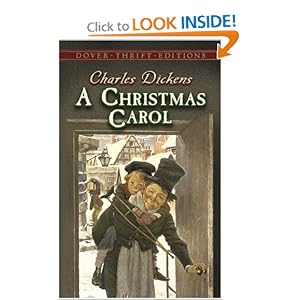
A Christmas Carol

Reading to Know - Book Club
I had never read it.  Oh, I have seen the movie many times, but I had never read Charles Dickens' classic, A Christmas Carol.


But I enjoyed it.  I enjoyed it very much. (Thank you, Carrie.)
Here's the thing:  people just don't write like this anymore.  I keep trying to read newer fiction and, while it satisfies me for a short time, I rarely pause to savor wording like this:
The owner of one scant young nose, gnawed and mumbled by the hungry cold as bones are gnawed by dogs, stooped down at Scrooge's keyhole to regale him with a Christmas carol (13).
or this:
For the people who were shoveling away on the housetops were jovial and full of glee, calling out to one another from the parapets, and now and then exchanging a facetious snowball--better-natured missile far than many a wordy jest--laughing heartily if it went right, and not less heartily if it went wrong (62).
or my favorite:
a red-faced gentleman with a pendulous excrescence on the end of his nose, that shook like the gills of a turkey-cock (95).
This kind of writing just tickles me.  I think we're in too big of a hurry to get through books these days.  We don't want to deal with Dickens-style sentences or descriptions extraneous to the storyline.  I thought this book would be a quick little read, and it was as I completed it in one afternoon, but I paused several times to read phrases again and then read them aloud to my teens as they were too good not to share.

As usual, the book is ever so much better than the movie.  In addition to the quality of prose, the book reveals a greater depth in the characters and is clearer in its theme of our responsibilities to one another as humans:
Mankind was my business.  The common welfare was my business; charity, mercy, forbearance, and benevolence were all my business (25).
This is what I'm "taking to heart" from the book.  It's too easy to waste our lives away in frivolous entertainments, chasing materialism, and excessive busyness.  To waste our lives with self.  May my life not be a wasted opportunity of usefulness.

"Any Christian spirit working kindly in its little sphere, 
whatever it may be, 
will find its mortal life too short 
for its vast means of usefulness. . .
no space or regret can make amends for 
one life's opportunities misused (25).

Friday, November 30, 2012

Jewel of Persia

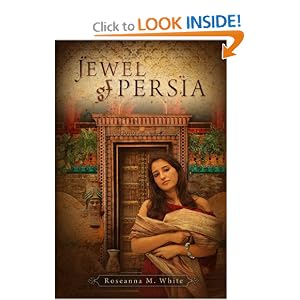
I was pleasantly surprised at how much I enjoyed reading Jewel of Persia by Roseanna White, which was the November selection for Carrie's book club.  I'm not generally a fan of fictionalized Bible stories, but this story was less about Esther and more about the historical time period and the fictional Kasia.  I have to admit I was impressed by the historical information she incorporated into the story.


In a nutshell, it's a love story about a fictional Jewish girl who becomes one of King Xerxes's wives as he is seeking to expand the kingdom.  There are undercurrents of conflict due to the false god the Persians serve and the One True God of the Jews.  As the spiritual battle comes to a head, Esther is chosen to be the queen and bravely appeals to the king to allow her people to defend themselves against Hamen's edict.

I enjoyed White's writing as I was sucked into the plot and made to care about the characters.  She did a good job presenting Xerxes as a well-rounded character who struggled between his personal feelings as a man and his duties and power as king.  There were also sub-plots going on as the former queen and Hamen conspired against the Jews and a Jewish man struggled simultaneously with his vocational calling, his desires, and submission to the Lord.

White illustrated many spiritual concepts including forgiveness, repentance, submission, trust in the Lord's deliverance, remaining faithful in difficult times and even under persecution, the power of prayer, and sacrificial love.  I mention these themes because two of my biggest complaints against so-called Christian fiction are 1) the poor writing and 2) the wimpy spiritual themes.  Often they stamp a "christian" label on it just because the characters go to church or something similar rather than truly addressing spiritual concepts.  Many books not labeled as "christian fiction", especially classics, do a better job illustrating redeeming themes than our modern christian fiction genre.  (stepping off soapbox)

While I probably shouldn't get hung up on it since it's really not the point of the book, I can't help dwelling on the idea of sharing my husband with other wives.  While White doesn't go into inappropriate detail on Xerxes's marital (and extramarital!) relations, she nevertheless paints a vivid picture of life in a harem.  I will just say right here that I am far too possessive, jealous, insecure, selfish, and whatever other words you would like to use to calmly and lovingly accept the necessity of my husband paying attention to his other wives and providing them with children.

Overall, I enjoyed this read and am glad Annette chose it.  I liked it well enough I am seriously considering adding another Roseanna White title (perhaps A Stray Drop of Blood) to my incredibly long list of books I would like to read some day.

Tuesday, July 31, 2012

What I Learned in Narnia

I thoroughly enjoy CS Lewis, and particularly his Narnia series.  I get even more out of his books as an adult than I did when I first read them in junior high, which supports his popular quote “A children's story that can only be enjoyed by children is not a good children's story in the slightest.”  I usually like the actual Narnia books far more than other books about Narnia, but after reading Douglas Wilson's book, What I Learned in Narnia, I have to highly recommend it for Narnia lovers to read alongside their beloved friends.
One of the best things about this book is that Wilson refuses to usurp the proper place of the Narnia books.  If you don't know Puddleglum, Tirian, Digory, Lucy, Caspian, Trumpkin and Aslan, he says to put this book down and go read the Narnia stories.  "This is like a conversation between good friends about some other good friends, talking about what a good time we all had and why.  But in order to have that conversation, we have to have had the good time first" (11).

Wilson goes on to thoroughly examine the proper and improper attitudes and behaviors of various Narnian characters toward seven themes:  authority, confession of sin, nobility, spiritual disciplines, love of story, thorough grace, and love for Aslan/love for God.
Reading to Know - Book Club

The truth is, I started this review several months ago when I first read the book with Briana and Destry alongside our reading of the Narnia chronicles in our worldview study.  I loved the book so much, I couldn't condense my review.  But in conjunction with Carrie's book club and her obsession with love for all things Narnia, I decided to revisit Narnia this month through the wonderful lessons Wilson highlights.  (The assignment really was to read one of the actual Narnia books, but I decided to tweak the assignment).

I'm forcing myself to limit my discussion to the two sections that stood out to me the most.
  • True and false authority.  False authority is based on selfishness and grasping and exemplified in Jadis and Uncle Andrew who try to put themselves above all authority but their own.  "True authority can only be exercised by leaders who delight in submitting to authority themselves" (17).  False authority is also frequently gained through manipulation, trickery and groveling before others (consider Ahoshta and Shift) and is motivated by a desire for power.  True authority, on the other hand is sacrificial and humble and prompts obedience.  "True authority and submission is one of the great lessons of Narnia--not only how to rule without being a tyrant, but also how to obey without being a mindless follower or a slave" (37).  (I think the section on authority stood out to me as I have simultaneously been reading Atlas Shrugged--what a contrast!)
  • Memory and forgetfulness.  "Remember, remember, remember the signs," Aslan said to Jill in The Silver Chair.  "Say them to yourself when you wake in the morning and when you lie down at night, and when you wake in the middle of the night".  In my 16 years of parenting, I would hate to try to number how many times I have heard "I forgot" as an excuse for disobedience.  But "remembering to obey is itself an essential part of obedience" (89).   If we focus on "the signs", the commands of God's Word, that will be our focus and we won't forget; we won't be distracted by the comforts of the world.
    "Meditating on God's word should be an activity that permeates your whole day, even filling in those little spaces of free time that you get when you are walking down the street. . .Repeat them.  Memorize them.  They are the signs by which God guides you through the confusion of the world, and without them you are lost" (88).  "There is a direct connection between lack of spiritual discipline and lack of both joy and spiritual fruit in your life" (93).
  • Just as Eustace, Jill, and Puddleglum got distracted by anticipating the comforts of Harfang and neglected remembering and reciting the signs, so do I get distracted by life on Earth and neglect God's word.  But my excuse of not remembering God's will when I give in to temptation is really just another sin to confess and repent--first for neglecting to consciously and deliberately remember, and second for succumbing to the sin that His Word would have steered me clear of had I allowed it to permeate my very being.  I found this section particularly convicting.
I will stop there, even though there are many more gems that blessed me.  After you have thoroughly devoured Lewis's Narnian chronicles, I suggest you luxuriate in the lessons Douglas Wilson brings to light.

Saturday, June 30, 2012

A Girl of the Limberlost

Reading to Know - Book Club
I had never read Gene Stratton-Porter's book, A Girl of the Limberlost, so I was rather looking forward to the June selection for Carrie's bookclub.  I have mixed feelings about it now that I've finished it.  I'm glad I read it, even though I didn't always enjoy it while reading.

My favorite aspect of A Girl of the Limberlost was the heavy emphasis on nature and self-education, both of which appeal to the homeschool mom in me.  I appreciate the example of a young lady who is determined to learn and sets out to do so without being propelled by any teacher, parent, or artificial motivation.  Even more, I love that her most valuable knowledge--that which provided her with the income to attain her dreams and caught the interest of her "worthy suitor"--was obtained outside of the restrictions of school and classroom learning by pursuing and immersing herself in her interests--self-directed learning at its best.  That simply delighted me and this example alone provides the book's merit.

In our current age when children are shoved through education factory-style (irrespective of unique talents) I enjoyed Elnora's individuality.
What you have to give is taught in no college, and I am not sure but you would spoil yourself if you tried to run your mind through a set groove with hundreds of others.  I never thought I should say such a thing to anyone, but I do say to you, and I honestly believe it; give up the college idea.  Your mind does not need that sort of development. (153)
I can imagine reading this book aloud with my children as part of a unit study on Lepidoptera, looking up pictures of the insects she names, and trying to identify those she describes but doesn't name.  I can imagine this reading inspiring my children to begin their own insect collections complete with pinned specimens and identification tags from perusing field guides.  Reading this book resonated with my reading of Charlotte Mason's philosophies as it emulates a love for nature and nature study--all in a living book!

On the other hand, I had a hard time connecting with the style of writing.  I realize part of that likely stems from the time it was written (early 1900s), but it was also a little. . .flowery and romantic for my taste.  (By romantic I don't necessarily mean romance as in love, although that was present in the end of the book, but rather I mean impractical and "over the top").  I think the style was the main reason it took me several days to get past the first few chapters, but once I got used to the style, I actually finished the book in just a couple days.

I was also conflicted at the mother/daughter relationship and the competing daughter/neighbor relationship.  I'm certainly well aware that mothers aren't perfect, and they are frequently self-centered to the point of hurting their children emotionally.  But just because I'm aware of it, doesn't mean I like it, nor especially to read such foolishness.  With Elnora, I agree tragedies "in quite as tragic a manner, have happened to thousands of other women, and they have gone on with calm faces and found happiness in life by loving others" (107).  I simply don't understand a woman shutting herself off from her child and wallowing in her own unhappiness and grief.  Then as the story turned and the mother's "love" (idolatry!) for her dead husband was killed by the knowledge of his unfaithfulness, she realized "the width of the gulf that separated her from her child" (112) and poured herself into "earning" her daughter's love and trust by cooking tasty morsels, updating her appearance (did that make any sense to anyone?), and learning about moths and butterflies.  Too little too late?  Not for Elnora, for she had "grown bigger on knocks than she would on love" (39).

This leads me to another theme it would be fun to discuss in a book club meeting of this book:  child rearing.  I think it would be quite fun to contrast Elnora's upbringing and her mother's philosophy that it's best for children to face trials alone and develop character through working to overcome those trials with the philosophy held by Wesley and Margaret.  Then we could discuss Philip and Edith and contrast Elnora's character with Edith's:
I cannot understand these people I hear about who live only for their own amusement.  Perhaps it is very great; I'll never have a chance to know.  To me, it seems the only pleasure in this world worth having is the joy we derive from living for those we love, and those we can help" (140).
And we could discuss marriage, its purpose, and the roles played by the man and the woman and compare them with the perceptions held by Philip, Edith and Elnora.
If you could have your choice you wouldn't have a society wife, either.  In your heart you'd like the smaller home of comfort, the furtherance of your ambitions, the palatable meals regularly served, and little children around you" (229).
The more I think about it, the more I enjoyed it and find it worthy of a book club discussion.  Sometimes I felt a little mocking of it for the drama and moralizing, but overall it was well worth reading.  I think my 16-year-old daughter would enjoy it.  Thanks to Stephanie for bringing this title to my attention!

Thursday, May 24, 2012

Tom Sawyer

"You can tell he was a kid once--and he loved it."  

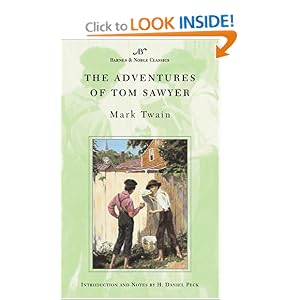
This is what Destry said about Mark Twain as I chuckled aloud one afternoon while reading The Adventures of Tom Sawyer for Carrie's May book club selection.

Reading to Know - Book Club
I think Destry perfectly summarized why this story is a classic.  I've read this book several times and each time, I escape through Twain's unmatchable ability to paint the life of a carefree, mischievous boy.  Who else but a young boy would consider himself rich with "an apple, a kite in good repair, a dead rat and string to swing it with, twelve marbles, part of a jews-harp, a piece of blue bottle-glass to look through, a spool cannon, a key that wouldn't unlock anything, a fragment of chalk, a glass stopper of a decanter, a tin soldier, a couple of tadpoles, six firecrackers, a kitten with only one eye, a brass doorknob, a dog collar--but no dog, the handle of a knife, four pieces of orange peel, and a dilapidated old window sash" (14).

Other examples of Twain perfectly capturing the unique energy that is a little boy:
  • "Tom was over the fence and gone.  There was a gate, but as a general thing he was too crowded for time to make use of it" (18).
  • "The next moment he was 'showing off' with all his might--cuffing boys, pulling hair, making faces--in a word, using every art that seemed likely to fascinate a girl and win her applause" (27).
  • "he was the envy of every boy he met because the gap in his upper row of teeth enabled him to expectorate in a new and admirable way" (39).
  • "There comes a time in every rightly-constructed boy's life when he has a raging desire to go somewhere and dig for hidden treasure. . . to buy a new drum, and a sure'nough sword, and a red necktie and a bull pup, and get married" (143).
I couldn't help but laugh as I enjoyed Twain's clever insight into young boys, and my enjoyment of the book had my teens vying for their turn to read the book again.  Even as I read the book from my current perspective as a parent and don't want my boys to experience his same adventures, I have to agree with Aunt Polly that Tom "warn't BAD, so to say--only mischEEvous.  Only just giddy, and harum-scarum, you know.  He warn't any more responsible than a colt.  HE never meant any harm, and he was the best-hearted boy that ever was" (92).
Twain's gift with words made me stop and savor his phrasing more than once.  I think my favorite word picture was this one:
"the old man laughed loud and joyously, shook up the details of his anatomy from head to foot, and ended by saying that such a laugh was money in a man's pocket, because it cut down the doctor's bill like everything" (174).
Even as Tom Sawyer provides lots of entertainment and laughs, Twain shares some more serious, adult themes within his story.  As I face challenges in raising my children and resisting ornery eyes or smart mouths, I echo Aunt Polly's "I've GOT to do some of my duty by him, or I'll be the ruination of the child" (4).

 I also got a kick out of Mark Twain's less-than-subtle observations on the nature of mankind.
  • "He had discovered a great law of human action, without knowing it--namely, that in order to make a man or a boy covet a thing, it is only necessary to make the thing difficult to attain.  If he had been a great and wise philosopher, like the writer of this book, he would now have comprehended that Work consists of whatever a body is OBLIGED to do, and that Play consists of whatever a body is not obliged to do" (15).
  • "Often, the less there is to justify a traditional custom, the harder it is to get rid of it" (32).
  • "This funeral stopped the further growth of one thing--the petition to the governor for Injun Joe's pardon.  The petition had been largely signed; many tearful and eloquent meetings had been held, and a committee of sappy women been appointed to go in deep mourning and wail around the governor, and implore him to be a merciful ass and trample his duty under foot.  Injun Joe was believed to have killed five citizens of the village, but what of that?  If he had been Satan himself there would have been plenty of weaklings ready to scribble their names to a pardon-petition, and drip a tear on it from their permanently impaired and leaky water-works" (192).
I'm so grateful to the fellow book lover who recommended Tom Sawyer for our May book club selection.  As my Spring calendar collected more and more scribbles and I thought the last day of school would never arrive, I enjoyed a refreshing break in the form of  a good visit with this old friend.

Friday, April 27, 2012

Meeting Sir Wodehouse

I've been wanting to call him "Sir Wodehouse", because his writing is so delightfully British, so imagine how happy I was that Wikipedia referred to him as such.

Reading to Know - Book Club
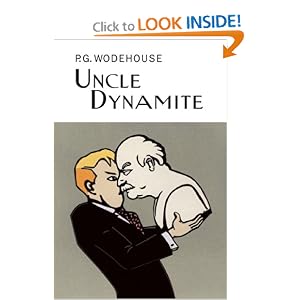
For our April selection of Carrie's book club, one of Carrie's friends suggested we read a book by P.G. Wodehouse and I chose to read Uncle Dynamite.   This was my first exposure to Wodehouse (which I had always heard pronounced just as it looks but recently learned its correct pronunciation is WOODhouse) although I had frequently been asked if I had read any of his books when talking about books with fellow readers.  He had been described to me as an author of "British wit" and that description certainly fits. 

I found this book ridiculous to the extreme and impossible to take seriously.  In a nutshell, the plot involves the character (I use that word in more ways than one) Lord Ickenham who creates all sorts of bedlam in his endeavors to steer everyone in his acquaintance to life decisions of the happily-ever-after variety.
'Uncle Fred,' he said, speaking in a low, metallic voice.  'I don't know if you know it, but you're Public Scourge Number One.  You scatter ruin and desolation on every side like a ruddy sower going forth sowing.  Life, liberty, and the pursuit of happiness aren't possible when you're around.  You're like the Black Death or one of those pestilences of the Middle Ages, taking their toll of thousands.'

His vehemence seemed to occasion Lord Ickenham a mild surprise.  

'But, my dear boy, what have I done?' (185)
Wodehouse is a gifted writer and it took me much longer than I expected to read this pointless (yet fun) story because I couldn't help but savor his phrasings.  His wit jolted more than one giggle out of me which led to my family's request to "read it to us, Mom".
There are extraordinarily few good answers to the ejaculation 'You!' especially when preceded by the monosyllable 'Ugh!'  Pongo could not think of any of them.  The other's entry had caused him to repeat that sitting high jump of his, and on descending from the neighborhood of the ceiling he had found his mind a blank.  The best he could achieve was a nervous giggle (189).
Lest you think this book was 'fluff' or 'twaddle', I will point out some of the words Wodehouse introduced me to.  I could deduce most of their meanings by context,  and some of them I had heard before, but didn't know the exact definition.  These words are certainly not a part of my daily vocabulary!
  • somnolent (7)--Sleepy; drowsy.
  • impecunious (24)--Having little or no money.
  • comported (40)--Behavior; bearing
  • abstemiousness (40)--sparing or moderate in eating and drinking
  • deleterious (43)--Causing harm or damage
  • fatuous (49) --Silly and pointless
  • nadir (82)--the lowest point
  • somnambulist (103) --a person who engages in sleepwalking  
(In Bill Oakshott's demeanour, as he approached, there was the suggestion of a somnambulist who, in addition to having blisters on both feet, is wrestling with an unpleasant nightmare.)  I couldn't figure this one out by context, but once I looked up the definition the imagery was quite effective.
  • contradistinction (139)--Distinction made by contrasting the different qualities of two things
  • escutcheon (179)--A shield or shield-shaped emblem bearing a coat of arms (used in this context, I assume, as the family name or reputation)
  • stertorously (184)--Noisy and labored breathing
  • distrait (208)--Inattentive or preoccupied, especially because of anxiety
  • captious (208)--Tending to find fault or raise petty objections 
I have Very Good, Jeeves, also by Wodehouse, sitting here on my desk waiting for me to read it.  I thought I would be able to read two Wodehouse books this month, but April was too busy and Uncle Dynamite took more time than I expected, so I can look forward to reading another Wodehouse this summer.  I'm glad I finally met Sir Wodehouse and thankful to Tim for spurring me on!

Thursday, March 29, 2012

The Pilgrim's Progress--Completed

Reading to Know - Book Club

As I’ve said before, I like The Pilgrim’s Progress because it reminds me that each of us is living his or her own story—that of our spiritual journey toward our eternal home.  It is so easy to get caught up in this life, whether it’s the humdrum of daily existence and endless chores or material pursuits of stuff, power, or earthly acclaim.  Books like Pilgrim’s Progress challenge me to live my story well.
Each time I read or think about this book, something new stands out to me, probably due to what is going on in my life at the time.  I was struck this time by the many distractions Satan uses to deflect our attention from the goal, especially as I had multiple distractions in my attempt to finish the story for Carrie's book club.  Sometimes the distraction is obvious, like Apollyan.  For me, these tend to be the easiest ones to resist.  If only the devil always took this big, scary form we would always be able to recognize when we need to take up the whole armor of God.

Other times the distraction is in the form of good things—people we love, ministries we believe in, items we use for daily survival.  Like Christian, we must love God more than the family who won’t follow Him.  And just as he bemoaned his misuse of the arbor saying “O that I should so indulge the flesh, as to use that rest for ease to my flesh, which the Lord of the Hill hath erected only for the relief of the spirit of Pilgrims” (48) so too must I bemoan my abuse of that which God intends for good when I am distracted with overindulgence of the flesh.  Unfortunately, good things are too frequently twisted, including the gospel, resulting in false teachings that distract honest seekers from the Truth.

Most of the time, however, the most effective distractions are birthed from within (James 1:14-15).  It's my own selfishness, greed, and desire for instant gratification which, like Passion, entices me to value and pursue what I want right now rather than patiently waiting for the better end, the "glory which shall be revealed in us" (Romans 8:18).  It is my own pride that distracts me from humbly receiving rebuke and correction and instead leads me to "bid him look to himself" (44), defensively seeking the speck in the other's eye.  It is my own lazyness that finds the "discoursing of things that are profitable" (80) more enjoyable than the actual fruit-producing application. (gulp)  My selfishness, indeed my love for self, seeks an easier way--especially when I'm tired, discouraged, and long for a little break.  I convince myself that surely this path in the meadow, "according to my wish is the easiest going"(116), and will lead me in the same direction I was headed.  My lack of faith distracts me from the freedom I have in Christ by supporting a "weak and feeble mind, offended and made weak at that which others can bear" (278) resulting in fear and second-guessing my service to God.

I could say so much more about this book, but I'm trying to stay focused on the potential distractions Christian encountered and evaluate my own journey to identify and remove similar distractions.  I long to truly have my affections "set on things above, not on things of the earth" (Colossians 3:2) and cry out with Christiana "O, deliver me from this Muck-rake" (205).
In a room where was a Man that could look no way but downwards, with a Muck-rake in his hand.  There stood also one over his head with a Celestial Crown in his hand, and proferred him that Crown for his Muck-rake; but the man did neither look up, nor regard, but raked to himself the straws, the small sticks and dust of the floor.


Then said Christiana, I persuade myself that I know something of the meaning of this; for this is a figure of a Man of this World, is it not, good Sir?


Thou has said the right said he, and his Muck-rake doth shew his carnal mind.  And whereas thou seest him rather give heed to rake up straws and sticks and the dust of the floor, than to what he says that calls to him from above with the Celestial Crown in his hand, it is to shew that Heaven is but as a fable to some, and that things here are counted the only things substantial.  Now where as it was also shewed thee that the man could look no way but downwards, it is to let thee know that earthly things when they are with power upon men's minds, quite carry their hearts away from God. (205)
I wonder, for those of you who read the book, what theme or themes most stood out to you?  And whether you read the book or not, what distractions are you encountering along your journey today?

Saturday, February 25, 2012

The Pilgrim's Progress

We start 'em young here!  I think we have four editions of The Pilgrim's Progress in progressive degrees of difficulty.  Even my littlest ones like to read this picture book version with its eye-catching cartoon illustrations.
That burden on his back is so obvious in these pictures that they can imagine why he would want his sin removed.
And the depictions of trials and dangers and battles with evil grab their imaginations and I hope will stick in their minds throughout their adult lives as they live out their own stories.
For the fact that we each are living our own story is one of the reasons I chose The Pilgrim's Progress when Carrie asked me to select a book for her book club.  I think it's easy to lose sight of that fact when we get caught up in the day-to-day tedium of our lives.  We aren't able to comprehend the big picture of our lives as we are too close--our emotions, distractions, and myopic vision mislead us.  We are part of a great story--the ultimate story--that of good vs. evil.  If we could only keep that perspective each day of our lives, I think our lives would look very different.  We would perceive the fiery darts of the devil for what they are instead of obliviously focusing on this earthly life.  I'm counting on this allegorical story to remind me to focus on the big picture so I can live a more God-glorifying life each day.

I enjoy the allegorical aspect of The Pilgrim's Progress as the parallels to life are so clear, even as the story itself is enjoyable.  I haven't read the original, unabridged version for about twenty years, so I'm looking forward to visiting it with my big kids--it's time for them to graduate from the picture book, the version with mice as the main characters (this book is still packed and I can't remember the name of it!) and Little Pilgrim's Progress to the real thing!  I think it will also be good for them to realize where author John Bunyon's focus was when he was imprisoned for sharing the good news.  So often we are tempted to wallow in our self-pity and fear and SELF rather than immersing ourselves in the Lord and His Word when life gets difficult.  I am humbled and inspired by the lasting works produced by people like John Bunyon and Dietrich Bonhoeffer while they were persecuted for their faith.
Reading to Know - Book Club
You're invited to travel along with us and Christian through the month of February as we read The Pilgrim's Progress and journal your thoughts on your blog (post a link with Carrie!) or discuss them in the comment section. 

''There's no Discouragement,
Shall make him once relent,
His first avow'd intent,
To be a Pilgrim.''

Sunday, January 15, 2012

What's in My Book Basket?

This post is actually 100% for me because I seem to be having a hard time remembering what I'm reading lately.  I'm going to put it all together in this post so I can come back and remind myself what I'm doing.  

Yes, something is wrong with my brain and my ability to focus--too much going on!
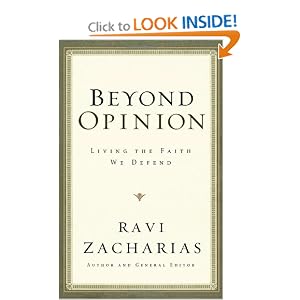
  • Beyond Opinion by Ravi Zacharias:  I'm reading this because it's the January selection for Carrie's Book Club.  I was intimidated--it's a deep book about defending our faith and living our faith and the writers are waaaay smarter than I am.  I will confess that I have only read the introduction and the first two chapters, but it's actually a great book and I'm enjoying it more than I thought I would.  I can only read it when kiddos are sleeping and when I have a chunk of time to really get into it (reminiscent of Crime and Punishment) because my brain isn't accustomed to working quite this hard, but once I get into it, I'm finding it readable and thought-provoking.  You can see the table of contents here to appreciate what great things I'm getting to learn about even as I'm not promising I will have it finished by the end of the month.
  • The Holy Bible:  I'm continuing the "Read through the Bible chronologically in 182 days" challenge and very much enjoying it.  This is a really fun way to get an overview of the big picture again, and I'm enjoying the way "trivial" facts are standing out to me by reading a larger portion at once.  For example, this is the first time I've realized that Uriah the Hittite was one of David's closest "valiant men" (we all tend to remember him as the guy that got sent to his death in the front lines so no one would know David had gotten his wife pregnant).  I am also appreciating the way this schedule interweaves the psalms David wrote with the accounting of the history in Samuel and Chronicles.  Fascinating--really adds to the big picture.  Finally, I am reading the Bible in the English Standard translation--a translation I am unfamiliar with, so that also makes the reading fresh for me and my temptation to skim over verses I've memorized in the past is removed since I didn't memorize them in this translation. 
  • Loving the Little Years:  Motherhood in the Trenches by Rachel Jankovic:  Okay, I'm going to just get the negative out of the way right off the bat.  This book is too short!  Yep, that's my big complaint.  It's requiring a great deal of discipline to savor this book in small bites.  The author is the mother of five kiddos five and under (one set of twins) and she truly has a gift.  I'm finding this book to be 1) very encouraging, 2) funny, and 3) surprisingly insightful.  What a little gem!  If you are a "mother of littles", trust my promise that you will love this breath of fresh air.
  • What I Learned in Narnia by Douglas Wilson:  I could rave about this book, but will save that for a better review later.  We started back to school this week and the big kids have been applying their worldview studies to an in-depth analysis of CS Lewis's worldview as evidenced in the Chronicles of Narnia.  We're having a blast!!  My kiddos are so smart and insightful and NEAT! (Whoops, that just slipped out!)  Anyway, we're sharing Wilson's book together--great times!
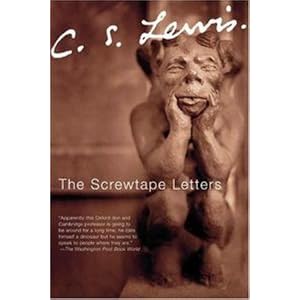
  • And to continue the Lewis theme, Alan, the big kids and I are also enjoying "The Screwtape Letters" together.  I'm having so much more fun with this reading than I did the first time I read it--homeschooling high school truly IS a reward for sticking with it all the other years. 
  • Organize for a Fresh Start:  Embrace Your Next Chapter in Life by Susan Fay West:  I started reading this as something of a joke because those who know me well know organizing my home is not exactly my strongest talent (a-hem).  But I've actually found it rather interesting and at 32% of the way through it (hey, it was free for my Kindle, what can I say??!) I am getting some good ideas as we prepare to move.  Don't expect anything *too* major, but small steps count, right?!
Okay, there--phew!  This is not a list of books I hope to read; these are the books I am currently reading.  I *must* finish them before I get to start any other books. (Ha! We'll see how that works out!)

Sunday, December 18, 2011

Book Club 2012

Reading to Know - Book Club

Woo-Hoo! I'm getting so excited for 2012! I'm expecting lots of great things from next year, and being asked to participate in Carrie's book club was just the icing on the cake. I think I'm especially excited because my 2011 book club rather fell apart and only 2-3 of us are still reading and the discussion has trickled to a few sentences, so I'm hoping this group of readers will have more stamina.

I chose the great Pilgrim's Progress by John Bunyon because I haven't read it for almost twenty years. I read a condensed version to my older kiddos a few years back, and we have a beautiful picture book version (which I should review because it's an absolute delight), but it's time to revisit the original edition. We'll be reading this book in March and I'm looking forward to discussing it with my teenagers and all of the other lovely members of Carrie's book club. Considering all the Lord has done in my life since my last reading, I'm sure the book will have an even greater impact on me this time.

I'm also anticipating the other book selections. I ordered the January selection, Beyond Opinion by Ravi Zacharias and am expecting it any day. The only book of his I've read is his autobiography, From East to West
, which was fascinating. I'm also curious about the February book, which looks to be about a Des Moines, IA family who abruptly moves to Croatia in order to learn about the woman's family history and appears to discover one another and the important things of life in the prospect. I haven't looked closely at the selections beyond March, but at a glance I'd say I'll be revisiting some great friends and meeting new ones next year. You're welcome to read along (and chat with us, please)!

January - Beyond Opinion, by Ravi Zacharias. Selected by Sky.

February - Running Away to Home, by Jennifer Wilson. Selected by *Carrie* at With All That I've Been Given.

March - The Pilgrim's Progress, by John Bunyan. Selected by Shonya at Learning How Much I Don't Know.

April - Any title by P.G. Wodehouse of your choosing (selected by Tim at Diary of an Autodidact) Just choose one. Especially if you've never read Wodehouse before. (Happy to make suggestions if you need some.)

May - The Adventures of Tom Sawyer, by Mark Twain. Selected by Amy at Hope is in the Word.

June - A Girl of the Limberlost, by Gene Stratton Porter. Selected by Stephanie at Simple Things.

July - Any book in the Chronicles of Narnia series (as part of the Chronicles of Narnia Reading Challenge hosted annually at Reading to Know) (Again, just choose one. And make the most of it!)

August
- The Girl Who Circumnavigated Fairyland in a Ship of Her Own Making, by Catherynne M. Valente. Selected by Bluerose at Bluerose's Heart.

September - Professionalizing Motherhood, by Jill Savage. Selected by Stephanie at Stephanie's Mommy Brain.

October - Uncle Tom's Cabin, by Harriet Beecher Stowe. Selected by Barbara H. at Stray Thoughts.

November - Jewel of Persia, by Roseanna White. Selected by Annette at Live, Learn, Love.

December - A Christmas Carol, by Charles Dickens. Selected by Carrie