Showing posts with label books about adoption. Show all posts

Wednesday, December 2, 2015

Dear Adoptive Parents

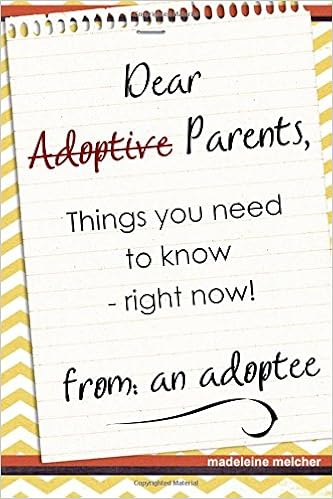
Dear Adoptive Parents, Things you need to know right now from an adoptee by Madeleine Melcher

This quick book, while not particularly deep or profound, was a breath of fresh air. Too often in the adoption world, everything is negative and I can come away feeling like I've made a huge mistake adopting four of my children--that I've messed them up for life by their very status as adoptees.

This adult adoptee (and adoptive mother), however, shares her story along with encouragement for families formed by adoption. She says the most important voice to listen to is the voice of your child, not the voices of negativity and fear, and that life should not be about adoption. There might be side effects of being adopted, of course, and parents should be watching for struggles, but not all children will suffer from feelings of rejection, abandonment, identity crisis, primal wounds, etc. as a result of being adopted and there is no point in "borrowing trouble" by talking about such things all the time.

This book validated many of my own perspectives so it was nice to read and I'll tuck it away on the shelf in case "the voices" get too loud at some point and I need a perspective adjustment.

Saturday, August 22, 2015

In Their Siblings' Voices

In Their Siblings' Voices: White Non-Adopted Siblings Talk about Their Experiences Being Raised with Black and Biracial Brothers and SistersIn Their Siblings' Voices: White Non-Adopted Siblings Talk about Their Experiences Being Raised with Black and Biracial Brothers and Sisters by Rita James Simon

I found this book very interesting.  I have wondered what our two oldest (biological) children would say 20 years down the road about us having adopted their younger siblings, so this peek into the thoughts of men and women whose parents adopted black siblings intrigued me.

There are many who take the stance that white people should not adopt black children because they are unable to teach them how to survive in a racist society nor can they help them retain their black identity.  Some black people even say transracial adoption is a form of genocide as it is a "creation of a race of children with African faces and European minds" (12).  The authors of this book have set out to interview adult transracial adoptees, their adoptive parents, and their siblings to see what effect transracial adoption has had on their lives.  For the most part the responses were positive, with most participants saying both black and white members of the families were more comfortable across racial lines than people whose lives have not been touched by adoption.

One thing that stood out to me was the importance of not trying to be "colorblind".  Saying we don't see color, or don't even see our son or daughter as a black person, really robs our children of the opportunity to fully embrace their full identity and heritage.  Being black is not something to be embarrassed about or ashamed of--we needn't whisper the word or be uncomfortable with this aspect of who they are.  I was glad to read this as it's given me words to articulate my thoughts when someone says something like "I don't even see him/her as black anymore--they're just (their name)."   As one adoptive sister summarized "I don't think "color-blind" is the goal and I don't think it's realistic either.  I don't think it is true that you don't see their color.  Certainly you get beyond the point where their color is their most salient characteristic and you see just simply who they are and the person who you love, but race is always there.  It isn't something we should pretend isn't there" (166).

I was also glad to read how open-minded the siblings were as a result of growing up in a home with adopted siblings.  Several of them expressed an interest in knowing all kinds of people rather than isolating themselves from people who are different from them.  "I'm around me twenty-four hours a day, you know what I mean?  I don't need to be around me, I need to be around people who are different than I am" (68).

There are two other books in this series and I look forward to reading them.

Saturday, January 31, 2015

She Is Mine

She Is Mine: A War Orphan's Incredible Journey of SurvivalShe Is Mine: A War Orphan's Incredible Journey of Survival by Stephanie Fast

I have a four-year-old.

I can't imagine him being abandoned, left to fend for himself, desperately following train tracks to try to find his mommy, chewing on roots and grasshoppers to survive, being rejected and persecuted for his ethnic make-up anytime he encounters other people.

I have a seven-year-old daughter.  I can't imagine her learning at this tender age "that there was a price for the clothes, food, protection, and the privilege of sitting at the fire" (141).

I really don't like thinking about the horrible crimes humans commit against one another, especially when the victims are innocent children.  But the truth is, they happen.  Stephanie Fast shared her story as a mixed race American-Korean in the aftermath of the Korean war until she was adopted and came to know acceptance and belonging in a family and ultimately as a child of God.

This was a quick read, I read it in one afternoon, but be warned:  it will make your heart hurt and you'll likely be left asking yourself what you can do to help children caught in a similar situation.

Thanks for the recommendation and thorough review, Carrie.  And for more information about the author, check out Carrie's post here.

Tuesday, January 20, 2015

Black Baby White Hands

Black Baby White Hands: A View from the CribBlack Baby White Hands: A View from the Crib by Jaiya John

While this book was not easy for me to read, it was excellent and I think anyone who loves a good book would appreciate this memoir of a Black man's experience growing up in a White family, even if said reader is not a White parent to Black children as I am.

The author is very introspective and philosophical (which I mostly appreciate, although sometimes I get a little weary of the navel-gazing) and his prose is poetic without being annoying.  I learned so much about racial identity and adoption identity by reading this book, and know I'll need to refer back to it repeatedly as I raise these children I've been blessed with.
  • It was hard for me to read because he struggled so much and I hate the thought of my children having similar struggles.  I do think a lot of his struggle came from his inherent personality:  "I contained a genetic and spiritual predisposition to feel my emotions very deeply.  Those emotions would last for hours and days.  This shaped my moods, sensitivities, and responses to life.  I thrived on quiet and calm, and on large doses of reassurance and reflection.  Our house was usually filled with noise, chaos, tough-skinned emotional flow, and little pause or allowance for pensive silence.  The contrast affected my attachment in ways that would persist" (37).
  • It was hard for me to read because, like his parents, there are so many things I didn't think about before adopting Black children.  "Theirs was an innocent simplicity.  They wanted more children, the consequences of that possibility were not a thing they were designed to dwell upon or hold up life for" (297).
  • "I didn't find my reflection anywhere I looked" (39) hurt my heart as I have been trying to adjust our life so that my children have "mirrors" of Black-skinned faces around them on a frequent basis.  "The lack of secure and meaningful attachments to other African American people was a vacuum that bore a hole in the bottom of my self-esteem reserve" (50).  I cringed as he and his brother tried to figure out how to be acceptably Black people in the midst of Whiteness.  "He went hip, hard, and happy.  I went bent, burrowed, and benign.  We both lost ourselves along the way. . .Increasingly I smiled as a way of comforting others, letting them know I was friendly and not to be feared (105).
  • As he described his developing radar for people's biases, I felt a nearly physical ache.  Some people, even extended family members, accepted him "in spite" of his Blackness--because he was different from "those other Blacks".  "My great grandfather saw no contradiction between his attitudes toward Blacks as a group and his feeling for Greg and me.  This was a perceptual dichotomy that would prove one of my central sources of wounding. . .This was simply the shaded love of people who spent their lives distant from people who looked like me.  Children can discern the subtle difference between embrace, ambivalence, tolerance, and disdain.  Incongruent emotion was a great bane to me in most of my relationships.  A person caring for me but feeling less than positive about a group of people that I held myself a part of never was good enough for me" (77).  He wanted to be loved and accepted for who he was--as a Black boy.  "More than unconditional love, or bountiful love, it was clean love that made the world of difference for me.  The vibes weren't polluted with a discomfort with my race, an avoidance of the idea of my race, or a strained tolerance or forgiveness for my race.  Crisp and clean, that's how I needed it" (53).  "Now, I knew that I had not been crying out for my Blackness to be ignored.  I just wished that it not be treated as such an alien, foreboding stain on my skin that it should not be mentioned.  I had stood in the intense glare of spotlight not because I was different, but because of how people reacted to my particular difference" (288).
His relationship with his adoptive mother was especially interesting to me.  It seems to me that he was really close to her, yet that very closeness led him to expect more from her which led to his ultimate disappointment in her ability to be what he needed.  Years later he was better able to understand her approach in his upbringing. "I treated all my kids the same.  When I heard those words a dawning light splashed all around in my mind. . .This was the explanation, finally, that allowed me to begin to understand why my parents had so overwhelmingly not addressed in tangible, audible ways the undeniable fact that Greg and I were Black, and that we were adopted.  Mom was saying that she had done her best to show that her love for us was equal to that of all her children.  And she had done it by relating to us as if the facts of our adoption and race didn't exist.  She had whitened them out" (296).

There were many, many other topics I benefited from in John sharing his story, even as they were uncomfortable and even a little scary for this adoptive mama.  He fleshed out the dangers of professing colorblindness.  He vividly painted the progression of White people's perceptions of him as a "cute little baby" to a "scary Black man."  He shared techniques his parents could have employed to make it easier for him to grow up in a White family.

Points of contention include his worldview, as he concluded that Christ is for White people and embraced an animalistic, Native American-type of religion which he wove throughout his narrative.  I also think he is incredibly self-absorbed.  I genuinely hope that we will be able to raise our children with more of an "upward and outward" focus which might circumvent some of his focus on how challenging life is when transracially adopted.

Monday, December 8, 2014

New Adoption Books for the Kiddos

I try to pick up a couple of new children's adoption books each year during national adoption month, and last month was no exception.

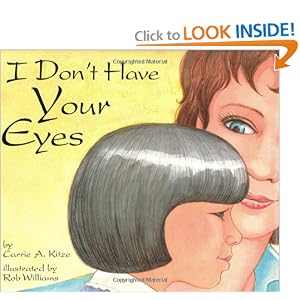
The first book was I Don't Have Your Eyes by Carrie Kitze.  I think the children liked this one and particularly enjoyed the illustrations.  Each page highlights another body part and discusses the ways mother and child are different and alike.  I really liked this one because I am always noticing the physical characteristics my children get from their birthfamilies, and the perspectives and habits they get from us. Both nature and nurture are at work in their lives and this book shows both.  I also think it will be a different take for Aryana as she gets a little older and we are learning the names of body parts.


As I'm slowly reading Black Baby, White Hands, a memoir by an adult transracial adoptee, I'm being reminded how important it is that we not pretend to be "colorblind" and not discuss the differences between us and our children.  The author of the memoir struggled as he watched his parents and their biological children highlight their similarities to one another (red hair, freckles, interest in science, etc.) but yet in their efforts to show him they loved him "just the same", they ignored their differences, which made him insecure.  I think reading books like this one will naturally provide opportunity to talk about ways we are alike and ways we are different and most of all, how we are a family who loves one another.


I also bought Motherbridge of Love illustrated by Josee Masse.  I didn't realize this book is basically just an illustrated version of a well-known poem about birthmothers and adoptive mothers until after it arrived.

Once there were two women Who hardly knew each other
One you do not remember, The other you call mother
Two different lives shaped to make yours one
One becoming your guiding star The other became your sun.
The first gave you life And the second taught you to live in it.
The first gave you a need for love And the second was there to give it.
One gave you a nationality The other gave you a name.
One gave you the seed of talent, The other gave you an aim.
One gave you emotions, The other calmed your fears.
One saw your first sweet smile, The other dried your tears.
The age old questions through the years; heredity or environment-which are you the product of?
Both my darling-both.
And two different kinds of love!
It's not as relevant to us as some books are since its focus is on Asian adoptees and it implies older adoption, but the children still very much enjoyed it.  There are few words and lots of vivid, colorful illustrations.  They enjoy observing all the details of this artwork, and look at it even when we aren't reading it to them.

Saturday, September 14, 2013

Child Catchers

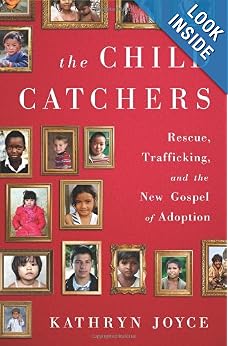
It took me almost three months to finish this book.  It wasn't because it was a particularly hard read, but because it was a very frustrating read.  I don't know when I've ever read a piece of writing with such a blatant anti-Christian bias.  (My brain is simply spinning with thoughts and I'm going to try to process them here because I couldn't find anyone to read and discuss this book with me. :))

In her book The Child Catchers:  Rescue, Trafficking, and the New Gospel of Adoption, Kathryn Joyce claims to be researching adoption ethics.  I have no problem with that--in fact, I think it's something we need to be aware of.  The more knowledgeable I have become of "the adoption community" in the seven years since we first adopted, the more I have become aware of unethical actions--of downright child stealing--and I have many times experienced that pit-deep-in-the-gut feeling that something isn't right when talking with people about their stories.  We stopped pursuing an adoption of a sibling group of sisters, in fact, when we saw some red flags that made us question the ethics of the people involved.  And it's no secret that there are some for whom adoption is big business--who ruthlessly and unethically use children to pad their bank accounts while professing to be "helping the children". 


No, it isn't the topic that bothers me.  A large part of my problem with this book has to do with the author's approach.  She calls herself a journalist and she calls this book "research".  Now, we're all aware that every journalist has a bias--a worldview--from which he or she approaches a story and I suppose I should be grateful that this author is so obvious in her bias that a reader needn't strain herself trying to discern the direction of the bias, but I sat through too many classes in my pursuit of my Communication-with-an-emphasis-in-journalism degree to consider this a credible piece of research journalism when its pages drip with her bias.  If you want to write a book "exposing" the seamy side of adoption, call it such.  Don't claim to be a journalist relaying research.  Whether you claim to be a journalist or just a person with a publisher and an axe to grind, please make sure you have your facts straight.  Additionally, anytime she interviewed a professing christian (especially those she labeled "fundamentalists"), she just focused on negative aspects (and I suspect twisted stories) to support her view.  I haven't read her other book Quiverfull:  Inside the Christian Patriarchy Movement, but I've read interviews and reviews which made me suspicious of her premise in the first place, yet I still wanted to read what she had to say about adoption ethics.

I should have just waited and read Jen Hatmaker's series on Examining Adoption Ethics.  Jen makes excellent points about what desperate people will do for money, what greedy people will do for money, what mistaken attitudes prospective adoptive parents might have, and how carefully one must research the adoption industry and she does all this without plagiarizing information from the blogs of adoptive parents (true story--I contacted a fellow blogger whose words I recognized and received validation of my suspicions) while calling herself a journalist.

If you're interested in ethical adoption (and really, why wouldn't you be?), I recommend you read Jen Hatmaker's series and search other credible sources rather than wasting your time wading through The Child Catchers where you'll have to weed through a lot of garbage, bias, and out-right error to discern about 20% which is worthwhile.  I suppose it is good that Joyce wrote this book as she certainly got the conversation started, but I can't recommend it for more reasons than I feel like going into in this post.

Tuesday, February 26, 2013

Recommended Adoption Books

AdoptionMagazine
The Adoption Magazine blog hop prompt for this week suggests recommending books about adoption.  I have reviewed several books related to adoption on my blog in the past, so I'm going to "copout" with a list of those books today.

My very favorite book about adoption
A great book to give an accurate and loving perspective of the birthparents:
A quick and easy reference for those adopting or who are part of a support group to friends or relatives on an adoption journey:
Accounts of adoption journeys, some from the perspective of the adoptee, others from the adoptive parents:
And finally, a book I just finished reading which I highly recommend which I'm just bursting to talk to someone about.  It's not necessarily about adoption but it's so good overall and the chapter about adoption is so spot-on that I'm going to list it here: 

Tuesday, February 19, 2013

Using Books to Teach About Adoption--Repost

first posted December of 2009--We have now adopted three children who are ages 6, 5 and 2.  This list is updated to add more books we have encountered in the last three years.

I think books are a great way to bring up discussions with our children. As a mother who has adopted three children, I am always looking for books that help the topic come up naturally and smoothly. I am of the opinion that it will be best for my children if they always know they were adopted so it is 'normal' and they don't remember 'the time mom and dad sat me down and told me. . .' or when a family member 'let it slip' or some other scarring event.

I'm finding, that just as with any other topic in children's books, some books handle the subject well, while others are boring, artificial, or simply unsuitable. I thought I would review a few books we have for future reference or for others who have adopted. This list might also bless you if you know someone who has adopted and you are looking for a special baby or "welcome home" gift. 
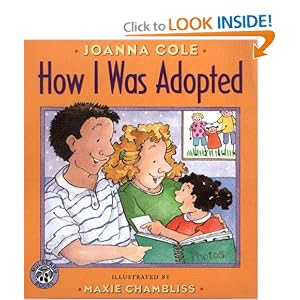
This book (How I Was Adopted by Joanna Cole) tells the story of Samantha's adoption. It is very conversational, written in first person, and even has questions written in the text ("Mommy told me that I was adopted. Were you adopted, too?"). One thing I especially like about this book is the way she talks about the characteristics she was born with and she talks about "what I know, how I talk, the jokes I like, the things I can do come from just being me and growing up in my family." I also like this book because I think it is appropriate for a variety of ages because of the engaging pictures.  This is my very favorite book about adoption and it has prompted many good discussions with my kiddos.
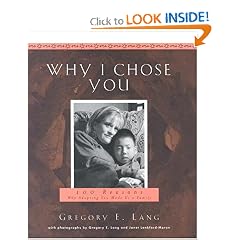
Gregory Lang's Why I Chose You is a tear-jerker, in my opinion. It is a series of pictures of children and their forever families. Each two-page spread features a black and white photo on one side and a sentence explaining WHY 'I chose you' on the other. There are 100 different reasons, and I think every family who has traveled the road to adoption will find reasons that resonate with their unique experience. Here are just a few that I identify with:
I chose you. . .because I was led to you. . .because you needed a loving family, and mine needed you. . .because you needed the love that I had to give. . .because I wasn't ready to stop raising children. . .because I wanted to be the one to encourage your interests and talents. . .so that I could sing lullabies once more. . .to complete my family. . .because being a parent is what I enjoy most. . .when I saw that you were waiting for someone to hold you close to their heart. . .to give you the opportunities that were once given to me.
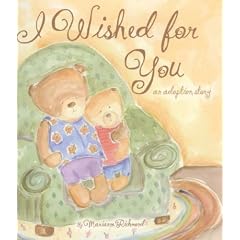
I really like I Wished for You, as the author uses a conversation between momma bear and her baby bear, all snuggled up together, to talk about the little bear's story and how he is his Mama's wish come true. There are three things about this book that appeal to me.

One aspect of this book that I really appreciate is the way the author addresses the birthmother. Barley Bear asks "What about the mama who grew me in her tummy? Didn't she wish for me too?" and Mama responds with "Sometimes a mama will grow a baby in her belly, and for all kinds of reasons, she'll decide she cannot be the very best mama she wants to be. The mama who grew you loved you enough to make a different wish--a wish for a family who would love her little one with a total and adoring love."

I also like the way the author shows God's role in 'placing the lonely in families' (Ps. 68:6) She tells Barley "Of all the children in the whole wide world, God picked you for me." I think this helps a child see how special they are and that God loves them.


Finally, Barley points out that his fur isn't the same color as his mother's and when he asks about that, she says "Some families look alike, and others don't. All families are different. What makes a family is their love for each other."

The fact that the main characters in this story are bears makes it easier for little kids, but it's a long book, so I don't know that it's great for children under the age of three because of their shorter attention span, but we sometimes just read pieces of the text to make it shorter.
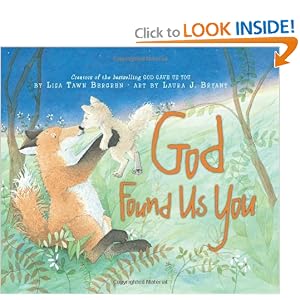
I bought this God Found Us You by Lisa Tawn Bergren because I read it in the bookstore and it made me cry. It is similar to "I Wished for You" in that it features animals (foxes this time) as the main characters, in a cozy conversation between the mama and baby. It also focuses a lot on God bringing families together. This book is shorter than the previous book, and I think more appropriate for reading to toddlers and younger preschoolers. I like the way the book addresses the process of parents waiting and waiting for the child God would bring them (pictures depict the mama waiting through the four seasons), and I liked when the little fox asks about his birthmother and part of his mama's response included "I think she prayed like crazy that you would be safe. I think she prayed for me as much as I prayed for her." Mama's voice got all whispery. "And God answered both our prayers."

Another feature that makes me love this book is the end where Little Fox asks "Mama, will you be my forever mama?" and the mama answers "Always and forever. No matter what."

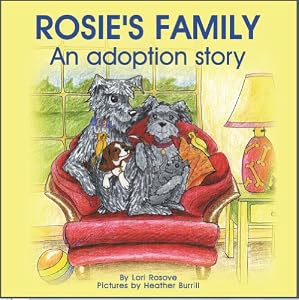
We also enjoy Rosie's Family by Lori Rosove from the perspective of Rosie who is a beagle who was adopted by a schnauzer family.  It addresses several questions adoptees might have and includes a nice guide for the parents about talking openly about adoption.

I have two other books in my "wish list" on Amazon.  I Don't Have Your Eyes has been on my list for sometime and I just added "We Belong Together" based on Sharla's recommendation.

There are other picture books that address adoption that we have checked out from the library. Some of them I don't like very well, and others just don't relate to our adoption journeys. But here are a couple I have enjoyed.
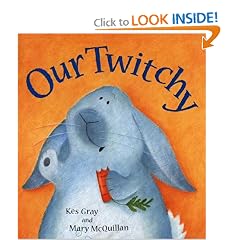
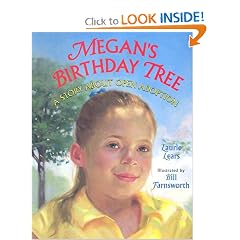
This book is about a bunny who is adopted by a cow and a horse. He realizes he is different from his parents, and has a really hard time with it and ends up running away. He eventually returns home and is trying to change and act like a cow and a horse, but they reassure him that they don't want him to change and they ARE his real mom and pop. Then 'they felt more like a family than ever before'. This is a cute book, great illustrations, and it's a short and easy read for young kids, but I'm not sure I love it. I guess it would be a good book if a child started focusing on his or her differences and they needed to be addressed for the child's reassurance, but I'm not sure it's my favorite book to just read on a regular basis.Finally, this book is about an older girl, Megan, who has an open relationship with her birthmother. Her birthmother has a tree in her yard that she decorates every year and sends a picture of it to Megan. But when the birthmother is getting ready to move and get married, Megan is afraid she will no longer be remembered without the tree in the front yard, so she tries to figure out how to give a new tree to her birthmother. As the story progresses, her birthmother tells her "I don't need a tree or anything else to remember you! Even though we don't live together, you will always be a part of me."

I really like this book for an older child, and will likely purchase a copy of it at some point. We are blessed to know our children's birth families, and I think this book helps a child figure out the roles played by the various members of their family (birth and adoptive), in a positive way, as the book ends with Megan thinking "how lucky I am to be part of such a special family."

If you made it through all that, share a couple of titles you like to use in teaching children about real life circumstances, whether they address adoption or some other topic that is important to you!
Tuesday, August 28, 2012

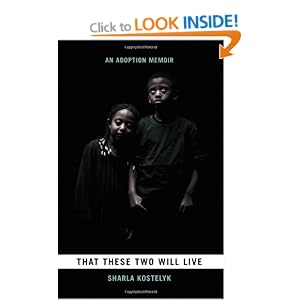
That These Two Will Live

Once I started reading That These Two Will Live by Sharla Kostelyk I could hardly put it down.  Sharla shares the story of her children's adoption with honesty, trust, and hope.
When their adoption agency went bankrupt, their son and daughter were stranded in a transitional home in Ethiopia.  These children had already suffered the loss of their home and their first parents and had been moved from the familiarity of the orphanage, so their parents were determined to do whatever it would take to bring them safely home.

While our adoption stories have never looked quite like that of the Kostelyks, there are some common threads I think every adoptive family will be able to relate to.
  • God's provision:  They knew the Lord would provide what was needed even as they saved and budgeted and collected items for garage sales.  Their motto was  'getting to Ethiopia ten cents at a time'.  "Some said not to bother with such a small amount, but dimes really add up when they are in God's hands!" (31). . .When I found a dime on the pavement that Wednesday, I knew it was no coincidence.  I was reminded that God would provide the money somehow" (70).  There is such a beauty in watching the Lord provide, both in our own lives and in hearing His faithfulness in the stories others share.
  • Fears and worries:  While joy overflows throughout the book, Sharla was too honest to minimize the fears and worries involved in an adoption journey.  "I wondered how they were, and if at that moment they were in an orphanage or still with a family member.  I worried about how they were feeling and whether or not they were hungry, sick, or scared.  I prayed for them.  I cried for them.  I grieved for the losses they would endure.  I loved the thought of them" (21).  "It was in the times of idleness that the worry crept in and overtook me and the tears flowed" (50). 
  • She was also painfully honest about Satan's attack on marriage during the stress of an adoption and shared how they worked through the tension and distance.  "We each voiced our deepest fears and had very little comfort to offer each other as we were both feeling the same way.  With the kids' frequent tantrums and violent outbursts, we worried that maybe we had made a mistake, that we wouldn't be able to cope with all the kids once we returned home" (141).
  • Wry humor at God's ways versus our ways: I drew a little smiley face in the margin several times because I love it when we make a statement from our own human limitations and then God shows Himself to be ever so much bigger.  You think you only want an infant, or a certain race, or a certain gender, or a "healthy" child or only one or, or, or?  He is so good to grow us past ourselves and Sharla wasn't afraid to share those moments when He worked in their lives. "Mark had been very clear from the first time I brought up my childhood wish to someday foster that he would never be willing, and here he was suggesting it!" (9)  "My motivation was mostly about what I wanted and what I thought would be best for me. . .I began redefining my motives and opening myself up to what God had in store for me" (14).
  • Fierce love:  "They were our children, just as much as the ones we could see in the backseat of the van, and we would do anything for any one of them" (6).
  • Waiting:  I don't think I ever ended up creating the tag "waiting" on my blog during our most recent adoption journey, but I seriously considered it.  I don't know anyone who has pursued adoption without experiencing the ubiquitous 'hurry up and wait' cycle (hurry up and get this paperwork done or these fingerprints or these references or this photo book followed by days and weeks and months of waiting).  Sharla eloquently expressed the lesson we all must learn.  "None of the timing was in my control, so it was futile to pretend that any of it was. . .On the days when the wait felt never-ending, I reminded myself that the timing was ultimately up to God.  I reassured myself with the knowledge that He had already chosen our children for us and us for them" (21).
I highly recommend this adoption memoir as it is about these two precious children finding their family, yet it is about so much more.  I found it very encouraging and affirming and even convicting.

Monday, June 18, 2012

Infinitely More

Kids need a mom and a dad.  They need to grow up in a family where they will be loved, nurtured, and trained.  We know that--even just instinctively, we know that.  But the more I learn, the more I read, the more I experience. . .well, the more I see how much better God's ways are.  Reading Infinitely More by Alex Krutov reminded me of what I already knew, yet painted an even starker reality of the future for orphans than I previously understood.

Alex grew up in the Russian orphanage system and his story begins when he was abandoned as an infant as the Soviet Union collapsed.  He shares what life was like in the orphanage, his experience with adoption "disruption", and the bleak future orphans face as they age out of an orphanage.  It becomes a story of hope, however, as he interacts with christian missionaries and grows in his knowledge of and relationship with Christ and His followers.  His story culminates with his beautiful desire to serve other orphans and pass on the hope and purpose he received by the grace of God.
I was most struck by the emotional and spiritual desert orphans face as a result of their lack of family.  Alex effectively illustrated how throwing money at a situation and buying stuff does nothing to address the core, heart issues.
"missionary dollars were flowing into the orphanages, yet it did not change the outlook for the orphans' futures to have nicer bathrooms or hot water.  There was no real investment in their morality, their spirituality, their identity, value, dignity, or purpose.  We watched, over time, as orphans left the system, hopeless.  In fact, the Russian society honestly believed it would be better for everyone if they just died"
I think we all know about the horrible lives many orphans lead after they age out of the system,
"For all these reasons, along with the emotional issues of hopelessness, isolation, and depression, the vast majority of emancipated orphans begin to make poor choices, choosing the streets as their 'home' and selling drugs and their bodies, or stealing, to survive.  At least ten percent of them end up committing suicide."
But I hadn't thought about orphans having a sense of entitlement since they had never learned to work for what they had (little though it was) or had the opportunity to realize their needs were met because they were  loved (as I was, or as my children are).
"There is a phenomenon with orphans, at least for those who grew up in an orphanage, that goes contrary to expectations:  a sense of entitlement that comes from years of someone else providing for you.  Never mind that their core needs of love and affection were never met, or that their provisions were secondhand, ill-fitted clothing and shoes, or that their showers were cold.  Their perceived needs were always met by someone else--and not anyone close to them, either, but by an impersonal 'them'.  Similarly, there is a concept with orphans known as 'silent love':  their inability to express appreciation.  They were never taught how to show appreciation or express affection".
I am  inspired by Alex's story and growth in the Lord.  There were certainly times he was immature, selfish, greedy. . .all sorts of ugly character traits. . .but I appreciated that his story didn't gloss over his own imperfections and growth.  That wouldn't have been realistic or honest, nor would it be helpful to others walking behind him.
"Too many missionaries believe you just bring the gospel and lead people to the Lord and then they'll be fine.  Yet, that is just the starting point.  You need to deal with the emotional baggage of these orphans, working through attitude and emotional changes, forgiveness, and validating these kids as individuals."
Reading stories like this touch my heart and make me think there's room for one more child in my heart and home--surely there's room for one more child who needs a mom and dad, security, love, the gospel. . .

For information on Alex's ministry to disciple and mentor orphans in family-style communities, check out The Harbor.

Saturday, December 3, 2011

Any Connection to Adoption?

Six years after beginning our adoption journeys, I have discovered a wonderful little resource for adoptive parents, potential adoptive parents, foster parents, and anyone who wants to support their friends or relatives who are traveling (or especially beginning) an adoption journey.
The premise of this ebook is a familiar one--you must take care of yourself in order to be able to take care of others. I've been reading Sharla Kostelyk's blog, The Chaos and the Clutter, for only a short time but have discovered in her a kindred spirit (except that she loves washing dishes--I can't relate to THAT! chuckle). The warm, conversational tone of her blog comes through in her book. Reading it is like sitting down for a good chat with a friend who has been there--indeed, is yet in the trenches beside you.

My favorite part of Shield: A Framework of Self-Care for Foster and Adoptive Families is the chapter on building a support network. In many ways, I had a great support group, but there are certain things people just don't know if they haven't had prior connections to adoption. If I were adopting now for the first time, I think I would buy a few copies of this to pass out to close friends and family! :)

As Sharla says, "It is important to prepare them for what lies ahead and to let them know what you will need from them. Do not assume that just because you have been there to support them in the past, they will be there to support you. Also, don't assume that they will know how to support you without being asked."

I remember explaining to close friends and family that our children wouldn't have had the experience of knowing my sounds and smells from their time in the womb, so I would be spending a lot of time with them at home, holding them, being the one to feed and change them, so they would know ME as their mama. It felt a little uncomfortable to both say and follow through on that, although people accepted it graciously, but how nice it would have been to have a little booklet to hand them which says "if you want to be the only one who is able to hold your child, people will be much more prepared and less likely to be offended if it has been explained to them ahead of time." (for more FANTASTIC information on attachment, check out this series my dear friend Kat is sharing as she prepares to bring home her daughter Jael--and pray for little Jael's attachment while you're at it).

Sharla's book has a lot of common sense advice which is easy to implement, yet it's also necessary to remind us that if we are running on empty, we have nothing with which to serve others. I appreciated her simple, practical steps to fall back on during a challenging time. This book is easy and compact and useful in passing on tips to successfully build a shield of self-care in the preparation for and process of adoption.

Monday, November 7, 2011

In Honor of Adoption Month

November is National Adoption Month, and I happen to be reading Kisses from Katie: A Story of Relentless Love and Redemption by Katie Davis. Katie is a 22-year-old woman who traded the American dream (as a 19-year-old!) in order to live out a life of obedience to God by ministering in Uganda and subsequently adopting 14 Ugandan girls as her own.
This book has brought me to tears more than once, even as I have followed her blog for quite some time. Her story is outstanding and challenging and inspiring--you really must read this book for yourself. I'm sharing this excerpt on adoption because even though each adoption has its own unique story, her thoughts so beautifully relate my own heart that I thought they might bless someone else.

God has continued to show me that adoption is His heart, and it was becoming mine.

Adoption is wonderful and beautiful and the greatest blessing I have ever experienced. Adoption is also difficult and painful. Adoption is a beautiful picture of redemption. It is the Gospel in my living room. And sometimes, it's just hard.

As a parent, it's hard not to know when your daughter took her first steps or what her first word was or what she looked like in kindergarten. It's hard not to know where she slept and whose shoulder she cried on and what the scar on her eyebrow is from. It's hard to know that for ten years yours was not the shoulder she cried on and you were not the mommy she hugged.

As a child, it's hard to remember your biological parents' death, no matter how much you love your new mom. It's hard to have your mom be a different color than you because inevitably people are going to ask why. It's hard that your mom wasn't there for all the times you had no dinner and all the times you were sick and all the times you needed help with your homework. It's hard when you have to make up your birthday. It's hard when you can't understand the concept of being a family forever yet, because your first family wasn't forever.

Adoption is a redemptive response to a tragedy that happens in this broken world. And every single day, it is worth it, because adoption is God's heart. His Word says "In love he predestined us to be adopted as his sons through Jesus Christ, in accordance with his pleasure and will" (Ephesians 1:5). He sets the lonely in families (see Psalm 68:6). The first word that appears when I look up adoption in the dictionary is acceptance. God accepts me, adores me even, just as I am. And He wants me to accept those without families into my own. Adoption is the reason I can come before God's throne and beg Him for mercy, because He predestined me to be adopted as His child through Jesus Christ, in accordance with his pleasure and will--to the praise of His glorious grace.

My family, adopting these children, is not optional. It is not my good deed for the day; it is not what I am doing to "help out these poor kids." I adopt because God commands me to care for the orphans and the widows in their distress. I adopt because Jesus says that to whom much has been given, much will be demanded (see Luke 12:48) and because whoever finds his life will lose it but whoever loses his life for His sake will find it (see Matthew 10:39).

God was showing me His heart and His Word in new ways right there in the life I was living through the children I was serving (72-73).

Now go order her book and see how her example of service to the Lord affects you--c'mon, I dare you! wink

Wednesday, March 2, 2011

Loved By Choice

I recently read a book which has a tone that is appreciated by an adoptive mom who reads a little too much. I have to admit I sometimes am drawn, like a moth to a flame, to blogs in which adult adoptees or birthparents write about how adoption has ruined their lives. I don't know what it is about me that goes back to those blogs. . .

Admittedly, I want to be educated about adoption, and I want to be as prepared as I possibly can to help my children through this aspect of who they are as an adoptee. I frequently find them frustrating, even irritating, to read as I'm just not one to get stuck in a "victim mentality." I tend to be more of an "okay, so this is the past, this is what I can do about it, this is what I just need to accept and move on, so let's move on" kind of person with issues in my own past.

But I also have empathy for the bloggers, and I also want to see things from someone else's perspective as I think that will help me to understand and help my children. So I keep going back, even though they tend to depress me a little bit--and scare me, if I'm being completely honest.

But this book is written from a different perspective (and some of the bloggers I've read would say contributors are in 'denial' or that the author selected only those who had positive experiences to include in their anthology--see how reading those blogs puts thoughts into my head?!). Loved by Choice: True Stories That Celebrate Adoption was compiled by Susan Horner and Kelly Fordyce Martindale and focuses on the relationships among adoptees and their biological and adoptive families and their respective experiences. It shares perspectives of birthparents, adoptees, adoptive parents, and even grandparents (both birth and adoptive, as I recall) and siblings, so it presents a pretty complete picture.

I was very touched by accounts from the first mothers who chose to make adoption plans for their children. As I read the experiences and emotions shared, I could really relate to them as I've heard similar sentiments from my children's first mothers. I read with a Kleenex in my hand as I know the pain these women experienced is all too real. At the same time, I was grateful to them for sharing their stories and can see how it could be comforting to an adoptee to hear these accounts and know it was never an easy decision, it was never an intent to reject, it was always a desire for the best these mothers could give their children.
"Our days together in the hospital were bittersweet. I held Becky and cried a lot. I told her how much I loved her and hoped she'd understand why I was giving her up for adoption. I asked my baby to forgive me, hoping that maybe someday she would understand how heartbreaking this was for me. . .The moment I saw her (sometime after the adoption) I knew I had made the right choice. She was a healthy, happy, smiling, wonderful child. When she looked at me it was as if she knew who I was and loved me. My joy was indescribable" (19) (birthmother)

"I was unprepared emotionally, physically, mentally, and spiritually. . .I have always believed a child needs a mother and a father if at all possible. I knew I was not ready to parent, even though I was already a parent, and the baby's father had made it clear he wasn't ready for parenthood either. I thought of all the love, support, and security my parents had given me through the years, and I knew I couldn't give anything close to that to my child. Not yet anyway" (65). . ."we would go our separate ways in just a few minutes--a family with a new baby and me with empty arms" (70).

"I could raise my child. Alone. Without family. Without security. Without any guarantees. The bottom line was, did I love this child enough to want the best for him--even if I wasn't the one who could provide it? Adoption is a choice of love. Of sacrifice. Of giving so that someone you love can have more even if it leaves you wanting" (81).

"I wanted my baby to have a safe, loving home, with a kind and nurturing mom and dad--something I had always longed for. How could I give what I didn't have? I was only fourteen. . .It hurt so much to be away from (my baby). But deep in my heart I felt at peace about my decision to go through the pregnancy and place my baby for adoption. I know it was the best thing, the most unselfish thing I've ever done in my life. . .She will always be in my heart and part of my family. I didn't reject her, but chose adoption because I loved her so much" (94).
Some of the comments from adoptive mothers resonated with me as well. One of the mothers expressed my exact thoughts as we've spent time with birthparents before placement:
"I desired to know the birthmother. I wanted to reassure her that we would be the best parents we could be. Further, the more I knew about her, the better I could answer our child's questions. . .We wanted to stay longer (in the hospital) but understood Tanya and her family were saying their goodbyes. This was their time with (the baby). . .The bittersweet part for me was while I was experiencing great joy, I knew Tanya was experiencing great loss" (22). (adoptive mother)
I have written before about the "extended family" relationship we have with birthparents of our children, and I really focused on the positive aspects. So far, we *have* had very positive relationships with our children's birthparents. But I have to admit there are uncomfortable aspects to the open adoption experience as well. For example, we haven't quite figured out what our children will call their birthparents. For now, we refer to them by their first names, and that is what the children call them. In our opinion, the children are young enough, we think it would be confusing to call them 'mom', for example, when that's what they call me. Birthmother or birthmom is one term, but it's awkward and. . .formal?? First mom feels more natural to me, as far as for reference, but when we meet face to face, what will our children call their birth parents? Our thought is to let the children decide what feels right and natural to them--but I'm not saying we have it all figured out. We'll see.

Sometimes I also wonder how it will be as the children get older and perhaps we have different parenting philosophies from a birthparent. Will that cause hard feelings? Might our children wish to be parented by a more lenient parent? Might a birthparent encourage rebellion in our son or daughter or side with them against us in a disagreement? I realize we will just have to cross that bridge if it presents itself. But I was comforted by some of the sentiments in this book, such as when an adoptee wrote "(my birthmother) and I both see my mom as "The Mom": the one who can put me on restriction, and the one who comforts me when I'm sad or sick" (35).

I was surprised to see another sentiment shared by an adoptive mom which I've held deep inside. It is actually rather freeing to know I'm not the only adoptive mom who has felt this desire to reassure my children's birthparents that they made the right choice in choosing us to parent their precious children by wanting to present this picture of a perfect parent and family, even as I'm so desperately aware that we aren't perfect--we're just humans doing the best we know in the moment, just like anyone else. But what if they should see something they don't like and then be filled with this horrible regret and feel they've made a mistake and there's nothing they can do about it? That's taking on quite a lot of unreal expectation and responsibility--so this woman's comment was rather freeing:
"The openness has not always been comfortable. . .It was because I was trying to do everything within my power to assure these women that they had made the right decision; that (my husband) and I were wonderful parents and that their child would always be happy with us. I wanted to appear perfect. The rub is that I am not perfect and neither are my children" (32).
It was also freeing and reassuring to read the reflections shared by the adoptees themselves. I don't know why I let myself get bogged down by reading blogs of adoptees who hate that they were adopted. It's especially ironic considering I know several people who were adopted and without exception they have encouraged us along this journey (another irony is that the only discouraging words we've heard have come from families who adopted children or siblings of children who were adopted???? still not sure what to think of that!). Good friends Dixie, Stacie, and Mary have gone out of their way to write and speak words to us sharing their positive adoption experiences and how much they love their (adoptive) parents. These three have comforted and reassured me as I share fears that have arisen from reading the pain of adult adoptees. Nonetheless, I was still glad to read words such as these:
"I felt doubly loved. I have always known my parents and both of their families loved me. But it just hit me that (my birthmother's) family loved me too" (28).

"When I hear my mom say how incredible (my birthmother) is and how hard it must have been for her to give me up for adoption, it makes me feel good about who I am. I came from her, and she will always be a part of me" (33).

"Being adopted is sad, but being adopted is glad. I lost something, but I gained something" (127) adoptee

"This I know--I was loved when I was born; I was loved again when I was adopted. And knowing this, I wouldn't change a thing about my life" (240).
So, all in all, I recommend this book highly--for those interested in adoption, for those who have any sort of connection to adoption, or for those who would just like to understand the perspectives of the many relationships forged by adoption. It's an easy read, and an honest look at the thoughts and emotions of various adoption experiences.

Friday, February 4, 2011

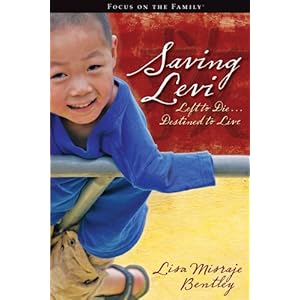
Saving Levi


A book about. . .
  • God's marvelous provision.
  • unity and bonding in a common goal.
  • loving and caring for the fatherless.
  • overcoming fear.
  • acting in obedience.
  • generosity from total strangers.
  • God's grace.
This book moved me to tears more than once. As I read about a six-week-old baby boy found abandoned in a field in China, my heart hurt. As I saw pictures of his horribly burned body, to the point that ashes fell off when his hand was touched, my stomach hurt.

But the story of what God can do through those who are willing to obey Him, who are moved by compassion, love, and faith, was inspiring and healing.

This was just one of those books that will always stay with me. It was a quick and easy read (I read it in one day during naptime and then finished it in the evening) but it was immensely powerful. I can't help but think of the amazing growth God produces in people when we are willing to step out in faith and allow Him to work in us and through us. I think of how often it is fear that keeps us from taking risks--whether it is the risk of loving a child not ours from birth, the risk of leaving a successful career for an uncertain financial future, the risk of caring for people when we might lose them, the risk of giving liberally at the cost of our children's college funds or our 401K, the risk of loving those who aren't easy to love and may never return that love. . .

Yet taking those risks while trusting in and serving God reaps growth that far outweighs the costs and risks. He pours blessings on us as if He was just hovering above us, His arms filled with the richness He longed for us to be willing to receive, and the moment we fully surrender He delightedly showers us with the gifts and growth we had been rejecting with our selfish and willful lives.
And so my prayer is that your story will have involved some leaving and some coming home, some summer and some winter. . .
My hope is your story will be about changing. . .
about learning to love a child. . .
about learning to love others more than we love ourselves. . .

We get one story, you and I, and one story alone. God has established the elements, the setting and the climax and the resolution. It would be a crime not to venture out, wouldn't it?. . .
And you will not be alone. You have never been alone. Don't worry. Everything will still be here when you get back.

It is you who will have changed.
--Donald Miller, Through Painted Deserts
I'm having a hard time reviewing it--just read it yourself. Seriously.

Tuesday, July 6, 2010

Black in White

I've not experienced judgment or criticism for adopting transracially yet. I wondered, back when we were on our first adoption journey, how our small, rural (white) community would react if we adopted a child of African American, Hispanic, or Asian heritage. The few locals we talked to about it had favorable responses, and since we've adopted Kiana, I've observed nothing but acceptance of her as a member of our family and community. Indeed, our little girl has the most crowded little finger I've ever seen as the entire community seems to be wrapped around that little finger! Our librarian reads her books at her every request, moms at Destry's ballgames bribe her with candy to come and talk to them, and all my friends adore her.

In fact, as I reflect back over the last nearly three years, I can remember only one incident that made the hair on the back of my neck stand up. It was very recently.
We were at one of Destry's ballgames, and a man standing behind me talked incessantly. I had never met him before, but to be perfectly honest, after listening to him go on for about an hour, I found him rather annoying. He barely stopped to breath in his jabbering, his conversation was mostly negative, and was liberally sprinkled with language I don't appreciate hearing at all, much less at a children's ballgame.

His young married daughter and her husband were showing their cute little black puppy to Easton and Kiana who were, of course, delighted. After some time, the daughter offered the puppy to her dad saying "Here, do you want to hold your 'grandson'?" The man replied "What would I want with a N. . .", then reached out and took the dog.
Shortly after this, I read Kevin Hofmann's book, Growing Up Black in White. You may remember my post awhile back when I discovered his blog.

Kevin was adopted as a young boy in Detroit where racial conflict was a daily experience. Some hater, in fact, burned a cross in his family's yard when he was still an infant, and their church refused to accept that the family had adopted a Black boy. As a result, his family took such drastic measures as to move to a predominantly Black neighborhood where they would become the 'minority' and their son could develop security and identity in his ethnic heritage. This autobiographical book is quite interesting for those touched by transracial adoption, and it has opened my eyes in many ways.

I have to admit I was distracted by the typing/spelling and grammatical errors. If he publishes a second edition, I am tempted to email him and ask if I can edit/proof it first, because it was pretty bad. (chuckle) He also switched between past and present tense in a way that kept the book from flowing smoothly.

Having said that, it is still a book worth reading and I appreciate his candidness. He doesn't paint a rosy, happy, happy, joy, joy picture of adoption in general or transracial adoption--but then, that's just life, isn't it? Our choices have consequences, and sometimes those consequences involve sacrifice. This book raised my awareness level, and revealed some areas I need to be especially diligent about. I especially was reminded that we need to instill in Kiana a strong sense of her personal identity in God, her identity in her family, and her identity in who God made her to be to equip her for the challenges of life.

I can't help but wonder, as I ponder this book, what might Kiana say 30 years down the road? What sort of autobiographical book would she write to families who are navigating a similar road? Will she see us stand up to ignorance and racism on her behalf? I can't help but feel we might have failed her at that ballgame. I was sitting behind Alan in the bleachers, and I saw his shoulders stiffen in my peripheral vision as I whipped my head around to give the man an arched-eyebrow "EXCUSE ME?!" look. But that's all. Some situations might be more appropriate than others to say something--I don't know. But I feel more prepared for 'next time'--and sadly, even as I see and hope that our society is doing better in this regard, I expect there may very well be a 'next time'.

What do you think we should have done/said? Anything?

Friday, June 4, 2010

One Million Arrows

I recently finished Julie Ferwerda's book One Million Arrows: Raising Your Children to Change the World. A book review I read intrigued me, and I knew I had to read it. There are so many nuggets I just can't do the book justice, so I'll share just a few that blessed me most.
  • I appreciated the message of humility in this book. The author introduces us to M.A. Thomas (Papa) from India who rescued tens of thousands of children off the streets, made "Hope Homes" for them to find safety and security in, and shared the gospel with them before sending them out in the world to tell others the story of Jesus. He is described as "a simple, warm, unhurried man who was genuinely interested in others. In fact, even after talking to him for several days, I had no idea" (12) of all the great works he's done and awards he's won for humanitarian contribution. The author continues that "most everything I learned about his achievements came from others" (12). This attitude is quite contrary to our human nature of wanting to make sure everyone knows and appreciates, indeed, validates, our every little accomplishment--while perfectly in line with what Jesus said about giving our alms in secret.
  • This book also reiterates the ideal of the teen years being productive and a preparation for life as they will soon be sent into the world as arrows for God. "More than just raising my kids to keep the faith, I want to raise my kids to save lives" (6) states the author. "The teen years are not a vacation from responsibility. They are the training ground of future leaders who dare to be responsible now (7). "The enemy wishes nothing more than to coax our kids, if not into rebellion, into pursuing passionless, insignificant, and potentially empty lives. As long as he can hamstring them with apathy, he need not worry about them doing damage to his kingdom. Our children can either be pawns unaware, or they can be weapons of mass destruction against forces of evil in the unseen realm" (21). "Our kids want more passion. They want more risk. They crave significance. Even in Bible days, kids were given big assignments full of exciting challenges, daring adventures, human impossibilities, and even death-defying feats" (31). "To fill their need for speed, many of our kids bury themselves in gaming, social networking, TV and reality shows, graphic movies, another forms of mind-numbing amusement, often at the expense of meaningful family relationships or selfless contributions in the lives of others. Our little ones grow up having almost everything their hearts desire, yet for so many, their hearts are still beyond empty. Their faith does not seem to be the anchor that holds on the rough seas of life" (42). "Young people have more energy than they know what to do with. They're no longer children, and yet they don't have the responsibilities of their own family, and so it's important at that point that your household have a sense of vision and adventure in doing hard things for the glory of God. You don't want to control what they're doing, but you do want to influence what they're doing" (61)
  • I really appreciated the message of family present in this book. They encourage families becoming a team in working together for God (61) and the importance of "parents who believe in making sacrifices necessary to raise their kids to make a difference" (8). She reminded me to focus "less on what your family can do for God and more importantly on what God wants to do through your family" (22). The author encourages parents to do their job as "the responsibility for raising spiritual champions (believers who continually seek to deepen their relationship with God, impact others for Christ, and accept the Bible as authoritative truth), according to the Bible, belongs to parents" (43). The importance of relationship was emphasized as "relationships are foundational to beliefs, values, and behavior. God doesn't work in a vacuum; He works through relationships. Rules without relationship lead to rebellion. Truth without relationship leads to rejection. Discipline without relationship leads to bitterness" (56).
  • I was touched by the role of adoption on this book. "If children are your gift to mankind, Lord, why are so many of them as broken and unwanted as dead branches?" Papa asked. He then realized he could "gather broken branches (orphaned and abandoned children), sharpen them with education, faith, and a heart for the Great Commission, and launch them like arrows back into all the regions of India that have never heard about Jesus" (17).
  • I am being challenged by the parenting principles recommended in this book. I have so much to learn and implement on this parenting journey! They interviewed parents who have produced fruit in the children they have raised. Some of the tips that I most appreciated are: start training them when they are young, memorize Scripture, emphasize humility and character above immediate pleasure and self-gratification, give thanks to the Lord in everything, teach them not to praise or talk about themselves but to let others do it, get them outside themselves from an early age, caring about the needs and problems of others. (53) One family summarized the way they raised their children to be arrows for the Lord by saying "it's a mentality, a lifestyle, and a change of priorities that permeates the whole family's lives and schedules, centering everyone on God's priorities and plans" (54). I can't get over that excellent statement, truly a challenge to me. Others shared that the "Bible uses the word 'christian' only three times, but the word 'disciple' occurs over 200 times" (61) so they were "teaching their children to live daily with Jesus, and to live like Jesus would have them live" as the word disciple literally means student or follower. "Discipleship is in essence training, not just teaching. The parent who trains, first explains to the children what to do (teaches), then shows them by example how to do it (models), then follows through to make sure the children implement and practice the behavior (holds accountable)" (61). Most outstanding to me, "Every Christian home in America is a potential Bible college" (83).
There is so much in this book that convicts, challenges, and inspires me--I think I'll have to do a 'part two' post. Like someone in the book said "I don't want to miss out on what God has for me" (83), nor do I want my children to miss out because of my laziness, apathy, or misplaced priorities. I know there is so much more our family could be doing for God, and it is my constant prayer that He will lead us in His paths.

Monday, February 1, 2010

Dear Birthmother

I've been reading this book again. I read it before we adopted Easton, four years ago, and I'm getting even more out of it this time. I think a person just doesn't realize the effect birthparents will have on the life of the adoptive parents until you have been through it. I first read it with no knowledge or experience, but this time. . .it's richer. I'm seeing things I didn't see the first time through.

It may sound crazy if you've never experienced it, but in some ways I feel like we have adopted our children's birthparents right along with their children. They become extended family members. You know how it is when your child does something, and you think they are absolutely the cutest, brightest, funniest and most darling child on the planet?? And even as you have friends and family members who love your children, they can only endure your doting so long before their eyes start to glaze over? Well, birthparents love your child, too, and they are so hungry to hear every detail about that child. They agree with you over how amazing that child is, they revel in identifying traits that they have a genetic contribution toward, and they have a tolerantly bemused attitude toward childish misbehaviors.

I cherish the relationships we have with Easton and Kiana's birthparents. I am glad to share these memories and milestones with them, and I am especially grateful for the interest they have in maintaining a relationship with their children and being available should Easton or Kiana have questions about their medical history, their birth families, or the circumstances of their adoption plans.

I share all that to build up to the fact that I am DYING to get a letter from Cleara! In addition to our original profile letter, I have written her three letters and I have been haunting my mailbox these last few days in anticipation of hearing from her. I look forward to hearing more about her life and about her pregnancy experience and the hopes and dreams she has for her little girl's future. I desperately want, and pray for, this connection with her, too--for my coming daughter's sake as much as anything. I feel like the more contact we have pre-placement, the more relationship we will be able to build and the more 'answers' I'll have for my daughter's future questions.

It's hard to review this book, but I will (at this point anyway) just highlight the most basic messages of the book. The first 75 pages focus on dispelling some common myths about adoption which are:
  • The birthmother obviously doesn't care about her child or she wouldn't have given him away.
  • Secrecy in every phase of the adoption process is necessary to protect all parties.
  • Both the birthmother and the birthfather will forget about their unwanted child.
  • If the adoptee really loved his adoptive family, he would not have to search for his birthparents.
The author spends a chapter refuting each of the above thoughts, and she does an excellent job. Like I said earlier, however, the points are driven home even deeper now that I've held my daughter's birthmother in my arms after she signed the paperwork as she sobbed uncontrollably until I literally thought she might vomit. I know birthparents don't forget the children for whom they've made adoption plans as I receive emails, letters, birthday and Christmas cards, and requests for pictures and as we make arrangements to meet for birthdays or just because. I've seen healing take place as Easton's birthparents are reassured that their child is loved and secure and happy by seeing him interact with his family. I wonder how secrecy could possibly seem necessary as I hear my daughter tell her birthmother 'I wuv oo' as we depart from our meeting and I see the gratitude and tears spring to birthmother's eyes. I wonder how it could possibly benefit these children not to know about their birthparents as Kiana walks around the house with a doll up her shirt saying "I tevie (her birthmother's name is Stevie). I ha' baby in my tummy." Yes, experiencing the blessing of an open adoption certainly makes this book more meaningful this time around.

The second half of the book shares information related to some adoption facts including
  • Adoption is a lifetime experience (it does not go away once the 'process' is over).
  • Adoptive parents will never totally parent their child; and adoptees will never be totally parented by their adoptive parents (This seems confusing, but think about the fact that only the biological parents can pass on their biological heritage and genetic future. Thus both adoptive and birthparents have their unique role in making up the person their child will become. "Adoption is the process of accepting the responsibility of raising an individual who has two sets of parents.")
  • Birthparents remain a part of the adoptee's life (whether physically separated or reunited).
  • Individuals handle their lives and their destinies best when addressed with trust and honesty instead of protective secrecy and half truths.
I especially appreciate the section that talks about the grammar of adoption, and that "adoption is a process." As "Adopted for Life" shared, 'adopted is a past tense verb, not an adjective'. An adjective 'denotes a quality of the thing named', (a label??) which is something we don't want to apply to our children. Being clear that adoption is a PROCESS recognizes that there are different ways to create a family, but the children of that family are not different.

Dispersed throughout the book are tear-wrenching examples of letters written between birthparents and adoptive parents sharing the depth of each parent's love for their child, their joy in the child, their plans and dreams for their child, and ultimately, their appreciation for one another and the roles played in their child's life.

I echo the full title of the book--Dear Birthmother, Thank You for Our Baby.

Sunday, December 27, 2009

A Book for Everyone

I finished my book I was so eagerly anticipating. It is called 'Adopted for Life' by Russell Moore. Don't think, however, that this book is only for people who are adopting children. You would be wrong. This book is for you if you have adopted a child, if you think about adopting a child, if you were adopted, or if you support friends or family in adoption. This book is for you if you have been adopted by God, if you can call Jesus your Brother, if you have a church family. This book is for you if you have noticed "there seems to be an orphan-making urge among us, whether we see it in the slave culture of centuries past or the divorce culture of today" (61) and you care--if it breaks your heart when you let yourself notice and think about it.
So what is this book about?
  • It teaches us to trust in God.
  • It reminds us that God has adopted us so we can be called the sons of God.
  • It examines the relationships of families and what the church would look like if we truly viewed one another as brothers and sisters.
  • It declares that adoption is a war against the evil one who preys upon the vulnerable and that Jesus calls the church to protect them.
  • It reveals, not only our identity and nature (as Gentiles) before we were called children of God, but also that the children of Israel were adopted by God.
  • This book beautifully expounds on the Abba cry, that we can groan out to God as the Spirit within us helps us to understand this life is not as it should be.
  • It challenges us not to be content with the status quo, not to settle for the security of the familiar.
  • It admonishes us that 'a person's life does not consist in the abundance of his possessions' (Luke 12:15).
  • It imagines 'if Christian churches were known as the places where unwanted babies become beloved children' (79).
  • It warns against pride and self-sufficiency.
  • It cautions us not to base love on performance.
This book also addresses physical adoption. It shares the author's journey through infertility and the adoption of two boys from a Russian orphanage. He addresses issues such as raising both the children you've adopted and the children of the flesh. He addresses transracial adoption. He addresses the financial aspects of adoption. He shares the insensitive (even rude) comments, questions, and cautions people offer. He addresses international adoption, domestic adoption, foster care and snowflake adoption. He educates regarding open and closed adoptions and warns against disrupted adoptions.

Doesn't it sound amazing?! This book is life-changing; it is deep; it is intense. Read it if you dare.

I'll leave you with a quote I love from this book. But be forewarned--I feel more ruminations rumbling for future posts!
"All of us are called to be compassionate. All of us are called to remember the poor. All of us are called to remember the fatherless and the widows. That will look different in our different lives, with the different situations and resources God has given us. But for all of us there'll be a judgment to test the genuineness of our faith. And for some of us, there will be some orphan faces there. . .a new son or daughter who escaped the abortionist's knife or the orphanage's grip to find at your knee the grace of a carpenter's Son." (83)