I think they "got it". Read their thoughts and prepare to read this great book if you haven't done so yet.
DESTRY:
How should we then live? A profound question really. A
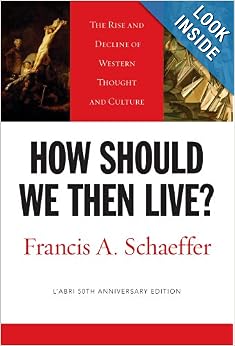
question that demands both thought and an answer. The purpose of How Should We Then Live by Francis Schaeffer is to trace the connection between
thought and action in history. “What they are in their think world determines
how they will act.” Throughout the entire book, Schaeffer focuses on the moral
standard applied to each culture in history. He tells us the causes, effects,
and future influences of each worldview by tracing the changes in the arts. Each
time period in history uses the arts to manifest its answer to the questions “is
there meaning in life? If so, what is it? And from whence does it come?” Schaeffer’s
down to earth and simply stated style convincingly demonstrates the importance
of absolutes in the structure of a civilization. He shows us how the lack
thereof has produced the failures of Greece, Rome, Humanism, the Enlightenment,
Darwinism, Nazi Germany, and even future America. Schaeffer closes his
fascinating, eye opening, and even disturbing account with the simple question:
“How should we then live?” Throughout the book we have been wondering how he
will answer this thought provoking question. He gives us the source of this
question from Ezekiel 33:1-11. The question is found in verse 10. Instead of
answering it himself, he gives us God’s answer from verse 19: if the wicked
turn from his wickedness, and do that which is lawful and right, he shall live thereby. Schaeffer wants
to encourage us to abstain from the great wickedness of placing anything in the
place of our Creator and live by that which is lawful and right. This is “how
we should then live.”
BRIANA:
BRIANA:
How Should We then Live was
assigned to us by mom as a part of our art appreciation course. While this book
is about art, its true subject is much more. It is a history of human worldview
starting with the ancient cultures of Greece and Rome, and finishing with the
1970’s. Dr. Schaeffer’s purpose with this book is to explain the thinking
behind the actions of society; to explain why we do what we do. Art is a
helpful tool for this, because artists use their works to express the
worldviews of themselves and their societies. Dr. Schaeffer moves through
Greece and Rome, the Middle Ages, the Renaissance, the Reformation, and into
the modern era, using art, politics, education and entertainment to describe
how our worldviews affect our actions.
I
learned so much from How Should We then Live. I was especially fascinated
by the last few chapters which dealt with the shifting worldview of America in
the 1900’s. Dr. Schaeffer’s words gave me new insight into how humanism leads
to pessimism which in turn leads to a desire to just “take it easy” in life,
and do what feels good. Dr. Schaeffer explains that this progression is what
happened in the sixties and seventies, and I can see it continuing today. I
have been able to apply this book to my other areas of study, including history
and government. I can more readily understand the “why” behind the “what” of
people’s actions and decisions. This book has helped me examine my own
worldview and realize that I need to reject humanism and embrace God’s love as
the reason for my value.
How
Should We then Live is one of the best books I have ever read, and I believe
it has been very beneficial to my education. I would go further to say that it
is not just beneficial to education: it is essential. If you have not read this
book, I urge you to do so. Your view of the world will be forever changed.