Saturday, December 26, 2015

The Great Gatsby

The Great GatsbyThe Great Gatsby by F. Scott Fitzgerald


I hadn't read this book since I was in high school and took my review of it to the state public speaking competition! I have to admit I didn't remember it very well, so I decided to read it again in preparation to discuss it with my son.

My overwhelming response to the story is a sigh for the vanity, the absolute emptiness, it portrays. The pursuit of wealth, prestige, stuff, "the pleasures of sin for a season" were in full swing in the roaring 20s, they were present in Solomon's time, and we still see such vanity, vanity, all is vanity around us today.

So what is the end result of endless partying, keeping up with the Joneses, materialism, sexual immorality, mocking others to elevate self. . .living for self, youth, and pleasure? Well, Fitzgerald paints the picture well. The result of such a life is cynicism, lack of character, disillusionment, discontentment, loneliness. Ultimately, it's death. Presented here in this book as physical death, we know that ultimately it results in spiritual death.

Fitzgerald's turns of phrase are so clever, his imagery, correlations between the mood of the book and weather, and the geographical connections to character. . .it's a very well-written book. Even if I don't necessarily agree with his worldview, people just don't write so carefully anymore.

I'm looking forward to discussing this with Destry, and I think I may have to watch the recent movie that was made about this book.

Monday, December 21, 2015

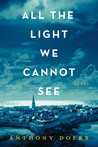
All the Light We Cannot See

All the Light We Cannot SeeAll the Light We Cannot See by Anthony Doerr

Two teenagers during World War II, one a girl in France, one an orphaned boy in Germany. This book tells their stories as Hitler rises and falls from power.

I must admit I did not like the way the book jumped back and forth, not just between the two main characters, but also between years. That is one disadvantage to reading a book like this on the Kindle, I think, as it's more difficult to flip back and remember which year this chapter is in when you've had to set it down and pick it back up. It also just broke the book up for me making it choppy and difficult to engage in.

Having said that, there was a lot to like about it. The historical aspect of the novel was well done. The growth of the characters and the effects the war had on them was also well done. I especially enjoyed all the unique characters he gave us: a mechanical genius, a brilliant bird-loving scientist with quiet courage, a blind, brave and practical girl, a damaged-by-war veteran, an insightful young girl who sees what's coming, a gentle, music-loving giant forced into killing. . .

This book hit me in a tender spot as my 18-year-old son is seriously considering joining the armed services. I think he doesn't realize the effects war has on a person. So as I read, I highlighted several poignant passages:
"You will strip away your weakness, your cowardice, your hesitation. You will become like a waterfall, a volley of bullets--you will all surge in the same direction at the same pace toward the same cause. You will forgo comforts; you will live by duty alone. You will eat country and breathe nation" (137). . ."They are each a mound of clay, and the potter that is the portly, shiny-faced commandment is throwing 400 identical pots" (139).
"Something in Werner's soul shuts its scaly eyes" (246).
"He has the sensation that something huge and empty is about to devour them all" (251).
"as if they ward off a vast and inevitable tidal wave of anguish only by staying forever drunk on rigor and exercise and gleaming boot leather" (262).
"Werner is beginning to see, approaching his sixteenth birthday, that what the fuhrer really requires is boys. Great rows of them walking to the conveyor belt to climb on" (277).
"Other times the eyes of men who are about to die haunt him, and he kills them all over again. Dead man in Lodz. Dead man in Lublin. Dead man in Radom. Dead man in Cracow" (498).
I enjoyed his use of language throughout the book and the many themes he explored: death, growing up, courage, conformity, friendship, loss, learning and appreciation of nature. . .

It was also interesting to find Verne's "20,000 Leagues Under the Sea" woven throughout the book as one of the main characters reads it throughout the story. I read that classic for the first time just last year so it was interesting to revisit it through her eyes.

Since I borrowed the book on my Kindle, here are a few other quotes I highlighted that I might like to revisit at some point:

"across the room is a miniature girl, skinny, quick-witted, an open book in her lap; inside her chest pulses something huge, something full of longing, something unafraid" (46).

"They lie on their stomachs and page through comics, feeling the pleasure of being outside of school, glancing at each other now and then as if curious to learn whether their friendship will continue to exist in another place" (220).

"Everyone trapped in their roles: orphans, cadets, Frederick, Volkheimer, the old Jewess who lives upstairs. Even Jutta" (229).

"She thinks of the whelks in Hubert Bazin's kennel, ten thousand of them; how they cling; how they draw themselves up into the spirals of their shells; how, when they're tucked into that grotto, the gulls cannot come in to carry them up into the sky and drop them on the rocks to break them" (446).

"When I lost my sight, Werner, people said I was brave. When my father left, people said I was brave. But it is not bravery; I have no choice. I wake up and live my life. Don't you do the same?" (469).

Tuesday, December 15, 2015

Love Anthony

Love AnthonyLove Anthony by Lisa Genova

So it turns out I LOVE reading Lisa Genova's books. I love the way she writes about neuroscience (our brains are so fascinating!) and I love her characterization. She knows people, she delves into the characters, what they think, how they are motivated, what makes them unique, and she examines the connections people have with one another.

Love Anthony focuses on two women, Beth (whose marriage is hit by a meteor) and Olivia (who has a son with autism). In a nutshell, the book is about learning to love (because, obviously, it is a lesson I need to be learning).

It's a little scary to me sometimes, reading about women who are going through crises, especially when those crises revolve around self-identity, mid-life questionings, and marital problems. According to my research, Genova herself is divorced, which I think affects her perception in some ways. Divorce is just not as big of a deal--not as scary--to her as it is to me. Yet for the most part, I appreciate the reflections the women go through in the story as I think they are thoughts we can all relate to at one time or another:
"Be yourself. But who is she? She's Jimmy's wife, and she's a mother. And if she gets divorced, if she's no longer Mrs. James Ellis, and she's only a mother, then is there less of her? She fears this and feels it already, physically, as if a surgeon has taken a scalpel to her abdomen and removed a whole and necessary part of her. Without Jimmy, she doesn't recognize herself. How can that be? Who has she become?" (65)
"She used to find inspiration in her everyday life here, and she used to write about it. When did she stop writing? When did her life become uninspiring?. . .She can't believe she stuffed so much of herself into a box, banished to the attic for so many years" (71).
"His once beautiful teeth. Her once beautiful skin. His annoying habits. She has them, too. She knows her nagging drives him crazy. This is what happens when people get older, when they're married for fourteen years" (7). . ."She remembers those days early on, when they were dating and first married, when he touched her, even in passing, and she felt it. Really felt it. That magnetic, electric heat of his hand on her. That invisible, magical, chemical connection. Where did that go?" (63)
The marriage counselor's assignment which I found interesting and enjoyed discussing with my husband:
"Here's your homework. I want you each to get out four pieces of paper, one for wanted, one for happy, one for secure, and one for loved, and I want you to write down specific actions and words that you need to see and hear in order to feel each of these things. Come up with as many as you can. Don't hold anything back" (196)
And the best quote of all, the book in a nutshell, a quote I have been pondering and using to examine myself the last few days:
"I was here to teach you about love. Most people love with guarded heart, only if certain things happen or don't happen, only to a point. If the person we love hurts us, betrays us, abandons us, disappoints us, if the person becomes hard to love, we often stop loving. We protect our delicate hearts. We close off, retreat, withhold, disconnect, and withdraw. We might even hate" (302).
What do you think?  Are you inclined to this self-protective version of love?

Monday, December 14, 2015

Pregnancy Center Fundraising Banquet

One of the blessings we've found since moving is the opportunity to get more involved with our local pregnancy center.  Alan has been serving on the board, and then as president of the board, for a few years, and this past year we suggested putting together a fundraising banquet like one we had attended in Missouri.  It's been a couple months since the banquet, and I've had this post sitting in my drafts folder for a while, but I want to post it now so I don't forget about it.


Alan had board meetings twice a month for several months to get ready.  It shouldn't take so much time planning in future years, but everything from getting a facility, finding a speaker, recruiting sponsors, advertising, programs, music, catering, etc. had to be researched and figured out from scratch.  When all was said and done, about $20,000 was raised, and the board deemed it a resounding success.


Alan welcomed the group, introduced the board, presented the vision the board has for the future of the center, and shared a little about his connection to adoption and pregnancy centers.  The speaker for the evening, Norm Palaski with Iowa Right to Life, shared his journey from pro-choice to pro-life.  Then Rita, the executive director of the center, shared her story of being adopted, and explained the many services the center offers women and families.


We had nice piano music playing in the background while we enjoyed a delicious supper of a beef tenderloin with a demiglaze and chicken breast, garlic mashed potatoes, and vegetable medley and our dessert choice of chocolate cake, cheesecake, and red velvet cake.


We had rented all the plates, cups, saucers, etc. and we volunteers cleared all the tables and washed all the dishes to save money.


Wow, that was a big job!  Ha! We hope to not have to do quite all of that in future years, but you have to start somewhere, right?!


Overall, the event was a resounding success.  It got people talking about (and learning about) the pregnancy center, raised money to keep the doors open, and resulted in 15 people filling out volunteer applications.  Alan has been asked to go and speak to a few people in the community (including at a baby shower to raise donations for the center, ha!) which will continue to raise awareness.

We had a great time with friends and feel really blessed to be a part of this community.

Friday, December 11, 2015

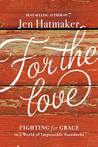
For the Love

For the Love: Fighting for Grace in a World of Impossible StandardsFor the Love: Fighting for Grace in a World of Impossible Standards by Jen Hatmaker

I'm always left with mixed feelings after I read one of Jen Hatmaker's books. On the one hand, I enjoy her conversational tone, her personality between the lines of the pages makes me want a personal chat with her, and she sometimes says things that resonate with me and/or challenge me. On the other hand, I get bored with her fluffy chatter and start skimming, just wanting to get the book finished, and sometimes I flat out disagree with what she's saying.

In this book, I liked her chapter on being who we are and using the gifts we have. I liked her chapter on marriage, and I really liked her chapter about raising kids 'on Jesus'.

I was almost inspired to start a Supper Club by her chapter of this title (but the thought of the effort just made me too tired in this season), and the subsequent chapter had me vigorously nodding my head at the need for real community and front-porch fellowship. The chapter on Difficult People had me loaning the book to a friend before I had even finished it myself.

Once I got the book back, I appreciated some of the points in her chapter titled "Dear Church":

"The early church involved small, organic communities who gathered around tables, lived simple lives on mission, and loved God and neighbor. That was kind of it. The first believers assembled for renewal and teaching and dinner and togetherness. It was so basic and lovely. Everyone pulled weight, pitched in, pressed into God" (171).

"We don't carelessly place our families under spiritual authority. My checkpoints, in order: 1. humility, 2. transparency, 3. integrity" (172).

My favorite quote of the whole book was the following:

"I pray for your kindness more than your success, because the latter without the former is a tragedy. God measures our entire existence by only two things: how we love Him and how we love people" (71).

Monday, December 7, 2015

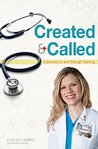
Created and Called

Created & Called: A Journey to and Through NursingCreated and Called: A Journey to and Through Nursing by Chelsia Harris

I read this book because we got it for Briana upon her completion of her advanced certified nurse's aide training and I can't resist reading a book! She is thoroughly enjoying it, and I can understand why. The author focuses on how she lives out her faith in Jesus Christ through serving others through nursing. She shares various fields of nursing, different levels of education in nursing, and other practical matters, but the bulk of the book focuses on the character traits needed to be a good nurse: compassion, humility, integrity, organization, patience, perseverance. I can see that it would be a very good book to read for anyone considering the field of nursing and it would also be encouraging for an active nurse.

A few quotes:

"A nurse is a helper, a servant, a leader, an advocate, an educator, a comforter, an encourager, a prayer warrior, and a team player" (15).

"I thought to myself, 'This is someone's daughter. Someone's mother. Someone's sister. Someone's wife. She was created by God in His image'" (35).

"The patients entrusted to our care are in some of the most fragile and vulnerable states that they will ever experience. They allow us intimate views of their hearts if we will simply create a sacred place for them to do so. It is our obligation to provide patients with professional, ethically sound care. It is our honor and privilege, and should be our desire, to regard them as highly valuable and to tenderly and compassionately love them through it all" (39).

Thursday, December 3, 2015

Freudian Slip

As Destry was filling something out the other day, he asked me what our school name is.  It's not something we talk about a lot--we were just supposed to choose a name some time ago in order to "qualify" as a homeschool for ordering purposes, so we developed a name and then just carried on with life.

I was busy doing something else, so just threw out "Together to Learn to Love."

Now, if you'll notice on my profile off to the right I describe our name:
Our school 'name' is "Together to Love to Learn" because whatever we do, we are together. The goal is to love together, to learn together, and to love learning together.
It wasn't intended to be "Together to Learn to Love" at all.

But you know what?    Fourteen years into this homeschooling journey, I think maybe we have been together to learn to love.  Really loving people doesn't come to us humans naturally.  We're having to work things out, even on the bad days, the seasons we aren't getting enough sleep, through hormonal changes, and the days we just wake up on the wrong side of the bed.  We are in close proximity to one another and have to learn to love one another and get along even when we don't get breaks from one another.

We're learning to share our hearts and our lives--developing "into-me-see" intimacy.  We're learning how to be tender and kind and sensitive with one another.  We're learning when to be patient and step back, and we're learning when to confront with deep and genuine affection.

This selfish mama is learning it's not about me, my comfort, my pride, my ease, or my preferences.  More and more we're learning it's all about the Greatest Commands.
You shall love the Lord your God with all your heart and with all your soul and with all your mind. . .You shall love your neighbor as yourself.  Matthew 22:37,39
Together to learn to love, indeed.

Wednesday, December 2, 2015

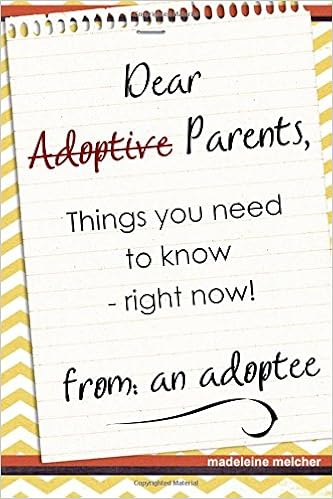
Dear Adoptive Parents

Dear Adoptive Parents, Things you need to know right now from an adoptee by Madeleine Melcher

This quick book, while not particularly deep or profound, was a breath of fresh air. Too often in the adoption world, everything is negative and I can come away feeling like I've made a huge mistake adopting four of my children--that I've messed them up for life by their very status as adoptees.

This adult adoptee (and adoptive mother), however, shares her story along with encouragement for families formed by adoption. She says the most important voice to listen to is the voice of your child, not the voices of negativity and fear, and that life should not be about adoption. There might be side effects of being adopted, of course, and parents should be watching for struggles, but not all children will suffer from feelings of rejection, abandonment, identity crisis, primal wounds, etc. as a result of being adopted and there is no point in "borrowing trouble" by talking about such things all the time.

This book validated many of my own perspectives so it was nice to read and I'll tuck it away on the shelf in case "the voices" get too loud at some point and I need a perspective adjustment.

Tuesday, November 24, 2015

He Is Faithful; He Will Do It

I love the idea of recording lessons the Lord is teaching me as "stones of remembrance" to remind me how faithful He has been in the past and thus how faithful He surely will be in the future.
He who calls you is faithful; he will surely do it.  I Thessalonians 5:24
Let us hold fast the confession of our hope without wavering, for he who promised is faithful.  Hebrews 10:23
I've experienced a series of events recently which led to my realization of how the Lord is working in my life these last couple years and I don't want to forget this lesson.

I had the opportunity to attend a Ladies' Day a couple weeks ago where the topic was about recognizing and using our gifts.  The day was quite practical in nature and the teachers asked us to examine our own gifts and also to help one another identify her gifts.  Most of my gifts, unsurprisingly, involved people. I came away challenged and inspired to exercise my gifts of encouraging people, mentoring younger women, teaching and studying the Bible with ladies, and creating or taking advantage of opportunities to rally a group of people to study, serve others, or work together.

Frankly, as the next couple days passed, I became more discouraged than inspired.  I felt like I wasn't using my gifts; I felt like in some ways wasn't even being allowed to use those gifts.

So I spent an afternoon studying and praying.  I read Romans 12 and the admonition in verse 6 that as we each have gifts given to us, "let us use them".  I personalized passages in my journal like the following:
Ephesians 2:10--I am created for good works which God prepared beforehand for me to walk in.
I Peter 4:10-11--As I have received a gift, I must use it to serve others.  My gifts are provided by God's supply and are for God's glory through Jesus.
As I continued studying and meditating, I realized the Lord has provided opportunities to use my gifts, even if I'm not using them in quite the same way or with the same people I've used them in the past. Some of the opportunities He has been providing for me include:

  • I was invited to study the life of Mary, the mother of Jesus, and share what I learned with a group of ladies at a Ladies' Day in Kansas City back in October.
  • It has been two years since two younger women asked me to teach them how to use freezer cooking in the managing of their homes.  In that time, more and more ladies have popped in and out of our freezer cooking days until I've had the privilege of developing friendships with at least seven younger women.  Our time together includes many life discussions such as budgeting, child rearing, marriage, faith walk, etc. and we have all been richly blessed by our time together.
  • I've had opportunities to gather several women from my homeschooling community in Bible studies and book discussions as well as joint efforts in educating our children.
  • As my husband served as president of the board for the local crisis pregnancy center, he enlisted my aid in organizing their first banquet fundraiser, rounding up people to host tables and invite others, taking care of advertising and promotion, and behind-the-scenes organization.

I wasn't out looking for any of these opportunities, and didn't really even think of them as "using my gifts".  But the Lord provided the right set of circumstances for my gifts to be used even when I was feeling stifled.  I realized the Lord is not limited by human weaknesses, but will use us in His way and in His timing.

Thursday, November 19, 2015

Station Eleven

Station ElevenStation Eleven by Emily St. John Mandel

I thought this book had a good idea, but it just never fulfilled its promise for me. The characterization was one-dimensional, no one really grew through the story, and some of the characters felt interchangeable for me rather than having their own unique identity.

I did enjoy pondering what it would be like if civilization as we know it would collapse, if 99% of the population died from a strange and sudden flu. Indeed, we would look back at "that ludicrously easy world where food was on shelves in supermarkets and travel was as easy as taking a seat in a gasoline-powered machine and water came out of taps" (48). I must admit, I have a rather hard time imagining that 20 years later, our society would be as far set back as the book depicts. There are so many smart and resourceful people (like my husband), I would think we would be farther along than survival mode.

It was interesting to consider a recurring theme of people not living their lives while they had the chance, just "spending their lives waiting for their lives to begin" (86) or "these people who've ended up in one life instead of another and they are just so disappointed. . .They've done what's expected of them. They want to do something different but it's impossible now, there's a mortgage, kids, whatever, they're trapped" (163).

I could also relate to Miranda's reflections on her younger self: "Those previous versions of herself were so distant now that remembering them was almost like remembering other people, acquaintances, young women whom she'd known a long time ago, and she felt such compassion for them" (206). I feel that way sometimes, as if I'm a completely different 'Shonya" than I was 25 years ago, like it's not even the same person.

I also liked the inclusion of a traveling symphony/acting troupe as "survival is insufficient" and people need the fine arts, even when their focus is on finding food, shelter, and a safe place from bandits.

Wednesday, November 18, 2015

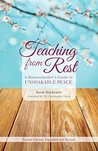
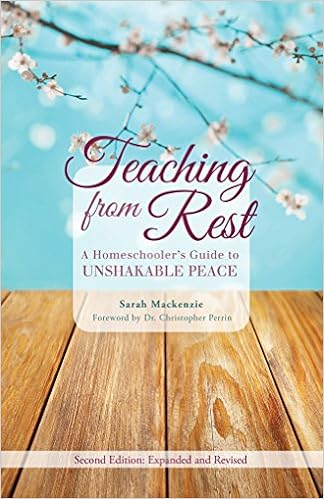
Teaching From Rest


Teaching from RestTeaching from Rest by Sarah Mackenzie

I loved this book. I think the author should maybe send me a commission as I have recommended it to so many people--I know 11 have purchased it so far for sure. :) It has been SUCH an encouragement to me in my homeschooling this season, and I'm expecting this title to appear on my list of "favorite books read in 2015". I have 8-9 friends coming over next Monday evening to discuss this with me. I'm hoping it is a blessing to them as well--you know how different books hit people differently, and we are all in different seasons and such, but it was such a blessing to me that I am actually getting ready to read through it again and will be journaling my way through it.

So, why has it been such a blessing?

1) The author keeps it real. This homeschooling journey is difficult, we are not enough in our own strength, and she validates and commiserates with the challenges without whining about them.
2) She points time and time again to the Lord as the source of our strength, as the one who is the author and finisher of our faith--and us--and our children. She offers many words of wisdom, both philosophically and practically.
3) It's only 80 pages! There's no fluff, she just says what needs to be said.
4) She offers practical suggestions that are changing my school year. We are about 8 weeks into our year, and frankly, I had just been surviving each day, desperately trying to juggle all my plates without any falling and crashing to the floor. I have been collapsing into bed each night, absolutely exhausted--and worse, weary--and feeling like I didn't do it well. These last couple of weeks, however, I have been implementing some of her suggestions and I have been ENJOYING my children.

REVIEW PART TWO:

It's not often that I read a book twice in one month AND host two discussion evenings to discuss said book. Here are just a few quotes demonstrating why it's been such a blessing to me in this season:

--This work of homeschooling and raising hearts and souls and bodies is hard. It is more than I can do in my own strength. . .But he is not asking me to feed the 5,000; He just wants me to bring my basket of loaves and fish and lay them at his feet.

--The true aim of education is to order a child's affections--to teach him to love what he ought and hate what he ought.

--Our work in raising up and teaching our children is never really done. But we must remember that *we* were never intended to finish it.

--I cannot serve two masters, and neither can you. Whose 'well-done' are you working for?

--Will He find that we used (daily life tasks) to draw closer to Him? Were the tedious details of a homeschooling day offered up as a way for us to love Him, or were they merely gotten through, checked off, and accomplished?

--Our children are not projects.

--It is our part to offer what we can, His to finish what we cannot.

Fresh ideas like morning time, implementation of looping subjects (which I've done before, but not quite like this), and "permission" to keep educating myself are just a few more ways reading this book has brought refreshment and, yes, rest, to my days.

"We (moms) are demonstrating with our very lives that the world is worth learning about, our minds are worth cultivating, and people are worth loving. We model delight in learning something new, and we demonstrate what it looks like to find like-minded peers to encourage and be encouraged by" (76).

Monday, November 16, 2015

Flying Along

I love seeing my children get to do something they genuinely love to do.  Easton has harbored a love for airplanes for a few years now.  He has talked about being a pilot, or maybe an airplane mechanic.  He's young, just 9 years old, so it's hard to tell what he'll choose an an occupation down the road.

But a friend of ours took Easton up in his plane recently and Easton has "got the bug!"


Yes, Jason even let Easton take the controls for a couple minutes!  Talk about making a little boy's dream come true!


They even had fun finding our place from the air.  That little homestead there closest to the airplane wing is our home.  You've gotta love seeing Iowa cropground from the air.

Easton is part of a team that is preparing to compete in a Lego Robotics competition in just a couple weeks.  I would guess that league and this special trip into the sky are the highlights of his school year so far.

Monday, November 9, 2015

Thanks?

Have you ever had someone pay you a "compliment", give you "encouragement", that felt more like a criticism, certainly of your past self? Some people need to learn how to apologize.  Others need to learn how to encourage.

Let's say, for example, that someone says:

"Wow, you're looking good.  You've lost a lot of weight and I can see that you've been working at that.  Because you used to be so fat!"

That exact situation didn't happen to me, but it was comparable.

Ummmmm. . . .
Thanks?


Saturday, November 7, 2015

Isolation

There are seasons that are just isolating, don't you think?

I find the baby season to be rather isolating.  I can get in survival mode, so tired from getting up in the night multiple times, drowning in feedings and diaper changes, watching everyone else seem to have their act together while I'm trying to get to know this new baby and make the needed adjustments to the dynamics of a growing family.  It can feel like no one else is there with me, like no one else quite understands what's going on in the day-to-day.

A season of sickness can also be isolating.  When there are eight people taking turns with a virus, I don't get to go anywhere and there certainly isn't anyone coming around.  If I'm sick, I don't feel like going anywhere or being with anyone, yet the enforced seclusion feels isolating at the same time.

Right now I'm in another season that feels rather isolating.  This season of launching arrows has found me retreating.  I have this haunting fear of failure.  What if they don't choose well?  What if they make mistakes that have far-reaching consequences?

What's that, you say?  This is not about me, but about them?  Oooh, yes, that ugly pride of mine rears its ugly head yet again.

Sometimes I look at a child and worry that there might be more character flaws than character strengths (critical eye--another ugly trait I struggle with).  I dwell in the "coulda, shoulda, wouldas".  It's isolating because I want to protect the reputation of my children so I don't feel like I can share with others, so I cry and pray and try not to worry.  Some mamas have walked this path before me, falling back and praying while their child makes his or her own way, sometimes stumbling, sometimes striding confidently forward.

I listen to plans and dreams and think "What?!  That was NOT in my plan at all!"

I guess it's not about MY plan either, now is it?  It's not my plan, and it's not just my story.

My story is that God is teaching me, yet again, to trust Him, to walk with Him.
Growing pains.

I find that when there are seasons that remove me a little bit from people, those same seasons move me closer to God.

Saturday, October 31, 2015

Cutting For Stone

Cutting for StoneCutting for Stone by Abraham Verghese

I thought this book was really interesting. I really enjoyed all the medical detail and the history of Ethiopia. I also really liked the characterization and the growth the characters experienced through their trials. I continue to be horrified by female circumcision/genital mutilation, and was absolutely sick to learn about vesiculovaginal fistula which is caused by young girls being given as brides, she then becomes pregnant and are physically unable to deliver the child who dies and rots in the womb, leaving her with a hole between the bladder and vagina so that the urine constantly leaked causing infection and horrible odor. (424) I think we in American really can't fathom what a life of such poverty looks like.

There were lots of interesting themes in the story. My favorite one was about choosing what kind of life you are going to live:

"Why must I do what is hardest?"
"Because, Marion, you are an instrument of God. Don't leave the instrument sitting in its case, my son. Play! Leave no part of your instrument unexplored. Why settle for 'The Three Blind Mice' when you can play the 'Gloria'?". .
"But I can't dream of playing Bach, the 'Gloria'."
"No, not Bach's 'Gloria.' Yours! Your 'Gloria' lives within you. The greatest sin is not finding it, ignoring what God made possible in you" (7).

"I hope one day you see this as clearly as I did in Kerchele. Everything you see and do and touch, every seed you sow, or don't sow, becomes part of your destiny. . .The key to your happiness is to own your slippers (from an Ethiopian folk tale about Abu Kassem who held onto his tattered old slippers past any reasonable use, but then every effort to get rid of them ended in disaster), own who you are, own how you look, own your family, own the talents you have, and own the ones you don't. If you keep saying your slippers aren't yours, then you'll die searching, you'll die bitter, always feeling you were promised more. Not only our actions, but also our omissions, become our destiny" (351).

There were themes about the relationship between father and son, brothers, and young love. There was the theme of forgiveness and themes of loss, particularly of parents.

There was the theme of where your home is, who "your people" are:
"Her skills were so rare, so needed for the poorest of the poor, and even at times in the royal palace, that she felt valued. Wasn't that the definition of home? Now where you are from, but where you are wanted?" (95)

The contrast between life in Ethiopia and life in America was. . .sickening? We really are such a wasteful and spoiled country. We expect to have what we want. We take for granted the luxuries of our lives. I was especially intrigued at the assertion that Ethiopians go to the doctor expecting to die, but happy when they don't die. In America, on the other hand, "death or the possibility of it always seemed to come as a surprise, as if we took it for granted that we were immortal, and that death was just an option" (486).

The more I think about it, the more I liked it. My primary complaint is that it seemed longer than it needed to be. He gave lots of background information about the characters in the beginning while I wondered where this story was going. I was at least 100 pages into the book before I was very interested. There is more description than there really needs to be, in my opinion. But overall, it was really interesting, I learned a lot, and it made me think.

Friday, October 30, 2015

The Boston Girl

The Boston GirlThe Boston Girl by Anita Diamant

This was a great story to make a four-hour car ride fly right by.  I love the way the author chose to tell Addie's story, as if she were answering her granddaughter's question "How did I get to be the woman I am today?"

I was captured by her initial answer "It started in that library, in the reading club.  That's where I started to be my own person" (11).

I loved the way we saw the passing of history, the big changes in society through Addie's eyes and experiences, even as there was a definite "feminist" flavor through her narrative.  I loved the role education played in Addie's growth, and (as a journalism major myself) I was tickled by the editing of her first newspaper article:  "Mort moved my ending to the beginning, took out all the adjectives, cut the whole thing in half, and made it one hundred percent better" (191).

I could relate to her descriptions of close friendships as there are certain people with whom I too "feel I understand myself better after we spend time together" (111) or I can share thoughts and experiences with and "telling (her) about those things made them seem lighter and less terrible" (287).  I am so thankful for the "Filomenas" in my life.

Addie certainly had her share of difficult times in her life.  I love reading a good book which examines people--who they are, why they do what they do--and this was one of these books.  Her relationship with her mother was especially sad as she never felt loved or accepted by her mom.  "Mameh had changed the least.  She cleaned and cooked and complained.  She wouldn't touch Betty's washing machine; she said it ruined the clothes and didn't get them as clean as she got them with her washboard, and then she groaned about how doing the laundry was killing her back" (234).  Oh, may I not be this person, always critical and complaining!  And she left behind an irreparable scar on her daughter's spirit, even after the mother had died:  "When they lowered the coffin into the ground, I remember thinking, She won't be able to make me feel like there's something wrong with me anymore.  But when the first clump of dirt hit the coffin, I realized that I would never stop wanting my mother to tell me that I was all right and that's when I started to cry" (276).  See how valuable it is to read books, even just a fiction novel?  Here is a perfect example of what NOT to be as a mother.

Monday, October 19, 2015

Ancient Egypt, Our Solar System, and Kindergarten Crafts

I haven't been blogging about school much lately--maybe because we've been schooling instead!  We are having a busy year with it being Tyrell's first year, Easton and Kiana in third and second grades respectively, and Destry trying to finish strong with his senior year (with little Miss Aryana, 18 months, keeping her finger in every pie).  We have once again formed a small coop with some friends to share some learning experiences together.

Because we are studying Ancient Egypt for history this year, we are having fun getting together for some hands-on activities to reinforce what we're learning.  We made salt dough maps of Egypt, a fun model of Egypt (with an overflowing Nile River and growing grass!), Egyptian sailboats and papyrus boats, and Egyptian toys like dolls and throwing sticks. 


We are using Jeanie Fulbright's science book to study astronomy and the kids have lots of fun doing the experiments and projects with their friends.  So far they have enjoyed making a model of the solar system, learning about the sun, and making models of Mercury.

Tyrell loves being "big enough" to get in on some coop classes.  They are having all kinds of fun learning about different letters and themes, reading books and making crafts centered around that theme.


This is a very busy season, but a good season.  I'm trying to enjoy each day with these young ones, knowing that the years fly by so quickly.

Sunday, October 18, 2015

Inside the O'Briens

Inside the O'BriensInside the O'Briens by Lisa Genova

This book was incredible--very well-written, wonderful characterization, and informative, all at the same time.

I bawled until I nearly sobbed.

Huntington's disease, an inherited neurodegenerative disease, sounds absolutely horrid. Terrifying.

I really liked Still Alice by Lisa Genova, and Left Neglected was also quite good. But Inside the O'Briens was an out-of-the-ballpark home-run.

My poor husband reminded me more than once, as I presented my tear-stained cheeks to him when he interrupted my reading, that the O'Briens "aren't even real people", but Genova made Joe, Rosie, JJ, Meghan, Katie and Patrick real to me. Genova is a Harvard-educated neuroscientist, so I enjoy reading her very informative books, but I appreciate even more the way she paints the picture of who the people are behind the disease and the many ways it affects them and their families.

Inside the O'Briens shows us how a man receives the news that he will lose control of his body, experience uncontrollable movements of his body and face and extreme mood swings, progressively lose the ability to speak clearly, swallow, formulate words at all, or walk, all while retaining comprehension, memory, and awareness. He would be literally trapped inside his body, unable to provide for his wife, express his love, or even control himself from hurting those he loves. At the same time, she helps us experience the emotions of his loving wife as she comes to terms with her future of watching the deterioration of the man she loves. We see the various responses of the children first to the news of his disease, and then to the shock that they have a 50% chance of inheriting the same disease. Meanwhile, she paints the picture of a family with all the normal family dynamics--tensions between mother and daughter, or between sisters, or a wild-running sibling, or the developing relationships of young adults. And she does it all with beautifully phrased words, such as the following examples of her figurative language:

"The air in the house is a thick swamp, today's heat and humidity already elbowing in on what was trapped inside yesterday" (3).

"The wind feel like an angry woman who won't shut up--relentless, caustic, making an already uncomfortable situation kiss the feet of unbearable" (232).

She also slips astute observations throughout the book, my favorite of which is this rumination about the television:

"The room does feel strange, oppressive even, with the TV off. In fact, Katie can't remember ever being in this room without it on. It's as if they're missing their fifth sibling, the one who never shuts up and demands all the attention" (119).

I loved this reassurance from Katie's boyfriend. I love the way he acknowledges what she's experiencing and offers to hold her hand and go through it with her.

"I know what you're going through is terrifying and unfair and really hard. But you have to go through it. Right now, you're just standing still. You're sinking in it. Let me hold your hand and go through it with you" (255).

And these two quotes really stood out to me as I considered what it would be like to have Huntington's disease in the family.
"We don't know anyone else with HD. You're the only example we have. We're going to learn how to live and die with HD from you, Dad" (273).
"To the uneducated or unloving eye, Joe is horrifying, unacceptable, and then invisible" (212).

I didn't agree with every choice the characters made, of course, so I would recommend this book to a more mature reader. Some of the characters make immoral choices, although there is no explicit detail, and there is a lot of discussion of yoga and its worldview, as well as some serious discussion of suicide. But this is still a wonderfully-written book, very interesting and informative, and I must heartily recommend it.


Wednesday, October 14, 2015

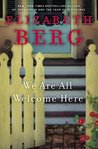
We Are All Welcome Here

We Are All Welcome HereWe Are All Welcome Here by Elizabeth Berg

Oh, we have to love us some Elizabeth Berg!  Her characterization never disappoints. One of the reasons I read, as I've said many times before, is because people are fascinating.

Berg takes the idea of a woman being paralyzed by polio, abandoned by her husband, and raising her daughter alone and makes it a study of the human will to not just survive, but overcome and thrive.  I was captivated by Paige's attitude after surviving polio:

"Anyway, what I believe is that what happened to me, revealed me. . .it made me know how I really feel about important things.  I mean, whatever the diagnosis is, isn't the issue.  The issue is the way the person who has it looks at it. Understand? I know that polio made me be my best self.  It's funny, it seems like people need obstacles to bring out their finest qualities" (143).

Diana, the daughter who grows up taking care of her mother as her mother teaches her about life, learns many lessons in this "coming of age" story.  Interestingly, the story is set during the Civil Rights movement and Diana comes to realize that her Black caregiver and other Black people are also limited by their circumstances.

"We're all trapped,' my mother said.  'We're all trapped in a body with limitations, even the most able-bodied among us! And we're all guided by minds with limitations of their own.  You want to know my philosophy?  It's this:  Our job, regardless of our bodily circumstances, is to rise above what holds us down, and to help others do the same" (158).

I liked this story because it made me wonder how I would respond to a similar situation (could I be so positive?!) and it made me appreciate the way I am able to move about freely, doing whatever I want without being dependent on others.  It made me better appreciate the ways I can interact with my children.  As a disclaimer, it did have a little more immorality than Berg usually does, but it's not explicit.

Sunday, October 4, 2015

The Unlikely Pilgrimage of Harold Fry

The Unlikely Pilgrimage of Harold FryThe Unlikely Pilgrimage of Harold Fry by Rachel Joyce
My rating: 4 of 5 stars

I enjoyed this story as Harold and Maureen grow individually and as a couple.  It made me sad in the beginning to see their lives so empty, to see the apathy that had taken over their marriage.  I think that would be a scary and hopeless place to be.  It was interesting to see their reflections on how they had lived their lives, both in their individual choices and their marital choices.  I think we can learn so much about ourselves by examining others, whether in real life or in fiction.

As I've talked with good friends before, we don't want to live a life that we look back upon with regret--especially regret for opportunities not taken.

--"Harold thought of all the things in life he'd let go.  The small smiles.  The offers of a drink.  The people he had passed over and over again, at work or on the street, without lifting his head" (17).
--"The regrets about all she had let go flooded her.  Where had all that enterprise gone?  All that energy?  Why had she never traveled?  Or had more sex when she could?  She had bleached and annihilated every waking moment of the last twenty years.  Anything, rather than feel.  Anything, rather than meet Harold's eye and say the unspeakable.  It was not a life, if lived without love" (147).

Their marriage was so saddening.  If I remember right, they had been married 47 years, but they hadn't been intentional with their marriage and it had withered up and died through the stresses of life and tragedy.  I was especially convicted by the first quote below.  Can Alan always expect my help or encouragement when he shares something with me?  Sometimes I can be too much of a "realist"--a dream killer.

--"Maureen would only give voice to the truth he was doing his best to avoid.  The days when he might expect her help or her encouragement, or whatever it was he still wanted, were long since gone" (29).
--"The reason she had stayed with Harold all these years was not David.  It wasn't even because she felt sorry for her husband.  She had stayed because, however lonely she was with Harold, the world without him would be even more desolate" (115).
--"He wanted to stay, talking to Maureen, but the silence and the distance, which they had nursed for twenty years, had grown to such a point that even cliches were empty, and they hurt" (121).
--"In that one glance they had made a pact that would oblige them for the rest of their lives to say only what they did not mean, and to wrench apart what they most loved" (304).

I was intrigued by Harold's observations as he learned more about people.  He had always felt like he was different from everyone else, but his pilgrimage taught him how very alike we all are.  This is one of the reasons I read, and one of the reasons I liked this book--learning about people.  People are so INTERESTING!
--"People were buying milk, or filling their cars with petrol, or even posting letters.  And what no one else knew was the appalling weight of the thing they were carrying inside.  The inhuman effort it took sometimes to be normal, and a part of things that appeared both easy and everyday.  The loneliness of that" (89).

I think the following quotes is the key theme of this novel.  Neither Harold nor Maureen had any hope.  As a Christian myself, I of course noticed their lack of faith in the Lord and the hope that brings.  How different their lives could have been!
--"He felt such hope, he was giddy with it.  If he kept looking at the things that were bigger than himself, he knew he would make it" (108).

Finally, I was intrigued by the following quote.  How often do we think we are doing something different, making a change, but we are still just the same, not growing, doing the same things, but calling it something different.  Hmmmm. . .
--"Beginnings could happen more than once, or in different ways.  You could think you were starting something afresh, when actually what you were doing was carrying on as before" (156).

Saturday, October 3, 2015

Go Set a Watchman


Go Set a WatchmanGo Set a Watchman by Harper Lee

In a nutshell, I expected it to be horrible--it was ok. As Lee showed us in TKAM (and tells us in Watchman),

"Integrity, humor, and patience were the three words for Atticus Finch. . .His private character was his public character. His code was simple New Testament ethic, its rewards were the respect and devotion of all who knew him. Even his enemies loved him, because Atticus never acknowledged that they were his enemies" (114).

But this is not the same Atticus you knew and loved. Is he now revealed to be who Lee intended him to be all along, Scout had just described him from her youthful, worshipful eyes in TKAM? Or should we consider him with respect to his time period and think he did the best anyone could then. One wonders.

"I mean I grew up right here in your house, and I never knew what was in your mind. I only heard what you said" (247).

Not a great book, but it's worth reading if you love TKAM as I do.

Wednesday, September 30, 2015

Laminating is Fun

Office supply nerds unite!

Some people get excited about things like comb binders, laminators, three-ring binders, and page protectors.

I'll admit it, I'm one of those people.

So, when my freezer cooking gals and I decided to compile some of our favorite recipes we've tried and make a series of menu plans complete with shopping lists, I got excited when Jenna brought the first installment in a three-ring binder.  Then we had the bright idea to LAMINATE them so they wouldn't get food on them and we could use them again!


We acted silly and laughed and laminated all the pages before we could even think about starting cooking.

Because we're just cool like that.

Tuesday, September 29, 2015

What's On Your Nightstand--October

I haven't played along with the nightstand posts lately, nor has my reading been terribly organized.  (Do you suppose there is some correlation?)

In September I read a couple of current fiction novels, Dark Places by Gillian Flynn and The Storied Life of A.J. Fikry by Gabrielle Zevin, and I re-read a homeschool book, Ignite the Fire by Teri Camp.  I also re-read Francine Rivers' novella, Unafraid, and read a short book by Russell Moore about adoption, and I finally got to Harper Lee's recently published book, Go Set a Watchman (which I have not yet reviewed).

What's On Your Nightstand

As I look ahead to October, we have quite a bit of traveling scheduled, so I'm hoping to read some more current fiction a friend has recommended that I've borrowed on my Kindle, The Unlikely Pilgrimage of Harold Fry by Rachel Joyce and The Boston Girl by Anita Diamant.


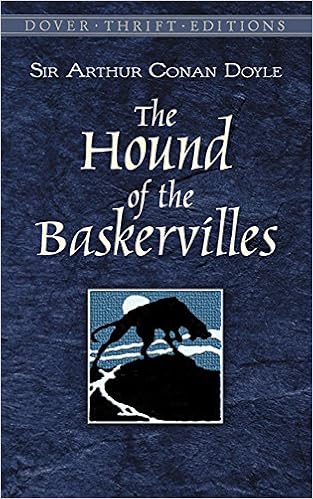
Carrie's Book Club has chosen The Hound of the Baskervilles by Sir Arthur Conan Doyle for October, and it's been several months since I've read along, so I hope to get to this one.


Two friends have recommended Teaching from Rest: A Homeschooler's Guide to Unshakable Peace by Sarah Mackenzie, so I recently ordered a copy.  I have read the first two chapters and enjoyed them very much.  I got the pdf journal with my order, so I'm thinking I'll read it quickly, then go back through and read it more carefully while journaling through it.  I may even have to gather a few friends to read and discuss it with me!


I've also been slowly re-reading Raising Godly Tomatoes by L. Elizabeth Krueger.  I have read this excellent parenting book several times, and it's the one I recommend whenever anyone asks me for parenting advice or a parenting book to read.  Little Miss Aryana has necessitated my brushing up on training a strong-willed toddler.  (rueful grin)  I've been slowly reading this for several weeks and want to finish it up in October.
There are other books I'm interested in reading soon if I get time, such as I'm Chocolate, You're Vanilla and Cleaning House, but they might have to wait until the next month.  I'll be really happy if I can check the above five books off my list the end of October.