Saturday, June 30, 2012

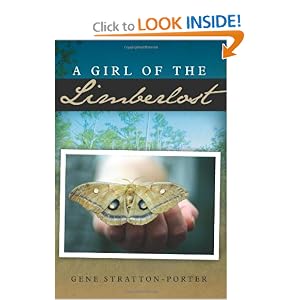
A Girl of the Limberlost

Reading to Know - Book Club
I had never read Gene Stratton-Porter's book, A Girl of the Limberlost, so I was rather looking forward to the June selection for Carrie's bookclub.  I have mixed feelings about it now that I've finished it.  I'm glad I read it, even though I didn't always enjoy it while reading.

My favorite aspect of A Girl of the Limberlost was the heavy emphasis on nature and self-education, both of which appeal to the homeschool mom in me.  I appreciate the example of a young lady who is determined to learn and sets out to do so without being propelled by any teacher, parent, or artificial motivation.  Even more, I love that her most valuable knowledge--that which provided her with the income to attain her dreams and caught the interest of her "worthy suitor"--was obtained outside of the restrictions of school and classroom learning by pursuing and immersing herself in her interests--self-directed learning at its best.  That simply delighted me and this example alone provides the book's merit.

In our current age when children are shoved through education factory-style (irrespective of unique talents) I enjoyed Elnora's individuality.
What you have to give is taught in no college, and I am not sure but you would spoil yourself if you tried to run your mind through a set groove with hundreds of others.  I never thought I should say such a thing to anyone, but I do say to you, and I honestly believe it; give up the college idea.  Your mind does not need that sort of development. (153)
I can imagine reading this book aloud with my children as part of a unit study on Lepidoptera, looking up pictures of the insects she names, and trying to identify those she describes but doesn't name.  I can imagine this reading inspiring my children to begin their own insect collections complete with pinned specimens and identification tags from perusing field guides.  Reading this book resonated with my reading of Charlotte Mason's philosophies as it emulates a love for nature and nature study--all in a living book!

On the other hand, I had a hard time connecting with the style of writing.  I realize part of that likely stems from the time it was written (early 1900s), but it was also a little. . .flowery and romantic for my taste.  (By romantic I don't necessarily mean romance as in love, although that was present in the end of the book, but rather I mean impractical and "over the top").  I think the style was the main reason it took me several days to get past the first few chapters, but once I got used to the style, I actually finished the book in just a couple days.

I was also conflicted at the mother/daughter relationship and the competing daughter/neighbor relationship.  I'm certainly well aware that mothers aren't perfect, and they are frequently self-centered to the point of hurting their children emotionally.  But just because I'm aware of it, doesn't mean I like it, nor especially to read such foolishness.  With Elnora, I agree tragedies "in quite as tragic a manner, have happened to thousands of other women, and they have gone on with calm faces and found happiness in life by loving others" (107).  I simply don't understand a woman shutting herself off from her child and wallowing in her own unhappiness and grief.  Then as the story turned and the mother's "love" (idolatry!) for her dead husband was killed by the knowledge of his unfaithfulness, she realized "the width of the gulf that separated her from her child" (112) and poured herself into "earning" her daughter's love and trust by cooking tasty morsels, updating her appearance (did that make any sense to anyone?), and learning about moths and butterflies.  Too little too late?  Not for Elnora, for she had "grown bigger on knocks than she would on love" (39).

This leads me to another theme it would be fun to discuss in a book club meeting of this book:  child rearing.  I think it would be quite fun to contrast Elnora's upbringing and her mother's philosophy that it's best for children to face trials alone and develop character through working to overcome those trials with the philosophy held by Wesley and Margaret.  Then we could discuss Philip and Edith and contrast Elnora's character with Edith's:
I cannot understand these people I hear about who live only for their own amusement.  Perhaps it is very great; I'll never have a chance to know.  To me, it seems the only pleasure in this world worth having is the joy we derive from living for those we love, and those we can help" (140).
And we could discuss marriage, its purpose, and the roles played by the man and the woman and compare them with the perceptions held by Philip, Edith and Elnora.
If you could have your choice you wouldn't have a society wife, either.  In your heart you'd like the smaller home of comfort, the furtherance of your ambitions, the palatable meals regularly served, and little children around you" (229).
The more I think about it, the more I enjoyed it and find it worthy of a book club discussion.  Sometimes I felt a little mocking of it for the drama and moralizing, but overall it was well worth reading.  I think my 16-year-old daughter would enjoy it.  Thanks to Stephanie for bringing this title to my attention!

Wednesday, June 27, 2012

Life at the Bottom

"A classic for our times.  It is as fundamental for understanding the world we live in as the three R's."
 The above endorsement by Thomas Sowell beautifully summarizes Theodore Dalrymple's collection of essays titled Life at the Bottom:  The Worldview that Makes the Underclass. This is one of those books that makes me long for a local friend like one I had in Missouri to spend several hours discussing the points Dalrymple illustrates.  If you like to read, like to think, are aware of worldview problems in our culture or are not aware of those problems, this is a book you need to read.  (Did I cover everyone there?  Because I tried to!)

It's not an easy read--Dalrymple is much, much smarter than I am--but it's not as difficult as it could be.  I found his writing very enjoyable as he chooses just the right words, he draws pictures for the reader instead of just stating a fact, and his delightful wit is sprinkled throughout.  As the back of the book states, "he writes in prose that transcends journalism and achieves the quality of literature."

Dalrymple is a British psychiatrist whose patients live in the slums and a prison in England.  His years of treating and observing the poor of England have opened his eyes to their worldview and thus the source of this socioeconomic group which continues to grow both in his country and mine.  He shares his observations, liberally laced with telling anecdotes, of the results of the ideas of the secular left as they trickle down the socioeconomic ladder.

Free love without responsibility or commitment, refusal to judge anyone's behaviors, the "exchange of liberty for a modest (if illusory) security," the exchange of personal responsibility for a victim mentality, an elevation of self-esteem at the cost of correction in education, the exchange of true value and quality for relativism. . .these are just a few of the principles touted by intellectual elites that Dalrymple attacks with the rotten fruits of the very ideas which bore them.

Savor-worthy soundbites stopped me several times:
So accustomed to the idea that the state would (and should) step in, they felt no personal duty to do something. . .Just as no one is guilty when everyone is, no one is responsible when everyone is (125).

If freedom entails responsibility, many of them want none of it (5).

The sexual revolution has turned the poor from a class into a caste, from which escape is barred so long as that revolution continues (47).

Life is, in effect, a limbo in which they have nothing to hope for and nothing to fear, nothing to gain and nothing to lose.  It is a life emptied of meaning. . .Nothing has the same devastating effect on the human personality as the undiscriminating welfare state. . .(resulting in) loss of dignity, self-centeredness, spiritual and emotional vacuity, the sheer ignorance of how to live. . .poverty of soul (142).

Experience has taught me that it is wrong and cruel to suspend judgment, that nonjudgmentalism is at best indifference to the suffering of others (194).

Never has so much indifference masqueraded as so much compassion; never has there been such willful blindness (245).
I have this book on my list of books to read with my teens in the upcoming school year and I look forward to our discussions as I hope they will resist the dominant culture's worldview and its dismal consequences.

Tuesday, June 26, 2012

Versatile Box Braids

 Briana and I braided Kiana's hair into box braids early last week.  I hadn't realized how much her hair has grown!  She's loving it in braids as they "make her hair long like Rapunzel's".  It would be healthier for her hair to have not put the beads in the ends, but she wanted beads and the beads keep the braids stretched out to her hair's full length, which she also wanted, so I let her have beads this time.
To complete this style, I part her hair from ear to ear to separate front from back. Then I part her hair from nose to nape of neck (to make four quarters). I do it this way so once her hair is in braids I can style the braids into pigtails, or put one pony in the front section, or pigtails with only the front section and leave the back hanging in braids, or whatever we feel like each day.


 Then I start with one of the back quarters. I start at the bottom of the section--at her neck. Make rows all the way up and section them off with clips--I usually make mine about 3/4 in tall.  The size of your boxes will depend on the thickness of your child's hair and how long you want the style to last (the smaller the boxes/braids, the longer the style will look nice).  Then start with the bottom row and make a box that's roughly square in shape. You don't have to be perfect with it, esp on the bottom rows as they will be covered up by layers of braids.
Please disregard the bow in her hair (Kiana picked it!), but here is how her hair looks with the front half put into one side ponytail.  I think it's really pretty, especially with the beads cascading down the side of her face.  (Her posing here, by the way, makes me chuckle).
 And here she is today with the back braids hanging down long and pretty and the front half pulled up into two quick pigtails.
This is a great summer style that keeps her cool, provides lots of versatility, and will last at least four weeks and possibly even six or seven.

Wednesday, June 20, 2012

About That Spring Reading Challenge. . .

It's time for my update from the Spring Reading Challenge.  Before I share my list, you might remember my disclaimer:
DISCLAIMER:  I reserve the right to add to and remove books from this list.  This list in no way prohibits my reading of a new book that crosses my path or is recommended by a friend, nor does it bind me to read a book I don't like, don't agree with, or don't have time for. : )
I guess I know myself pretty well because I had 17 books on my original list and completed 11 of them (two are yet in progress) but I got distracted by eight additional books which were not on my list. :)  I have links to reviews I've written.  It would be very difficult for me to pick a favorite book I read this Spring as I read some really great books from several different genres. Thanks to Katrina for this fun opportunity to organize and review my reading!
Books That Weren't On My Original List 


  • Little Bee by Chris Cleave--Interesting, well-written, powerful yet disturbing.
  • Exposed by Ashley Weiss (review to come someday, maybe. . .)--A novel which follows two women whose lives are affected by the s*x industry, one through her husband's addiction and the other through exploitation.  Written by a woman whose husband has overcome his addiction through the power of the Lord.
  • Growing Up Amish by Ira Wagler Interesting and thought-provoking by a man who, as the title says, grew up in the Amish communities.
  • The Truth About Us by Dalene Flannigan--shrug, free Kindle book
  • A Mom Just Like You by Vickie Farris and Jayme Metzga--A real blessing to me this Spring, encouragement from a homeschooling mother
  • Disciplines of a Godly Young Man by Hughes and Hughes--A wonderful book my son and I are now reading and discussing together.
  • Infinitely More by Alex Krutov--A very poignant account of a young man who grew up in a Russian orphanage and how his experiences led him to help orphans as an adult.
  • Children in Church:  Nurturing Hearts of Worship by Curt and Sandra Lovelace--a great book on a much-needed topic
Books I Had Started
  • Life at the Bottom:  The Worldview That Makes the Underclass by Theodore Dalrymple. This is a must read and I hope to get my review up later this week.  Add this collection of essays by a British doctor to your book list now!
Carrie's Book Club
  • The April "assignment" is anything by PG Wodehouse. Uncle Dynamite-
  • The May assignment is Tom Sawyer by Mark Twain. Such a fun re-read
  • The June assignment is A Girl of the Limberlost by Gene Stratton Porter, which I've never read and know nothing about.  (I'm slowly working on this one still)
Homeschooling (with my big kids or to help me improve our homeschool)
  • Setting the Records Straight by Lee Binz   --great motivator, review still to come
  • The Deadliest Monster by J.F. Baldwin--I didn't get to this one yet.  The big kids read it and said I have to read it still because it was really good.
  • Know Why You Believe by Paul Little I decided not to read this one, Alan read it instead.  I got overwhelmed and he was willing to read it with the big kids.
  • Assumptions That Affect Our Lives by Christian Overman  my son says everyone should read this great book
Spiritual Growth
  • The Bible--My "180-Day Challenge" turned into a 240-day challenge because I found I was doing my daily reading just to check it off the list (oh, ugly pride!).  I slowed down the reading to actually ponder the verses and it has been a time of great richness.  Now I'm starting back through the New Testament again.
  • James--I am studying the book of James using Beth Moore's study guide This was a great study, one of my favorites, and I completed my handwritten copy of the book, although I gave up on memorizing it.
  • The Best of A.W. Tozer--Didn't get to this one--yet again!
Miscellaneous
  • The Measure of a Man by Sidney Poitier. Didn't get to this one either
  • Monday Morning Faith by Lori Copeland. --I'm about halfway through this one, a light read which so far the best message from it involves taking our Sunday faith into our Monday mornings
  • Covenant Child by Terri Blackstock. This was a relatively light read, enjoyable, and it nicely paralleled our own story of rebellious, ungrateful children of God, suspicious of His love and grace.
Guilty Indulgence
  • Celebrity in Death by JD Robb. Typical Eve and Roarke, fun escape from reality, returned it to the library in less than 48 hours (do you think they smiled at me?)

Monday, June 18, 2012

Infinitely More

Kids need a mom and a dad.  They need to grow up in a family where they will be loved, nurtured, and trained.  We know that--even just instinctively, we know that.  But the more I learn, the more I read, the more I experience. . .well, the more I see how much better God's ways are.  Reading Infinitely More by Alex Krutov reminded me of what I already knew, yet painted an even starker reality of the future for orphans than I previously understood.

Alex grew up in the Russian orphanage system and his story begins when he was abandoned as an infant as the Soviet Union collapsed.  He shares what life was like in the orphanage, his experience with adoption "disruption", and the bleak future orphans face as they age out of an orphanage.  It becomes a story of hope, however, as he interacts with christian missionaries and grows in his knowledge of and relationship with Christ and His followers.  His story culminates with his beautiful desire to serve other orphans and pass on the hope and purpose he received by the grace of God.
I was most struck by the emotional and spiritual desert orphans face as a result of their lack of family.  Alex effectively illustrated how throwing money at a situation and buying stuff does nothing to address the core, heart issues.
"missionary dollars were flowing into the orphanages, yet it did not change the outlook for the orphans' futures to have nicer bathrooms or hot water.  There was no real investment in their morality, their spirituality, their identity, value, dignity, or purpose.  We watched, over time, as orphans left the system, hopeless.  In fact, the Russian society honestly believed it would be better for everyone if they just died"
I think we all know about the horrible lives many orphans lead after they age out of the system,
"For all these reasons, along with the emotional issues of hopelessness, isolation, and depression, the vast majority of emancipated orphans begin to make poor choices, choosing the streets as their 'home' and selling drugs and their bodies, or stealing, to survive.  At least ten percent of them end up committing suicide."
But I hadn't thought about orphans having a sense of entitlement since they had never learned to work for what they had (little though it was) or had the opportunity to realize their needs were met because they were  loved (as I was, or as my children are).
"There is a phenomenon with orphans, at least for those who grew up in an orphanage, that goes contrary to expectations:  a sense of entitlement that comes from years of someone else providing for you.  Never mind that their core needs of love and affection were never met, or that their provisions were secondhand, ill-fitted clothing and shoes, or that their showers were cold.  Their perceived needs were always met by someone else--and not anyone close to them, either, but by an impersonal 'them'.  Similarly, there is a concept with orphans known as 'silent love':  their inability to express appreciation.  They were never taught how to show appreciation or express affection".
I am  inspired by Alex's story and growth in the Lord.  There were certainly times he was immature, selfish, greedy. . .all sorts of ugly character traits. . .but I appreciated that his story didn't gloss over his own imperfections and growth.  That wouldn't have been realistic or honest, nor would it be helpful to others walking behind him.
"Too many missionaries believe you just bring the gospel and lead people to the Lord and then they'll be fine.  Yet, that is just the starting point.  You need to deal with the emotional baggage of these orphans, working through attitude and emotional changes, forgiveness, and validating these kids as individuals."
Reading stories like this touch my heart and make me think there's room for one more child in my heart and home--surely there's room for one more child who needs a mom and dad, security, love, the gospel. . .

For information on Alex's ministry to disciple and mentor orphans in family-style communities, check out The Harbor.

Thursday, June 14, 2012

Children in Church

I could write about this book and its topic every day for the next week, but I'll try to spare you that.  Without going on about it too much, I have been noticing with increasing concern a tendency toward the devaluing of children in the prevailing culture.  For example, at Destry's violin recital and symphony performance, I felt people glaring at me that I should dare bring my younger children.  My mom noticed it too.  I tend to surround myself with people who love children and consider them a blessing, so I was unprepared for this attitude.

Sadly, I'm afraid this attitude is infiltrating the christian church at large.  Quite frankly, (and attempting not to be offensive at all) I was shocked some time ago to visit a church where children were strongly discouraged from being in the auditorium for the service.  If parents insisted on keeping their children with them, they were relegated to an assigned area.
 Stained glass window in a church building at a wedding we attended recently.
In my numb shock, all I could think was "What does Jesus think of this?  Didn't He say 'Let the children come to me; do not hinder them, for to such belongs the kingdom of God'?  I can think of multiple Old Testament passages that specifically list children as being included in the presence of the reading of God's Word.  Why wouldn't we want children with their parents as they approach the Lord in worship and study of the Word?

Two possibilities come to my mind: 
  1. The general tendency we have in our society to want entertainment.  If we see the gathering of the church body as a time to be entertained with great worship music and a dynamic message, we might not want to be distracted by the responsibilities of parenthood.  If, however, we see the gathering of the body as a time to worship, to remember the Lord's sacrifice, to build one another up, and glorify  God, we might be more likely to bring our children alongside us so they can witness our worship and learn to worship Him as well.
  2. Our sad neglect of child training.  If we haven't trained our children to obey or to know when it's appropriate to sit quietly, our children will be a disruption to the body at large and they will need to be shuffled off out of the way.

When I saw Children in Church:  Nurturing Hearts of Worship by Curt and Sandra Lovelace, I couldn't wait to read it.  I was most struck by their "sense of loss at the mass exodus of the next generation immediately before the opening of the Word of God" (118) and can't help but notice how it coincides with the mass exodus of young adults from the church.  This likely correlation makes me sit up and take notice.

The Lovelaces gently explore Scriptures showing the Lord's heart for children and helping the reader understand that children both benefit from gathering with the congregation and contribute to the service.  My personal experience resonates with their statements as my children frequently whisper "we know that story/verse" when they hear the teaching and many encouraging older members have reassured me that baby sounds give them joy and hope for the future. 

I think the Lovelaces do a good job of not only addressing the principles of children in church, but also the practicalities.  They share tips (from experience) for packing activity bags, illustrating sermons, and training children to worship alongside the adults.  They address the "Philippians 2 principle" simultaneously reminding parents to train their children at home so they won't hinder the worship of fellow believers and encouraging others to be encouraging and helpful to the struggling parent rather than condemning.  They give examples of bringing an activity to share with a parent and even examples of inviting children to sit with an older, more experienced parent to support a younger parent.  This sounds like true "one another" christianity.

My slight criticism of this already short and easy-to-read book is that it might have belabored its points a little more than it needed to, but I also realize I was already convinced before I started reading so another reader might not share this criticism.  I was most blessed by the reminder to teach/lead my children to worship, not just keep them quiet so they won't disturb worshipers around us.  I have been guilty of having the wrong focus this last year and I am so thankful for their speaking the truth in love which I needed to hear.  They also ended the book with a very nicely done summary of points addressed to "church leaders".

Children in Church:  Nurturing Hearts of Worship by Curt and Sandra Lovelace encouraged me to keep on keeping on and refuse to grow weary in well-doing.  I appreciated the abundance of Scriptures cited in support of children worshiping with their parents and am motivated to bring my children alongside me in adoration of our Savior.  The Lovelaces speak with a voice of experience and authenticity liberally sprinkled with both grace and conviction as they share encouragement and practical hints for those of us still in the trenches with our children beside us in the pews.

I received a copy of this book in return for my honest review. 

Wednesday, June 13, 2012

Our Fun and Learning Never Ends

 If you just finished my title with "here's what we learned today" in your big, purple dinosaur voice, you just might be a mother.
We've had several fun learning opportunities this summer, so prepare yourself for a bunch of pictures.  Above, Briana and Destry enjoy puzzle-solving in the blacksmith shop at Living History Farms.  Below, Kiana checks out the broom in the broom-maker shop.
We thought the "retro" ballgame, played with rules, announcer, and uniforms from the late 1800s was pretty fun.
And we finished our day by gorging ourselves at the Machine Shed.  I had just taken snacks for our day at the farm and we were all ready for some good food.  The Machine Shed never disappoints in that regard!
Another day found us at the Science Center, which my kiddos love.  I think they would be happy to visit there once a week.
Faces by Briana and Destry, chuckle
Easton's engineering
Building dams to make electricity is always a big hit

Easton loves building Lego cars for the racing ramp.  He could do this for  hours.
Tyrell was slightly overwhelmed, but enjoyed playing with the toy food.
Then he climbed up on the table to build with dominoes just like the "big kids"
Designing with dominoes to ring the bell
Kiana somehow managed to wrap the fake egg in such a way that it survived the machine without cracking.  She was pretty proud.
The bubble center was a huge hit with the little ones.

I think Briana and Destry had the most fun when they ran into another home schooling friend and they all decided to play with the static electricity ball.  Briana had the bright idea of using her ring to conduct the electricity, and then they found a piece of aluminum foil to play with and shock themselves. They are *definitely* their father's children. ;)

Briana and Destry also had the honor of playing a duet of "I Do" for their cousin's wedding.  They worked really hard on it and did a great job.  What a great experience for them to get to share their talents in serving this way!  It was also good for them to work together, to set a goal, and have a deadline for learning the piece.  This non-bookwork learning is my favorite kind and these are experiences they will always remember.


Tuesday, June 12, 2012

How Do You Say "I'm Sorry"?

Some people say the words with sincerity, their eyes pleading for forgiveness.  Some people say the words begrudgingly, their body language shouting pride and rebellion.  Some people say them cavalierly, as though the words give them a free pass to do whatever they want and you can see they'll continue blithely through life, doing as they like without regard to others, and expecting a casual "I'm Sorry" to excuse them yet again.

There are still other ways of saying "I'm Sorry."  Some people put the blame on the recipient of their apology.  "I'm sorry you were hurt. . .I'm sorry you feel that way. . .I'm sorry you took it that way."  What they did or said wasn't wrong, you understand--YOU are wrong for how you reacted, but since an apology seems to be in order to restore the relationship, they will apologize for you.

Still others, of course, refuse to ever say "I'm sorry" at all.  They think they were in the right, or you deserved it, or they just continue on as though nothing ever happened, or try to be extra nice or bring a gift or something to ease it all over.  Or perhaps they make excuses for why they acted that way, like the murderer who is not responsible for his crime because he was "under the influence."

Then there are other people who go way overboard with a so-called apology and manage to make it all about themselves instead of actually asking for forgiveness and seeking to restore the relationship.  They whine and go on about how horrible they are until you end up comforting them and reassuring them that they really are not a bad person and it's not that big of a deal and doing or saying whatever it takes to get them to stop wallowing in their self-pity.  Not until you've walked away do you realize they've managed to make it all about them, yet again, and manipulated you, yet again, without ever sincerely apologizing for their wrongdoing.

This leads me to how we receive an apology.  I am of the camp that doesn't teach my children to say "that's all right" when someone apologizes for wronging them.  Just because you forgive someone doesn't make what they did all right.  Usually it was absolutely *wrong* not at all "all right".  I am trying to teach them to simply say "I forgive you" and then act on that statement.

But what is forgiveness?  It's not a feeling, I don't think, but a choice.  It doesn't mean you think what the other person did was okay, and it doesn't mean you have to lie down and take it again.  It doesn't mean you haven't been hurt.  It doesn't mean you automatically trust them, for as a book my friend reviewed says, "trust must be earned by kind, respectful, considerate behavior."  Forgiveness means you don't hold what they've said or done against them or over their head.  It means you want a relationship with that person.  It means you realize you make mistakes as well and you are willing to extend grace and mercy just as God has extended it to you.

So how do you say "I'm sorry"?  I don't have it all figured out--it's actually rather new to me.  My family of origin. . .well, we just didn't do apologies.  Holding grudges, brushing things under the carpet, avoiding conflict rather than resolving it--that's what I am accustomed to.  But I'm trying to learn.  So far, this is what I'm thinking from my short life thus far.
  • I am at a point where I think it is good to confess your fault.  This is what God tells us to do when we are in a covenant relationship with Him and we stumble but want our relationship restored.  When we wrong someone, it is good to humbly confess "I was wrong to __________."  
  • Then it is good to apologize if you really are sorry.  What does it mean to be sorry?  To wish you hadn't done it.  To have genuine regret for your behavior.  It implies, of course, repentance--making a change.  Turning away from doing that again.  "I am sorry I hurt you."
  • Finally, meekly ask for what you want.  Ask that your relationship be restored.  Ask that the person give you mercy by not making you pay with a breach in your relationship for what you've done.  Expect to show them you are worthy of their renewed trust.  "Will you please forgive me?"
It requires the laying aside of self both to apologize and to grant forgiveness.  It requires humility, when we are so much more naturally prideful.

How do YOU say "I'm Sorry?"

Saturday, June 9, 2012

Little Bee

My favorite passage from Little Bee:
On the girl's brown legs, there were many small white scars.  I was thinking, Do those scars cover the whole of you, like the stars and the moons on your dress?  I thought that would be pretty too, and I ask you right here please to agree with me that a scar is never ugly.  That is what the scar makers want us to think.  But you and I, we must make an agreement to defy them.  We must see all scars as beauty.  Okay?  This will be our secret.  Because take it from me, a scar does not form on the dying.  A scar means, I survived.

In a few breaths' time I will speak some sad words to you.  But you must hear them the same way we have agreed to see scars now.  Sad words are just another beauty.  A sad story means, this storyteller is alive.  The next thing you know, something fine will happen to her, something marvelous, and then she will turn around and smile (9).

Did you read those words?  I love that perspective and have read those sentences over and over again.  Scars are simply evidence of events that have shaped who we are and made us stronger.  Let's not dwell on the events or wallow in a victim mentality, but rather celebrate our survival, learn from our experiences, and move on.

I read Chris Cleave's novel, Little Bee, in one day.  I thoroughly enjoyed his way with words and characterization, but mostly, the book was just plain powerful.  It's the story of a Nigerian refugee and an English woman and how their lives intersect in a way that changes both of their lives forever.  It's a book about survival. . .and its alternative.  It's a book about the choices we make and their inevitable consequences.

I don't recommend it unreservedly as one scene is horrifying in its intensity, and I certainly don't condone the actions of some of the main characters.  In fact, there were times I wanted to reach into the book and shake the characters.  At the same time, it's an honest portrayal of how life can be.

It made me think, it opened my mind to terrors in other parts of the world, it made me reflect and challenge myself.  It's one that sticks with the reader.  I'm glad I read it.

Wednesday, June 6, 2012

Cornrowed Pigtails

I have Kiana's hair in off-set pigtails right now.  I parted her hair from ear to ear and on the first day cornrowed the front over to one side and collected the braids into a ponytail with a ballie.  She wore the back loose and curly that first day.
Then on the second day I cornrowed the back to the opposite side and secured the ends of the braids with a ballie into another ponytail.  This is a darling--and cool--style and took about 45 minutes each day to complete.  I expect it to last at least two weeks and maybe three.

My only complaint is she chose the new variegated orange bead set and she doesn't seem to have many orange clothes this summer!  Oh well, she pulls off orange and pink just fine.
Tyrell is sporting the two-strand twists again, which is still my favorite hairstyle on him as I continue to hold out on getting his first haircut.
And in the spirit of keeping it simple, Kiana wore simple braided pigtails for about a week before this most recent cornrowed pigtail style.  Just a reminder to all of us moms, the style doesn't have to be fancy or complicated to be adorable! :)

Tuesday, June 5, 2012

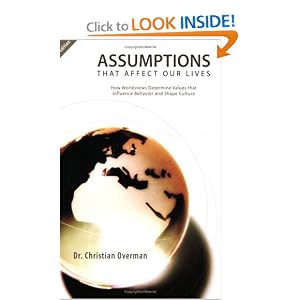
Assumptions That Affect Our Lives

"I think everybody needs to read it."  --Destry

I read Assumptions That Affect Our Lives:  How Worldviews Determine Values that Influence Behavior and Shape Culture by Dr. Christian Overman with my teens this past school year.   This book is so outstanding, it's one of those I have a hard time reviewing.  I agree with Destry; my temptation is to just say go get this book right now and read it.  Period.

Why are you still here reading this review?  Do you need further convincing?  Let's see if I can organize my racing brain.

This book is written from the premise that we all have certain assumptions--a pattern of thought, if you will--that shape what we believe and how we live.  Many times we don't even examine why we believe what we believe, or how our beliefs are affecting the choices we make.  This book breaks down how the choices we are making, both as individuals and as a culture, are revealing underlying beliefs.

It's a bit scary.

This is a huge topic, but Dr. Overman did a wonderful job making it easier to understand (his acknowledgements give credit to his wife for 'reviewing the manuscript with an eye for understandability for everyday people', so I am also grateful to her).  He breaks it down into its most basic form as a comparison between Hebraic thought (that of those people who believed in God and attempted to follow His commandments) and Greek thought (in which people believe there is no absolute truth and worship the created rather than the Creator).  He shows that our belief system is something like a map, and if our map is flawed, we simply won't reach our destination.  It doesn't matter how talented we are, how hard we work, how sincerely we are attempting to arrive if our map is flawed.

Now aren't you ready to check this book out so you can examine your map?  This is serious business.

Overman challenges us to a history quiz.  "What time and place in history do the following statements describe?
  • People, especially the educated ones, have rejected traditional religion.
  • The upper class is consumed with the pursuit of pleasure.
  • Education stresses knowledge more than character, and produces masses of half-educated people.
  • Public athletic games have turned into professional contests.
  • Homosexuality is popular.
  • Men who want to watch dances by unclad women do not have to go far to find them.
  • The dramas of the day are full of seduction and adultery.
  • A women's liberation movement has brought women into active roles in a  previously male-oriented culture.
  • Motherhood is devalued, and the bearing of children is viewed as an inconvenience.
  • Abortion is commonly practiced, as well as infanticide.
The similarities between decadent Greece and present day America are stark and sobering.  Even more sobering is the fact that many of these descriptions so fitting for America today would have been unthinkable just two generations ago.  We've come a long way in a short time.  The descriptions of ancient Greece listed above are those given by historian Will Durant in his well-known book, The Life of Greece, published in 1939.  He writes about these characteristics of Greek culture near the latter part of the book, in a subsection entitled, "The Morals of Decay."  This was Greece near the end of her life" (20, emphasis mine).

"It all has to do with thinking.  What was once unthinkable, became acceptable thought.  And what is accepted thought, sooner or later is acted out.  Our assumptions have changed.  What most Americans assumed years ago to be true about ourselves and our offspring, many no longer hold to be true.  There has been a large scale shift of assumptions about who we are and what determines our values.  At the present time in our history, many Americans have assimilated those same assumptions held by the ancient Greeks that allowed a few Nazi Germans to justify the elimination of bed-wetters.  These very same assumptions are now allowing a multitude of apple-pie-eating Americans to eliminate 4,000 pre-born children a day, before they have an opportunity to sleep in a bed, let alone wet one" (70).
Briana shares her favorite idea she took from the book:   "There is no such thing as secular.  There is no area that God is not present in.  As Colossians says, in Him all things exist and hold together.  Instead of secular and spiritual dividers, we should designate things as either natural or supernatural; God is present in both."  I thought this was a great lesson for her to retain, especially considering our tendency to "compartmentalize" God and our belief in Him.  It's tempting to relegate God to Sunday and think education, employment, relationships, government, etc. somehow operate independently of Him.

I could go on and on about the tons of information packed into this book.  I could have written a blog post responding to each chapter if I had just had the time.  It's really that good.  What are you waiting for?  wink, (and no I don't receive a commission, I just think it's that great).