I read Charlotte Mason's works several years ago, maybe 8 or 9 years ago, and promptly sold the series.
(That was before my book fetish was completely developed. At that time I had the silly idea that after reading a book, the information was in my head and I could recycle the book and thus the money. Now I know I will need to reference back so it's best to keep the book and just have your husband build more bookshelves, chuckle.) Anyway, I read Charlotte Levin's books discussing Mason's philosophies a few years after selling the original series, implemented what seemed useful, and moved on. This last summer, however, I decided to read Karen Andreola's "Charlotte Mason Companion: Personal Reflections on the Gentle Art of Learning" as my "annual-summer-educational-perspective-renewal" selection.
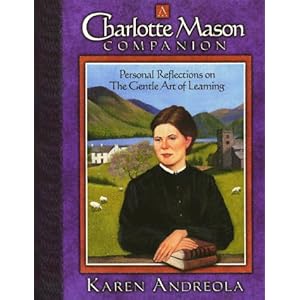
I think this book was one of my favorite summer reads for this purpose of renewal. I was exhausted from homeschooling at the end of last year and Andreola's gentle love both for her children and for education was just the breath of fresh air I needed. She helped me remember *why* I do this day in and day out:
because I love my children, I love being with them, and their education, whether intellectual, emotional, spiritual, or moral, is more important than anything I might otherwise do with my time.
Perhaps it's because my first set of children was getting older, but I was starting to think we had "outgrown" CM's educational philosophies. With a kindergartner starting up, however, I wanted to revisit CM. And in so doing, I realized how many delightful tips she has for children of all ages.
There were many, many nuggets I copied from this book onto index cards to meditate on over the summer, but I'll highlight my two favorites.
Be sure that your children each day have:
something or someone to love,
something to do,
something to think about.
I love this thought and think there is much merit in it. I've pondered this for hours. What a well-rounded child-to-adult this would develop! Indeed, even as adults don't we need these same things? If we have someone or something to love, it teaches us compassion. It takes our focus off ourselves. It teaches us to think about another and "love our neighbor as ourself".
When we have something to do, we are more motivated, we have more energy--we have a purpose. As Proverbs 19:15 says, "lazyness casts one into a deep sleep." Children without purpose are bored, get into trouble, and become disinterested in living. I have experienced this myself--on the occasional lazy Sunday afternoon I get *so* lazy I don't even enjoy the day. I become irritable and frankly can't even stand to be around myself. How much better it is to have work to do, a focus, a PURPOSE for our days and lives.
And finally, when we have something to think about we develop our curiosity. The more we learn, the more we realize how much there IS to learn and the more likely we are to explore and investigate. This produces growth, independence, and a desire to learn more. Besides that, people who think are simply more interesting.
Our aim in education
is less good conduct
than good character.
My very favorite tidbit Andreola shared was this aim in education. At first glance, we might think our aim is good conduct in our children. We might want them to act respectful, obedient and polite. We might want them to earn good grades, be competitive in sports, and proficient on a musical instrument. But if that is our only goal, we have missed the target completely. Our aim in education is to point these precious children to the Lord and shape their character to prepare them for a life of service to Him.
Truthfully, the education of our children is more a means to the end. As they juggle their schoolwork and chores, they will learn time management, self-control, and thoroughness. As they practice their instruments they will learn diligence and responsibility. As they struggle through algebra they will learn endurance and determination. As they volunteer in the community they will learn resourcefulness, generosity, hospitality, and compassion.
I can't let myself settle for short-term goals and successes, but must always keep the big picture in mind. These two tidbits have been great to refocus me as this new school year begins and I hope I won't get distracted with the daily responsibilities as the school year continues.
And, just for free, here are a few more tidbits I have copied onto my index cards for further pondering.
- The atmosphere of a close family: a respect for parents, the satisfaction of learning together, a fondness for simple pleasures, good humor amidst hard work, sympathy in sorrow, and the joy of worshiping together.
- Open communication: the freedom to express opinions in an atmosphere in which discussion is open and far-reaching
- Main causes of bickering: selfishness and harsh judgment of others
- The teacher's business: Let them learn from first-hand sources of information. indicate, stimulate, direct and constrain to the acquirement of knowledge.
- Children must be left to ruminate.
- We feed upon the thoughts of other minds, and thought applied to thought generates more thoughtfulness. No one need invite us to reason, compare, imagine. Like the body, the mind digests its proper food; it must have the labor of digestion or it ceases to function.
- Knowledge is not assimilated until it is reproduced. Whatever a child or grown-up person can tell, that we may be sure he knows, and what he cannot tell, he does not know.


My penchant for re-reading explains why I BUY so many books! Sometimes I borrow a book from a friend or the library, read it, then go out and buy a copy b/c it was *SO GOOD* I know I'll want to read it again. (I've never quite understood, by the way, why some people buy books only to read them once and let them sit on the shelf--what is the point of that?) When the book is my own, I can underline, highlight, and even "talk" to the author with scribbles in the margins. When I want to find a particular point, I can pick up the book and invariably find the passage as I know just where it is on the page, how I marked it (underlining or color of highlighter), and even if I scribbled a comment or scripture reference in its margin.
As much as I love re-reading great books, it's hard to do, especially as my time is becoming more and more limited and I keep finding so many books I *want* to read (for the first time!). But I can't see myself giving up this practice. Just talking about it, in fact, has inspired me to hurry up and get through my Fall Reading List so I can reward myself with a book I've read before. I'm thinking it might be time to savor the incredible skills of wordsmith Khaled Hosseini again, for his book, The Kite Runner, is one of the best examples of my re-reading tendencies. IMMEDIATELY upon turning that last page, I returned to the front of the book and started reading it again. I needed to savor the rich symbolism and expert foreshadowing now that I knew the whole story. Yes, it was THAT good. How could I put such a masterfully written book away on a shelf never to be experienced again?