Tuesday, February 19, 2013

Using Books to Teach About Adoption--Repost

first posted December of 2009--We have now adopted three children who are ages 6, 5 and 2.  This list is updated to add more books we have encountered in the last three years.

I think books are a great way to bring up discussions with our children. As a mother who has adopted three children, I am always looking for books that help the topic come up naturally and smoothly. I am of the opinion that it will be best for my children if they always know they were adopted so it is 'normal' and they don't remember 'the time mom and dad sat me down and told me. . .' or when a family member 'let it slip' or some other scarring event.

I'm finding, that just as with any other topic in children's books, some books handle the subject well, while others are boring, artificial, or simply unsuitable. I thought I would review a few books we have for future reference or for others who have adopted. This list might also bless you if you know someone who has adopted and you are looking for a special baby or "welcome home" gift. 
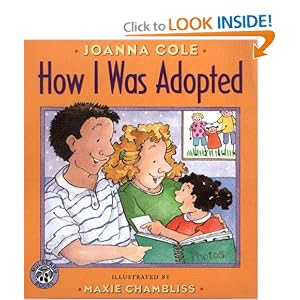
This book (How I Was Adopted by Joanna Cole) tells the story of Samantha's adoption. It is very conversational, written in first person, and even has questions written in the text ("Mommy told me that I was adopted. Were you adopted, too?"). One thing I especially like about this book is the way she talks about the characteristics she was born with and she talks about "what I know, how I talk, the jokes I like, the things I can do come from just being me and growing up in my family." I also like this book because I think it is appropriate for a variety of ages because of the engaging pictures.  This is my very favorite book about adoption and it has prompted many good discussions with my kiddos.
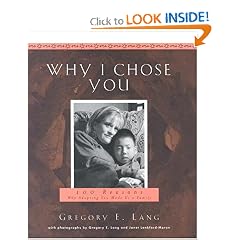
Gregory Lang's Why I Chose You is a tear-jerker, in my opinion. It is a series of pictures of children and their forever families. Each two-page spread features a black and white photo on one side and a sentence explaining WHY 'I chose you' on the other. There are 100 different reasons, and I think every family who has traveled the road to adoption will find reasons that resonate with their unique experience. Here are just a few that I identify with:
I chose you. . .because I was led to you. . .because you needed a loving family, and mine needed you. . .because you needed the love that I had to give. . .because I wasn't ready to stop raising children. . .because I wanted to be the one to encourage your interests and talents. . .so that I could sing lullabies once more. . .to complete my family. . .because being a parent is what I enjoy most. . .when I saw that you were waiting for someone to hold you close to their heart. . .to give you the opportunities that were once given to me.
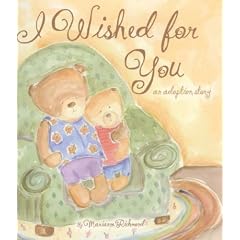
I really like I Wished for You, as the author uses a conversation between momma bear and her baby bear, all snuggled up together, to talk about the little bear's story and how he is his Mama's wish come true. There are three things about this book that appeal to me.

One aspect of this book that I really appreciate is the way the author addresses the birthmother. Barley Bear asks "What about the mama who grew me in her tummy? Didn't she wish for me too?" and Mama responds with "Sometimes a mama will grow a baby in her belly, and for all kinds of reasons, she'll decide she cannot be the very best mama she wants to be. The mama who grew you loved you enough to make a different wish--a wish for a family who would love her little one with a total and adoring love."

I also like the way the author shows God's role in 'placing the lonely in families' (Ps. 68:6) She tells Barley "Of all the children in the whole wide world, God picked you for me." I think this helps a child see how special they are and that God loves them.


Finally, Barley points out that his fur isn't the same color as his mother's and when he asks about that, she says "Some families look alike, and others don't. All families are different. What makes a family is their love for each other."

The fact that the main characters in this story are bears makes it easier for little kids, but it's a long book, so I don't know that it's great for children under the age of three because of their shorter attention span, but we sometimes just read pieces of the text to make it shorter.
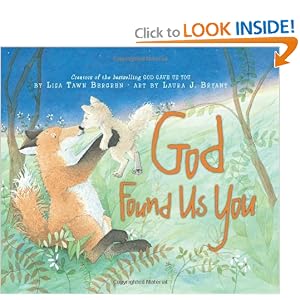
I bought this God Found Us You by Lisa Tawn Bergren because I read it in the bookstore and it made me cry. It is similar to "I Wished for You" in that it features animals (foxes this time) as the main characters, in a cozy conversation between the mama and baby. It also focuses a lot on God bringing families together. This book is shorter than the previous book, and I think more appropriate for reading to toddlers and younger preschoolers. I like the way the book addresses the process of parents waiting and waiting for the child God would bring them (pictures depict the mama waiting through the four seasons), and I liked when the little fox asks about his birthmother and part of his mama's response included "I think she prayed like crazy that you would be safe. I think she prayed for me as much as I prayed for her." Mama's voice got all whispery. "And God answered both our prayers."

Another feature that makes me love this book is the end where Little Fox asks "Mama, will you be my forever mama?" and the mama answers "Always and forever. No matter what."
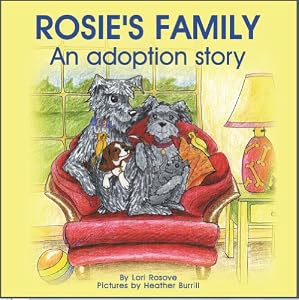
We also enjoy Rosie's Family by Lori Rosove from the perspective of Rosie who is a beagle who was adopted by a schnauzer family.  It addresses several questions adoptees might have and includes a nice guide for the parents about talking openly about adoption.

I have two other books in my "wish list" on Amazon.  I Don't Have Your Eyes has been on my list for sometime and I just added "We Belong Together" based on Sharla's recommendation.

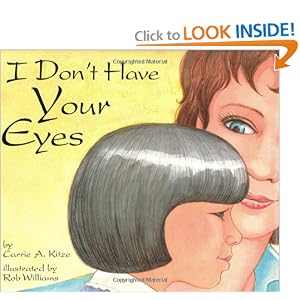
There are other picture books that address adoption that we have checked out from the library. Some of them I don't like very well, and others just don't relate to our adoption journeys. But here are a couple I have enjoyed.
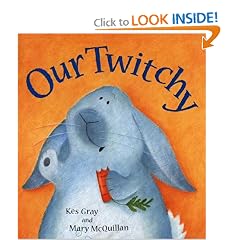
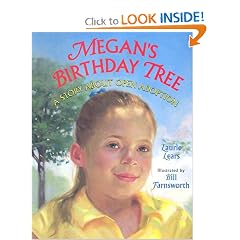
This book is about a bunny who is adopted by a cow and a horse. He realizes he is different from his parents, and has a really hard time with it and ends up running away. He eventually returns home and is trying to change and act like a cow and a horse, but they reassure him that they don't want him to change and they ARE his real mom and pop. Then 'they felt more like a family than ever before'. This is a cute book, great illustrations, and it's a short and easy read for young kids, but I'm not sure I love it. I guess it would be a good book if a child started focusing on his or her differences and they needed to be addressed for the child's reassurance, but I'm not sure it's my favorite book to just read on a regular basis.Finally, this book is about an older girl, Megan, who has an open relationship with her birthmother. Her birthmother has a tree in her yard that she decorates every year and sends a picture of it to Megan. But when the birthmother is getting ready to move and get married, Megan is afraid she will no longer be remembered without the tree in the front yard, so she tries to figure out how to give a new tree to her birthmother. As the story progresses, her birthmother tells her "I don't need a tree or anything else to remember you! Even though we don't live together, you will always be a part of me."

I really like this book for an older child, and will likely purchase a copy of it at some point. We are blessed to know our children's birth families, and I think this book helps a child figure out the roles played by the various members of their family (birth and adoptive), in a positive way, as the book ends with Megan thinking "how lucky I am to be part of such a special family."

If you made it through all that, share a couple of titles you like to use in teaching children about real life circumstances, whether they address adoption or some other topic that is important to you!

Monday, February 18, 2013

The Red Pony

I finished John Steinbeck's The Red Pony pretty quickly.  I had never read it before and it has been years since I read Of Mice and Men and The Grapes of Wrath.  When I found it for a quarter at a thrift store, I decided to "broaden my horizons" by reading a classic I hadn't read before.
I'm not quite sure what I think of this book.  It follows a young boy growing up in the early 1900s in his relationship with his father, his experience-driven-education about life and death, and his admiration for some of the older men in his life.  In Steinbeck's trademark realism, it was rather depressing.

But at the same time, I saw a little boy developing more compassion throughout the story--both more than he had in the beginning and more than his father had.  It has also made me think and it makes me want to revisit Steinbeck's classics I've read in the past, so I can't say it was a wasted quarter or a wasted couple hours of my life.

Friday, February 15, 2013

Blog Love

I don't feel like I've had much of depth to say lately, but I have been reading a few posts shared by friends which just keep percolating in my mind.  I'm going to share them here both to give you the opportunity to read them and also to help me process them a little bit.
For those not in adoption circles, an adoption disruption is when a family formed by adoption decides it's not working out for any of them and they find a different home for the child or children to whom they have promised to be their forever family.  It's a rough, rough road that I have a hard time wrapping my head around.

I was most struck by the quoted characteristics of the mother who disrupts an adoption:
Certain types of parents are more likely to end up giving up adopted children, as well. Younger adoptive parents, inexperienced parents, and parents who both work outside the home are linked with higher levels of disruption. Wealthier parents and more educated mothers, in particular, are also more likely to disrupt an adoption.
"I understand where that might seem odd, but I think there's a potential for less tolerance if someone's more educated or they make more money," says Brooke Randolph, director of adoption preparation and support services at an Indianapolis adoption agency.
 I keep thinking about what this means.  My gut equates these characteristics with selfishness.  I'm not professing to have it all figured out, I'm just not comfortable with those characteristics and lower tolerance leading to upheaval in a child's life.

This one is a must read for every mother.  It got me big time.  We serve Christ when we serve our families.  What do we think is so important that we need to get to that we try to hurry up and get all our housework done for, that we try to get our kids to hurry up and be perfectly trained for, that we want to check "done" beside our families so we can get to it???
Be here, in the now. There is nowhere more important to be; there’s nothing more important to accomplish.
I really encourage my fellow mom-friends to read this one.  It's too good to miss.

WOW!!  There's so much in this post, I just can't stop thinking about it.  I ordered her book just today and can hardly wait to read it.  It addresses the stumbling block of non-thinking Christians, the way your worldview affects the way you think, and the effectiveness of loving kindness.  It addresses the difference between praying a prayer for the willingness to obey and praying a prayer for miraculous healing "if" God really doesn't want me to live this way.

Even more, it shares the power of the WORD OF GOD to bring people to Him. Even when the cost is an entire lifestyle, your loved ones, your career path, your very identity.

It's so easy to lose my vision--my focus--in our daily homeschooling.  High school, worrying about future careers and goals, getting distracted by what others around me are doing, wondering if I am doing enough. . .all this clanging noise tempts me to push my teenagers into a typical, college prep academic path.  St. John's reminder that doing more is not God's expectation was a breath of fresh air to me.  She looked back at the pioneer homeschooling mothers and reminded me why they were successful.
these moms had a vision for homeschooling—they weren’t trying to re-create school at home. They were simply being obedient to the One who had called them to be different. They knew that if He had called them, He would equip them. And they were right.
I'm so excited for more fresh air from Heidi St. John when I get to go with three new friends to the Teach Them Diligently conference in a few months! (giggle and tee hee)

Thursday, February 14, 2013

Revisiting the Mysterious Benedict

My big kids and I had so much fun reading The Mysterious Benedict Society series a few years ago (so much so that Briana requested her own copy of the set just last year) that I was actually a little afraid to read the recently written prequel to the series.  I was afraid of being disappointed in The Extraordinary Education of Nicholas Benedict by Trenton Lee Stewart.
Mostly, I was not disappointed. I'll get the one negative out of the way by sharing that I had the "mystery" figured out literally halfway through the book.  At times that made the book seem a little long.  In retrospect, however, I might have just figured out the mystery because of the way I think and because of what I treasure.  That's all I'm going to say about that because I don't want to spoil the story you will surely want to read.

One of the things I love about Stewart's books are that they are just so fun.  Main character Nicholas Benedict is an exceptionally bright orphan boy who is moved to yet another orphanage.  As he encounters the expected bullies and a couple unlikely friendships, he also happens upon a mystery--a hidden treasure--a treasure mysteriously described in a discovered ledger.  I had to giggle aloud in the scene where Nicholas was attempting to read the ledger in a mysterious and adult male voice to his compatriots.  Finally his buddy requested  "Just use your regular voice, Nick.  I doubt Mr. Rothschild sounded quite so much like a frog, anyway"  (275).

Another reason I love Stewart's books is the way he sprinkles wonderful lessons through the story.  This particular book makes the reader think about true character.
  • Sacrifice.  Haven't you ever had to think about someone else rather than yourself?  This is such a test of true character--letting go of your own dreams and wishes because you love someone else.  And sacrificing a friendship because helping them reach their dreams means letting them go is even more difficult.  As Nicholas said "I didn't want you to go, see.  Something in me--well, I wouldn't even let myself think about what I could do for you.  Not if it meant losing you. . .Sure, I wanted you to be happy--but not if it meant losing you!" (414).
  • Self-deception.  Then there are the times when we don't want to be honest with ourselves.  We see a truth before us, but we choose not to recognize it because it isn't the truth we want.  It might require us to change something in ourselves or a relationship.  It might require us to give up a lifestyle we enjoy or to step out of our comfort zone.  But Nicholas realizes he must always seek the truth and accept it for what it is.  "Why would he not wish to know the truth?  There could be no more shying away from the truth, he told himself.  Never again, no matter what.  He must always seek it out" (423). 
So if you're looking for a delightfully written, character-driven, just-for-fun adventure, I recommend The Extraordinary Education of Nicholas Benedict with the expectation that you won't be disappointed and you  just might be given a little to think about.

Tuesday, February 12, 2013

Mother and Daughter Retreats

I'm gasping with a mixture of shock and panic as Briana's 17th birthday quickly approaches.  Sometimes in the back of my mind I hear a rushing, repetitive refrain:  one more year, one more year.  One more year until she is 18; one more year of high school; one more year until she is able to vote and be considered an adult.

This last year, 2012, even with its busyness and many changes, was a good year for the two of us as we twice got to slip away for some mother/daughter time while being surrounded by friends and immersed in the Word.
We had the wonderful opportunity to go to a Bright Lights conference, a ministry of older girls discipling younger girls created by Sarah Mally, with some longtime friends from Missouri.  This mother and I began the homeschooling journey together with our firstborn daughters as they started kindergarten twelve years ago.
Our daughters have also become close friends over the years and attending the conference together was especially sweet as we had so recently moved away from this support system.

The conference was incredibly encouraging and focused a lot on developing RADIANT purity--purity comprised not of a list of rules, not mandated by parents, but from a desire to bring glory to God.  They brought their message through straight-talking Scripture, personal stories and examples, and entertaining skits.
My favorite part was Sarah Mally's chalk drawings.  As she taught how to be a young woman who trusts the Lord, she drew on a large board with chalks.  She's quite a gifted artist and filled in the entire sheet with all sorts of colors, but most of the time it just looked like a big blob.  It was impossible for me to figure out what she was making as she seemed to randomly grab this color, then that and randomly shade in the left side, then the right.
At one point it was still without identifiable form but the colors were so beautiful and then it looked like she was actually destroying the picture as she seemed to scribble over it with dark colors!  As she continued speaking about trusting God--with our futures, with our purity, with our dreams and struggles--a beautiful picture finally took shape. 
As a person whose stick people are barely recognizable as such, I was quite impressed with her artistic ability.  But I have to admit I was even more impressed at the subtle message she illustrated.  We, too, are beautiful works of art in progress in the hand of the most gifted Artist of all.  We can't see the end picture.  We don't understand why this color is being used in our lives right now, or why work is being done on the left side when the right side is clearly unfinished.  We might even have times of horror in our lives when we think we are starting to look pretty good and that beauty is seemingly ruined by harsh black strokes.

But just as Sarah had a plan and a vision for her final product, so does our Master have a vision and a purpose for us.  Not one brushstroke is wasted--each is purposeful to be used in creating the final masterpiece as He conforms us into His image.

Monday, February 11, 2013

Love and Duty

If you were to point to a Scripture that summarizes how a Christian should live, what verse would you share?

I've been thinking lately that the verse we choose might be more revealing of our theology--our understanding of who God is--than we realize.

Here are the first three verses that come to my mind:
  • Galatians 5:6  The only thing that counts is faith expressing itself through love. 

  • Ecclesiastes 12:13  Here is the conclusion of the matter:  Fear God and keep his commandments, for this is the whole duty of man.

  • Revelation 4:11 Thou art worthy, O Lord, to receive glory and honor and power: for thou hast created all things, and for thy pleasure they are and were created.  
Have you ever thought of the difference between expressing our duty as "fearing God and keeping His commandments",  "expressing our faith through love" and "bringing pleasure to God by giving Him glory and honor"?  I've been meditating on this the last couple of days. 

Friday, February 8, 2013

King Alfred's English

My true homeschooling inclination is to pursue delight-directed learning.  I applied this philosophy pretty consistently when Briana and Destry were younger, chasing rabbit trails and their curiosity in one unit study after another.  High school, however, seems so much more serious, and I keep having to remind myself that even though it's good for them to study biology and chemistry, geometry and algebra 2, we still must protect time for them to investigate their interests.


Briana has been fascinated with linguistics ever since our unit delving into The Lord of the Rings when she learned that English has descended from the Germanic branch of languages.  Her fascination continued through two years of studying the Spanish language and the occassional foray into Greek and Latin roots.  When I read reviews of the book, King Alfred's English:  A History of the Language We Speak and Why We Should Be Glad We Do, written by Laurie White, I bought it for her to read.  After receiving it and glancing through it, however, I decided it looked too fun to limit to Briana alone, so she, Destry and I chased this rabbit trail when we resumed school after the first of the new year.
It really was the perfect little unit to reawaken our curiosity and joy in learning.  The author has provided a free unit study guide on her website complete with suggested movies to watch, articles to read, primary sources, and videos demonstrating ideas in each chapter.  The book itself was engaging and easy to read.  We found it a particularly fun review of history we've learned over the last several years as she took us on a quick trip through Ancient Rome, the Middle Ages, the Renaissance and Reformation, and finally to America while explaining the influences each of these time periods had on our native language.

In closing, I'll allow Briana to express her appreciation for this book in her own words (and I especially got a kick out of her little jab at the English spelling rules which have frustrated her for many years):
I enjoyed this book because it tells the story of the English language, from its beginning to the present. The author spends time describing and explaining each morph in English resulting from inward changes and outward influences such as the invasions of the Northmen and the French, as well as the changes brought about by the printing press. King Alfred's English introduces readers to one of the most complex, facinating and influential languages yet to be spoken. You will come away from this book with a new appriciation for the beauty and creativity of the English launguage and will discover a newfound affection for the language you speak. You will also understand why our language is so difficult to spell, and you will be able to trace hundreds of English words back to their origins. King Alfred's English opened my eyes to the richness of English, and I came to see that English, a language that compiles words and concepts from many different peoples, is the perfect representation of America.