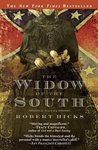
 The Widow of the South by Robert Hicks
This fiction novel, based on real events during the Civil War, had a slow start, but got much better as it progressed. I think the author did a good job fleshing out the different characters and exploring their stories and motivations. Above all, I think it was a story about doing what you have to do whatever circumstances warrant. It also made me think about grief and the different ways people handle life's tragedies.
I'm looking forward to discussing it with my local book discussion group. I borrowed this copy from the library and will need to return it before we meet, so I'm going to jot some discussion points here so I won't forget them.
- The perception of God. Carrie had lost three of her children and was struggling with her understanding of God. She felt "forsaken and abandoned by a distant God who had not once--not once--interceded in consideration of what she couldn't endure. What did it say in Deuteronomy? As thy days, so shall they strength be. I had believed this!. . .And our reward had been more than anyone could endure. . .I loved God. No, I didn't. I feared Him, I was in awe of His strength, and I had always obeyed Him" (106). Also "There are things we are called to do that we cannot refuse, as futile as they seem, because to refuse them would mean to lose faith. Not just faith in God so much as faith in man, which I suppose amounted to the same thing" (395).
- Being trapped in a (lesser?) role based on birth into circumstances beyond one's control (specifically "Negros" and women). "Theopolis was the most unlikely Negro I had ever known, and I wondered idly what kind of man he would be if he were white" (95). In regards to Becky: "what about our women (who were) sacrificed behind the plow in those years (of the Civil War)? It's not the plowing, you see; it's the elimination of everything but the plowing, the possibility that you could be anything but someone who walked behind a mule and gathered in the snap beans. A man could transform himself, and although these last few years that transformation had been completed by war and sometimes death, it is impossible to say how much bigger life must have seemed just knowing that it could be changed. A girl like Becky could not change anything for herself, and she had been called upon to take up the work and life of a man" (164).
- The necessity of having a purpose in life--of being needed. Carrie was aroused from her depression by the need of dying men after the Battle of Franklin. "I sometimes felt the old paralyzing darkness draw around me, but it was always tempered by the inescapable fact of these men lying around my house and in my yard, and the suspicion that they were harbingers of something I had not known before. How horrible, I thought occasionally, to think that these men were welcome and not a burden. I was freer than I had ever been. I felt obliged to the world, a world much larger than that contained between the four walls of Carnton, and although the burden seemed larger, I was similarly enlarged by the burden of shouldering it" (136).
- Life's experiences broadening a limited and sheltered existence. "The smell of men overpowered me. My nose had no experience with such a smell. It could not parse its elements. The smell was heavy and sour and musty, and I took it to be the smell of that world which had been kept at bay by my house and my husband these many years" (140).
- The significance of the color black. "Carrie began to wear black though. I suddenly realized that she had probably been wearing black for going on twenty years. . .she got used to it, like we always become accustomed to things. She thought she looked good, she thought the boys she saw every once in a while thought she might be pretty in her black. She learned we can become accustomed to anything, which is why things can seem to us like they're in their proper place when they really aren't. We just don't pay attention after a while" (192). "I could smell corn bread being burned in the kitchen, and for a moment I could barely keep myself from jumping out of the bed as best I could and going to save it. Keep it from going all black and wasted" (194). (Zachariah--also black thread/black cocoon pg 195)
- The nuances of marriage. "If as a girl I had loved John because he was a mystery and didn't interrupt me, I became obsessed with the one-legged man in the bed because he was a mystery and he did interrupt. I had grown old, and I knew the pain of being left alone with my thoughts. The silence John had given me was no gift, as well- intentioned as he was" (198).
- The draw to a completely different perspective of stuff. "My house did not impress him, nor our land, nor our few remaining fine things. What did he care for china or silver or French wallpaper? Perhaps that was why I was drawn to him: he didn't care, and I was shocked and excited by the idea that such things weren't worth caring about, that the most beautiful objects were still objects and therefore dead. He was alive, and he had lived for reasons other than propriety and position" (266).
- The inevitability of change. . .growth. . .transformation. "Men transformed themselves and the South. . .Transformation carries with it the creeping awareness of the infinite possibility of change, the infinite likelihood of change, and at some point the whole thing becomes frightening and unmooring. One longs to know that some things don't change, that some of us will not be forgotten, that our perambulations upon the earth are not without point or destination" (400).
- Doing what needs to be done. "This hadn't been my choice but something, in a long line of somethings, that had been thrust upon me without my permission. . .Things are just thrust upon you; that's just the way it is" (170).
- The paternity of Theopolis
The more I reflect, the more I am looking forward to the discussion!

No comments:
Post a Comment
Thank you for sharing your thoughts with me. When you comment, you're speaking my love language!