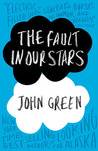
 The Fault in Our Stars by John Green
I have so many mixed thoughts and feelings about this book. It was quite well-written and full of delightful, memorable quotes worth pondering such as "Grief does not change you, it reveals you." Or "Some tourists think Amsterdam is a city of sin, but in truth it is a city of freedom. And in freedom, most people find sin." Or a cancer-survivor's explanation of why he carries an unlit cigarette between his lips: "It's a metaphor, see: You put the killing thing right between your teeth, but you don't give it the power to do its killing."
In regard to description and behavior, the characterization was good, yet all the characters kind of sounded the same. They were full of teenage angst wrapped in deep, philosophical conversations that reeked of pretension. I could relate to the teenage angst as I went through those faux deep thoughts and feelings as a teen myself, but the philosophical conversations seemed a stretch for a teenager. Then again, I was never a teenager dying from cancer, so maybe that would mature one's philosophical ponderings. I enjoyed the author's way with words, such as in this description: "Then he broke down, just for one moment, his sob roaring impotent like a clap of thunder unaccompanied by lightning, the terrible ferocity that amateurs in the field of suffering might mistake for weakness."
What I've listed above is mostly positive, so you might wonder why I have such mixed feelings and am hesitant to recommend the book. Part of my hesitation is in the targeted audience--teenagers--of the popular book (and now movie). The book is so hopeless. The teenagers who are dying from cancer have no hope--no faith in a Savior. There is some nebulous belief in a "capital-S-Someone" and vague references to a universe that wants to be noticed. The main character comes right out to say "I'd always associated belief in heaven with, frankly, a kind of intellectual disengagement." This hopeless worldview is in stark contrast to my own biblical/christian worldview and is not one I wish to see presented to teenagers (or anyone, really). The difference in worldview affects the actions of the characters when they are faced with cancer. If you believe life is all about you, then you will seek a way to MATTER. You will want your death--or your life--to MEAN something and begrudge not being able to die for a bigger cause than just cancer. You will worry about others remembering you. If, on the other hand, you have trust in a Savior, your life and death will be about Him, about serving Him, and about growing closer to Him in trials.
This distorted worldview also led the characters to make sure they didn't "die virgins." Because if you abandon morality to make sure to have avoided this terrible fate of dying a virgin, your life will have achieved meaning. (insert eye roll) I appreciate that the author didn't dwell in torrid detail of the act, but I still wish it hadn't been part of the story, especially when directed at teenagers. As if that line isn't used enough by teenagers as an excuse. I can just imagine the dramatic reaction of many teens at this moment, celebrating that they were able to be with their "soulmate" before dying (I had a roommate in college who frequently bewailed that she was destined to die a virgin because "everyone else has a boyfriend and I don't") without considering the sacredness of the act or its proper place within marriage.
Other quotes/themes I found interesting to ponder that I won't go into in this already-lengthy review:
"I fear oblivion."
"Don't tell me you're one of those people who becomes their disease."
"Sometimes people don't understand the promises they're making when they make them," I said. Isaac shot me a look. "Right, of course. But you keep the promises anyway. That's what love is. Love is keeping the promises anyway."
So, in summary, I thought it was pretty good and I don't regret reading it. However, I don't agree with the overall worldview espoused throughout so I can't recommend it without a caution to be discerning.

Great review. I enjoyed the book but have zero desire to see the movie. How about you? Do you want to watch the movie now that you have read the book?
ReplyDeleteI completely agree about the nature of the conversations...I certainly didn't know any teens who carried on conversations like this. I did enjoy that the book is written by a midwestern author and felt midwestern. I feel like it isn't often that a book takes places in the midwest in modern times. (like my life does!)
No, Laura, I have no desire to see the movie. I'm glad to know what people are talking about, however. :)
DeleteYour eye roll timing is perfect. I did that several times during this book, although I did like it- I think John Green has a beautiful way of expressing himself, and I did know a few fellow teenagers who spoke much like these two (ahem). "...teenage angst wrapped in deep, philosophical conversations that reeked of pretension," -nailed it! I had a lot of the same problems with the book you did, and overall found myself disappointed by Green. I still love the youtube videos he does with his brother Hank (the vlogbrothers).
ReplyDeleteGrin. Glad I wasn't the only one rolling my eyes. I may have to check out the youtube videos.
Delete