
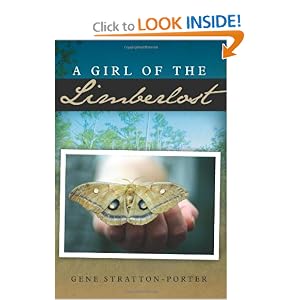
My favorite aspect of A Girl of the Limberlost was the heavy emphasis on nature and self-education, both of which appeal to the homeschool mom in me. I appreciate the example of a young lady who is determined to learn and sets out to do so without being propelled by any teacher, parent, or artificial motivation. Even more, I love that her most valuable knowledge--that which provided her with the income to attain her dreams and caught the interest of her "worthy suitor"--was obtained outside of the restrictions of school and classroom learning by pursuing and immersing herself in her interests--self-directed learning at its best. That simply delighted me and this example alone provides the book's merit.
In our current age when children are shoved through education factory-style (irrespective of unique talents) I enjoyed Elnora's individuality.
What you have to give is taught in no college, and I am not sure but you would spoil yourself if you tried to run your mind through a set groove with hundreds of others. I never thought I should say such a thing to anyone, but I do say to you, and I honestly believe it; give up the college idea. Your mind does not need that sort of development. (153)
I can imagine reading this book aloud with my children as part of a unit study on Lepidoptera, looking up pictures of the insects she names, and trying to identify those she describes but doesn't name. I can imagine this reading inspiring my children to begin their own insect collections complete with pinned specimens and identification tags from perusing field guides. Reading this book resonated with my reading of Charlotte Mason's philosophies as it emulates a love for nature and nature study--all in a living book!
On the other hand, I had a hard time connecting with the style of writing. I realize part of that likely stems from the time it was written (early 1900s), but it was also a little. . .flowery and romantic for my taste. (By romantic I don't necessarily mean romance as in love, although that was present in the end of the book, but rather I mean impractical and "over the top"). I think the style was the main reason it took me several days to get past the first few chapters, but once I got used to the style, I actually finished the book in just a couple days.
I was also conflicted at the mother/daughter relationship and the competing daughter/neighbor relationship. I'm certainly well aware that mothers aren't perfect, and they are frequently self-centered to the point of hurting their children emotionally. But just because I'm aware of it, doesn't mean I like it, nor especially to read such foolishness. With Elnora, I agree tragedies "in quite as tragic a manner, have happened to thousands of other women, and they have gone on with calm faces and found happiness in life by loving others" (107). I simply don't understand a woman shutting herself off from her child and wallowing in her own unhappiness and grief. Then as the story turned and the mother's "love" (idolatry!) for her dead husband was killed by the knowledge of his unfaithfulness, she realized "the width of the gulf that separated her from her child" (112) and poured herself into "earning" her daughter's love and trust by cooking tasty morsels, updating her appearance (did that make any sense to anyone?), and learning about moths and butterflies. Too little too late? Not for Elnora, for she had "grown bigger on knocks than she would on love" (39).
This leads me to another theme it would be fun to discuss in a book club meeting of this book: child rearing. I think it would be quite fun to contrast Elnora's upbringing and her mother's philosophy that it's best for children to face trials alone and develop character through working to overcome those trials with the philosophy held by Wesley and Margaret. Then we could discuss Philip and Edith and contrast Elnora's character with Edith's:
I cannot understand these people I hear about who live only for their own amusement. Perhaps it is very great; I'll never have a chance to know. To me, it seems the only pleasure in this world worth having is the joy we derive from living for those we love, and those we can help" (140).
And we could discuss marriage, its purpose, and the roles played by the man and the woman and compare them with the perceptions held by Philip, Edith and Elnora.
If you could have your choice you wouldn't have a society wife, either. In your heart you'd like the smaller home of comfort, the furtherance of your ambitions, the palatable meals regularly served, and little children around you" (229).
The more I think about it, the more I enjoyed it and find it worthy of a book club discussion. Sometimes I felt a little mocking of it for the drama and moralizing, but overall it was well worth reading. I think my 16-year-old daughter would enjoy it. Thanks to Stephanie for bringing this title to my attention!

As a homeschooling mom I can really connect with your thoughts about this book. I wish I could be such an inspiration to my own kids to get out and enjoy nature, but when it starts raining I turn into the biggest whimp.
ReplyDeleteYes! I agree with everything you say here. I like it more in retrospect rather than when I was actually reading it because of the "flowery and romantic" style.
ReplyDeleteYou are right. This book does open up the door for a discussion on child rearing. Hmm. I would say that I am personally of the opinion that I stand by my kids during trials and tribulations and teach and coach them through it. That is, until they show signs of maturity and ability to handle the trial themselves. Let us take learning to put on clothes, for example. ("Oh?" you ask, "Is that a trial?" Why, yes! Yes, it is!) I stand by, coaching, and assuring them that, "No, it is not too hard for you to do." Then they discover the strength within themselves to poke their arms through two holes and we all acknowledge that we have conquered a beast. I can't imagine doing differently as they age. Mostly, I watch for signs that they are maturity to indicate whether or not they can handle what's in front of them and try to offer appropriate help for as long as I feel I am needed. Then I step out of the picture.
The nature aspect of the book is indeed appealing. And that's really all I have to say about that!
That's so funny; if you were to ask me, I would easily say I don't like flowery or romantic language, but I love this book and had never thought of it that way. Reading it again, you're totally right!
ReplyDelete