Wednesday, June 22, 2011

The Book Thief

I just love it when authors have a way with words, and Markus Zusak didn't let me down in The Book Thief.This is one of those books I couldn't read fast because I kept pausing in order to savor his word choices, descriptive phrases, and rich personification. After reading it a couple times, I would even read a section aloud to my husband or one of my children. I never cease to be amazed by the things people can do with words. Just a small sampling:
her mother sat with clenched thoughts (25)
"The boy is crazy," he muttered, although he conceded that with six kids, something like this was bound to happen. At least one of them had to be a bad egg. (58)
Hans Hubermann wore a face with the shades pulled down. (63)
They could hear nothing, but the manner in which Hans Junior shrugged loose was loud enough. The sight of Papa watching him walk away roared at them from up the street. (105)
The sound of crying children kicked and punched. (380)
his eyes looked painful and loud (465)
Hot tears fought for room in her eyes as she would not let them out. (512)
And really, words are what this book is about. I knew I had to read it when I read on the inside flap "an unforgettable novel about the ability of books to feed the soul." Ooooooooh. And Zusak himself said "I thought about the importance of words in that time, and what they were able to make people believe and do." Oooooooh again.

The Book Thief is set in Nazi Germany. Death himself narrates this story about a young girl and the lives that touch hers, which is both macabre and appropriate. It is a story about life and death, growing, and relationships. It is about individuality in enduring life's trials. It is about boiling each individual down to the substance that lies (or doesn't) in each core. It is about finding something to live for.

As is the case with the great books, there are many themes woven throughout these pages.
  • The ability to continue on, even in the face of great trial or tragedy. "How could that woman walk? How could she move? That's the sort of thing I'll never know, or comprehend--what humans are capable of" (25)
  • "It's much easier to be on the verge of something than to actually be it" (87)
  • There is power in words--Death and life are in the power of the tongue (Proverbs 18:21). "She gave her a reason to write her own words, to see that words had also brought her to life" (524).
  • What would you do? Would you "watch the parade with pride, temerity, or shame"(392). Or would you interrupt it?
My favorite theme was that of how we face death, for surely "it is appointed unto man once to die and after that the judgment" (Hebrews 9:27). Some are afraid to die, others are afraid to live. Still others are ready.
His soul sat up. It met me. Those kinds of souls always do--the best ones. The ones who rise up and say "I know who you are and I am ready. Not that I want to go, of course, but I will come. . .He lay in my arms and rested (532).
The Book Thief is powerful. At one point tears were rolling not just down my cheeks, but down my neck. At another point I startled my husband when I couldn't restrain a sob. The horror of what people truly endured in not-so-distant history is beyond my ability to fathom. I think it's good for us to remember and thus possibly prevent a repeat performance, and rich, insightful novels like this one are an effective means to that end.

I am reading another book about this time period, the recent biography of Bonhoeffer. I was struck during this simultaneous reading by Zusak's fictionalized account of one of the Nazi's book burning parties. My non-fiction biography told about these paganistic offerings as the Nazis burned "un-German" thoughts. The prophetic words of German poet Heinrich Heine written in 1821 were just one example of the fuel that powered those flames: "Where books are burned, they will, in the end, burn people too" (162).

The Book Thief uses rich characterization and beautiful language to paint us a picture of the power of the word and the lives of the people who were caught up in that time when books, and indeed people, were burned.

Tuesday, June 21, 2011

Tractors and Relationships

Destry is seriously into tractors. I've never seen anything like it. As I'm driving down the road I suddenly hear an urgent "slow down, Mom!" I quickly press the brake while looking for signs of animals or flashing lights only to hear him mumbling random numbers "1066, 4020, 1800, 560, 400. . ." I never know what amazing piece of machinery is going to catch his eye, and now he has Easton doing the same thing. Easton drew a tractor last week and painstakingly wrote "1066" on it!

This interest is partly due to his grandpa, Alan's dad. Grandpa recently called us to insist we bring the boys to a tractor show. While it was all about tractors for the boys, I couldn't help but observe the relationships between the generations of this tractor-crazy family.
Alan was just as into it as his dad and sons.

Grandma even got into the excitement as she toured the tractors with Easton and talked about all the tractor parts.Kiana was mostly interested in hitching a ride in the sling while Daddy packed Tyrell. . .but eventually even she chose a favorite!
Some see tractors. . .I see memories and bonding.

Thursday, June 16, 2011

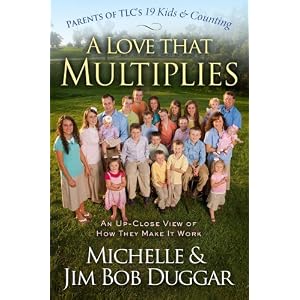
A Love That Multiplies

I liked it. I have really enjoyed both the first Duggar book and their latest book, A Love that Mulitplies: An Up-Close View of How They Make it Work.
It was a quick and easy read. They write with a very conversational style as Michelle and Jim Bob share about their life. A Love That Multiplies spends a lot of time talking about their faith in adversity as they examine some of the trials they've had in the last couple years with parents dying, sickness, storms, chicken pox (can you imagine?!) and most challenging of all, the premature birth of Josie and the family's seven-month separation. They spend more time on the premature birth than I really expected to read, but it was still interesting to see how they handled this trial, and I can see that it would be helpful and encouraging for other parents of preemies to be able to relate to their story. I appreciate that they "deliberately chose to allow that life storm to draw (them) closer to God, trusting His promise to bring good out of every situation" (79) and their honest transparency that "our hearts still bear the emotional scars from those moments when fear, exhaustion, and confusion seemed to muddle our thinking, steal our focus, and make us concerned about the future" (210).

I think my favorite thing about the Duggars, which continues through this book, is their humility. Multiple times they say "we don't know everything about parenting" or "we aren't experts" and "We may not be polished speakers, but our hope is that a message from our heart will reach another heart and make a difference in someone's life" (109). They confess that they don't have it all figured out and they give credit for ideas they have gleaned from others, such as with stewardship, parenting, marriage, and organizing their days. They are real enough to share their experience in learning to interact with their children with gentleness and kindness rather than anger, which was quite encouraging to me this week.

I was also quite blessed by their reflections regarding some of the criticisms their family receives. "We're going to incur criticism--justified or not. We can learn from our critics (they tell their children) either because what they're saying is true--or because of the way we respond when it isn't" (114). Their counsel on this subject was particularly relevant to a situation in our lives and I was encouraged when they quoted Joseph "Ye thought evil against me; but God meant it unto good" (Genesis 50:20).

Having said that, I can't help but roll my eyes at a couple stories that just don't seem like real, normal life. For example, they frequently allude to "Super Grandma" helping out with the kids during busy or stressful times, and of course there's the lady who just "loves" to do laundry so did their laundry twice a week (seriously?! this would never happen to me!). Then there are the surprise treat activities like bungee jumping and my favorite: the poor-man's water slide and swimming pool. Let me explain here, that the "poor-man's water slide" was created by using a backhoe to "scoop out a shallow hole at the foot of our sloping front lawn. Then we unrolled a giant roll of black plastic sheeting, twelve feet by one hundred feet all the way down the front-yard hill, brought out the garden hose, and greased up the plastic with Dawn dishwashing liquid and water" (19). I'm not sure what part of "poor-man" they don't understand, but in northeast Missouri "poor men" don't have free easy access to a backhoe, black plastic sheeting, etc. So, those sorts of things just kinda made me chuckle and count my reasons why I don't see any possibility of us having 19 children and living like the Duggars! :)

I really appreciated the way their faith is sprinkled throughout the book. There are more verses than I remember being referenced in the first book and while they are not prigs (just love that word and having an excuse to use it!) about it, they make no apologies or concessions regarding their faith. I respect them very much for both their courage and their graciousness.

If you're looking for an easy, encouraging book, this is a good summer read.

Wednesday, June 15, 2011

This Little Piggy

My son doesn't have any shoes that fit.

Oh, I know I need to get him some, but he lived in (homemade by a friend) Robeez those first several months, and now the weather is so nice. . .and his toes are so cute.Seriously, he has the cutest little feet and toes. How could I cover them up? He loves to play with his toes, and I love to tickle his toes. My dear Grandma always said it was mean to tickle a baby, so I try not to do it too much. But when I just touch them he giggles and squirms and curls them so sweetly.All I have to do is start the little nursery rhyme "This little piggy went to market. . ." and he's curling his toes, grabbing his feet, and giggling. This is a rare time in his life when he can go without shoes--to church, to the grocery store, to the ball field, or to a friend's house. I'll put off buying shoes just a few days more. . .

Monday, June 13, 2011

Cornrows and More Cornrows

I'm finding cornrows to be a great summer style for Kiana--both because of the heat and activeness summer brings and for fewer styling sessions. They last well, and look cute.

I can't believe I didn't get good pictures of her last hairstyle because I absolutely love it and hope to repeat that style frequently! I cornrowed her hair in angled rows toward a side ponytail. It was simply adorable and perfect for her age. I styled it in two sessions. I did the front once day and left the back in loose curls while we went to the science center (where patient big brother Destry helped her build and launch a rocket).
Below is the only picture I snapped while she had this style. It was a relatively easy style, took about two hours total (in two sittings) and stayed nice for about three weeks.This weekend I tried a new style I saw in It's All Good Hair.
I cornrowed the back of her hair straight down into free-flowing braids, then cornrowed the top half of her hair back into a little ponytail.
She wanted beads in the ends of the braids, then we gathered the top braids into an "Adi-bow" (as she calls the fu-fu hair decorations cousin Adi passed to her) and she was set. This is another really pretty "little-girl" style for her and I'm hoping it will last several weeks as well.I'm looking forward to finding more cute little-girl styles using cornrows this summer.

Monday, June 6, 2011

Discipleship

Last month I read The Cost of Discipleship by Dietrich Bonhoeffer with my book club. My impressions about this book are quite mixed, so I hope writing about it will help me come to an opinion!

First of all, I find Bonhoeffer himself absolutely fascinating. We have an audio book about him which I listened to with my big kids and I am slo-o-o-w-wly reading through the recent (fascinating) biography Bonhoeffer: Pastor, Martyr, Prophet, Spy. Bonhoeffer was a German theologian who experienced and commented on christianity and politics between the first and second world wars. He seems very insightful to me, and I am both amazed and saddened at the timelessness of his words.

Discipleship (Bonhoeffer's original title of his work, when it was translated into English "The Cost of" was added to the title, I would guess as a commentary on the contents) is not an easy read. The children had to be sleeping in order for me to read it with any hope of comprehension. Unlike some of my friends who forced themselves to read one chapter each day, I found it easier to read four or five chapters in a sitting. It took me a while to get into the frame of mind to understand his complex sentence structure and wordy analogies (he makes CS Lewis look succinct and to the point!) but once I was a couple chapters into a reading, I was able to see some of the bigger picture of his message. I would like to read it again some day--indeed, study it--but I'm thinking to do that when all my children are raised. Yes, sometime around the age of 55 I might be better able both to comprehend and thoroughly delve into the subject matter.

Yet I don't want to discourage anyone from reading it. I think it's just one of those books that will require multiple readings to mine the depths of his thinking. His subject matter is, after all, both deep and incredibly important. What does it mean to follow Christ? What does true discipleship look like? What does it mean to the individual? And what does it mean to the universal church of Christ?

I especially appreciated his contrast of costly grace and cheap grace. Cheap grace, Bonhoeffer explains, is "justification of sin without the justification of the sinner." Cheap grace is when we say God paid our account in advance and thus we can live however we wish. Cheap grace was being taught by many religious organizations in Bonhoeffer's time and sadly enough, I see it still being taught and believed. Costly grace, on the other hand, "is costly because it costs a man his life, and it is grace because it gives a man the only true life. It is costly because it condemns sin, and grace because it justifies the sinner. Above all, it is costly because it cost God the life of his Son. . .and what has cost God much cannot be cheap for us" (45).

I was astounded that the sentiment of cheap grace has been around for so long. I don't know why I always forget that "there is nothing new under the sun". Indeed Bonhoeffer was right when he observed this false teaching and noted the inheritance this cheap grace was leaving for the next generation as it would "seduce us to the mediocre level of the world" and be "the ruin of more Christians than any commandment of works" (55). "Unbelief thrives on cheap grace, for it is determined to persist in disobedience" (68).

There are so many great topics addressed in this book. He examines the sermon on the Mount, and various calls to discipleship by Christ to those following Him in New Testament times. He exposes our temptation to reduce the Bible to an academic question, "always learning but never understanding and coming to knowledge of the Truth" rather than obeying with simple, trusting faith. He challenges the reader to stop asking "who is my neighbor" but to realize "You are the neighbor. Go along and try to be obedient by loving others. Neighborliness is not a quality in other people, it is simply their claim on ourselves" (78). He reminds us that only when "we have ceased to notice the pain of our own cross" (88) are we truly oblivious of self and looking only to Christ.

Humility, justification and sanctification, works and fruit, church discipline, and the many ways a disciple of Christ is different from the world (such as a different motive for working, different marriages, and different business deals) are some of the other topics Bonhoeffer discusses in his book. I really enjoyed the first part of the book, got bogged down in the middle, but once again found the end to be very thought-provoking. I didn't agree with everything in the book, but I'm not sure I always understood exactly what he was saying, either (hence the need for a re-read some day!). I'm also looking forward to finishing the biography and wonder how to reconcile some of his statements ("to renounce rebellion and revolution is the most appropriate way of expressing our conviction that the Christian hope is not set on this world, but on Christ and his kingdom. . .it is not reform that the world needs, for it is already ripe for destruction" (260)) with the end of his life and his involvement in a plot to assassinate Hitler.

Overall, I am glad to have read this book and would recommend it to others (especially if someone would like to read it and then help me understand a few passages! smile)

Our book for June is Northanger Abbey by Jane Austen. I'm not really an Austen fan, but have to admit an easier read is welcomed on these warm summer days and I've been on a fiction kick lately anyway.

Thursday, June 2, 2011

Loving and Serving

I think it's only natural, when considering adoption, to wonder how adopting a child will affect the children you already have. We thought and prayed about it for some time when we first started considering adoption about six years ago. Might our older children feel somehow slighted, might they feel they would get less attention, might they feel replaced?

Would they feel burdened by a crying baby, or begrudge a younger sibling getting into their stuff, sharing a room, or the time it would demand from mom and dad? As the expenses continued to pile up, might they resent the lack of a college fund in order to bring more children into our family? Would they take exception to social workers prying into their thoughts and lives and repeated medical screenings to gain approval in the home study process? Would they regret being different from another family or having a brother or sister who looks different from them?

Fast forwarding to now, five years after our first adoption, I see evidence that these concerns were unfounded. Rather than reacting with selfishness, Briana and Destry have taken this opportunity to overflow with love for their younger brothers and sister. They have learned a lesson that many adults fail to realize: life is not about you. They have practiced serving by helping around the house, teaching their younger siblings, sharing rooms and toys, time and love.

This spirit of love and service, thinking of another, blessing younger siblings simply warms my heart and reassures me they will not later say we "ruined their lives" with younger siblings. Destry recently made Easton a sword and a shield. No one asked him to, he initiated this labor of love on his own.
Easton couldn't have been more proud. I couldn't have either. Extended education, sports accomplishments, proficiency in music, successful career. . .all of that is nothing weighed against my children loving the Lord and being vessels for His love to be poured out on others.
Briana poured her heart into making this outfit for her little sister. Much like the apron Briana made for her a few months ago, this gift made Kiana feel special and she frequently asks to wear it.These relationships will last a lifetime and surely bless all who are a part of them. If you're considering adoption but fear how it will affect your biological children, step out in faith, take a page from Missy's book and make it a priority for your children to be holy rather than just happy.