Sunday, October 13, 2013

We Shouldn't Starve This Winter

We've been blessed with an abundance of food this harvest season.  These pictures were taken before butchering chickens or canning pears and before my last two batches of apple butter.
I've been blessed to be able to can carrots, green beans, applesauce, apple pie filling, apple butter, pears, chicken, and broth.  We've also been able to freeze homemade pizza sauce (made from our tomatoes and fresh basil), pesto, apple pie slices and peaches.
Frankly, I'm tired of canning and otherwise preserving.  It has made for a very busy start to our school year!
Snapping beans is a family affair!
 Yet I'm thankful to have all this yummy, homegrown food to feed my family.  Several of my friends have also preserved a great deal of food. 
 It makes me wonder if we might be in for a pretty severe winter.  If you get hungry, you know who to hit up for a good meal! :)

Tuesday, October 8, 2013

The Apple Saga

We tried something new this year.  (Surprise, surprise--you DO know my husband, right?!)  We have five apple trees and this year was a bumper crop year.
What does one do with all these apples?  Well, the kids invariably grab one to snack on as they play outside, we serve them raw at mealtime, and we make applesauce, fried apples, apple pies and apple crisps to eat with our meals.  Then we can applesauce, can apple butter, can apple pie filling, and freeze apple pie slices.  

 
Next you take apples everywhere you go, giving them to any sucker friend who will take some.  Then you send an appeal through your local homeschool group for someone, anyone, everyone, to please come and get some apples.  You get rid of bushels and bushels of apples this way.  But the trees just keep producing.
Finally you borrow an apple press and make gallons and gallons (and gallons) of apple cider.  It's great fun and the whole family plays along. The simple process involves gathering apples, then chopping the apples in one machine before pressing the apple pieces in the final contraption.

Yum, yum, it really tastes quite delicious--so apple-y!  As for the rest of the apples?  They are rotting on the ground as they fall providing a great feast for all the buzzing insects gathered under the trees.

Unless you would like to come and gather some.

Monday, October 7, 2013

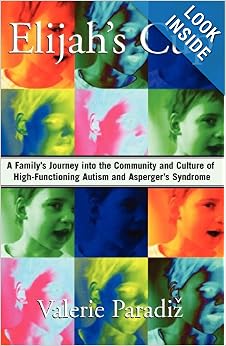
Elijah's Cup

I love Mondays.  I know that isn't normal, but Monday is the day Destry has his violin lesson and symphony rehearsal and I go with him.  I put the little ones down for nap, leave them with big sis, and then Alan is home before they wake up.  Meanwhile, I get to grade essays, prepare my speech lectures, write a blog post, waste time on facebook, or read a book in peace and quiet while waiting on Destry.

The book I picked up most recently from the library (conveniently located next door to his lesson--how fun is that?!) is called Elijah's Cup:  A Family's Journey Into the Community and Culture of High-Functioning Autism and Asperger's Syndrome by Valerie Paradiz.  Overall, I really enjoyed this mother's account of life with her son as she learned more about him and about the history and culture of autism.  I wasn't sure I would finish it at first as she writes with a rather flowery prose and it was slow getting started, but it got a lot better.

I didn't sense that she was writing from a position of professing faith, but I did find her title interesting.  Autism was part of the cup her son Elijah was given in this life.  All of our cups look different but as she said "Elijah's cup is full.  He has his special interests.  He has his comedy and his ups and his downs.  He has his autistic mentors and his friends" (199).  Like Jesus Himself, a parent might be tempted to ask the Lord to "let this cup pass from me" but Paradiz comes to recognize the gifts in autism and declares Elijah's cup to be full even pointing out the neurotypical culture's tendency to be preoccupied with "societal concerns, delusions of superiority and obsession with conformity".

I think I most enjoyed Paradiz's exploration into famous people who have had autism including pianist Glenn Gould, scientist Albert Einstein, comedian Andy Kaufman, and artist Andy Warhol.  I found it fascinating to read about these people's "eccentricities" and how they fit within the autism spectrum.  Maybe it's just my ignorance on the subject, but I would have never interpreted Warhol's Campbell's soup series as "an autistic predilection for the serial and the literal.
Autism is a life of profound serial experience.  It is a life of cataloguing repeated events and variations of events.  Repeated images.  Repeated language.  Repeated movements and repeated gestures.  Its expression is found, classically and clinically, in the lining up of things in rows, side by side. . .the repetition is compelling, a mirror of internal drama and development" (159).
I also enjoyed Paradiz's synopsis of what she learned about autism researchers including Hans Asperger, Bruno Bettelheim, and Leo Kanner.  It was interesting that some suspect Asperger himself had the very syndrome that wears his name.  "Asperger himself once said that one had to be a little autistic oneself in order to understand autism" (68).

I was also fascinated to learn that parents and siblings of autistic children are frequently called "cousins" as they possess autistic shadow traits, sometimes called broader autism phenotype (BAP).  The author of this book recognized that she, her father, and her grandmother were all cousins and it helped her to understand herself better and to mend her strained relationship with her father as she had spent most of her life feeling ignored and overlooked by him as he got absorbed in his interests or would talk with her only about what he found fascinating (such as counting cards in blackjack).

Finally, as a "neurotypical" myself, it was enlightening to consider society's expectation of conformity and how that expectation affects those with autism--or even to consider if this expectation is good.  As one of her friends said "I have exactly as many relationships as I want.  I relate only as myself, only in ways that are authentic to me.  I value people only as themselves, not for their role or status, and not because I need someone to fill empty spaces in my life.  Are these the severe deficits in communicating and relating that I keep reading about?   Actually, there are some pretty serious deficits, but not in my ability to care.  There are deficits in my ability to recognize people who aren't able to care, people who aren't authentic, who don't value me as myself, or who aren't connected at their own cores.  It's hard for me to tell when someone is lying.  It took me a very long time, and a lot of painful experience, just to learn what lying is" (182).

I was challenged when another of the author's autistic friends observed "If I know that I do not understand people and I devote all this energy and effort to figuring them out, do I have more or less empathy than people who do not understand me, but who do not even notice that they don't understand me?" (190)  As we become more aware of the ways the Lord made us to be different from one another, I think it is good to learn more so we can better understand and appreciate one another rather than trying to fit everyone into the same mold.  I'm trying to decide what I think of the following quotes which seem to imply our society is more concerned with making everyone seem the same--to fit in--than it is with equipping each of us to effectively use the gifts we have been given. 

"Today the main emphasis in the education of Asperger children is placed on learning social skills, such as how to take turns in conversation or how to broach a new topic gracefully" (151).

"I learned that autistics feel they can be helped with more important things than constantly making eye contact or mimicking what is thought to be appropriate social behavior.  I learned that more than anything else, they need help in identifying and communicating their needs, monitoring their levels of sensory stimulation, and knowing how and when to remove themselves from overwhelming situations before they reach a 'meltdown state'" (140).

All in all, it was a very interesting and enlightening book and I'm glad I read it.

Friday, October 4, 2013

Life Skills

Destry has been gaining more life skills this fall in addition to his academic studies.  In addition to the large 2-car garage, our property had an old single garage which the previous owner said he would likely just tear down if he were keeping it.
We found the extra space convenient, however.  It's nice to be able to park the car in a garage (especially when there is snow and ice in the winter) and we have a plethora of bikes, scooters, and other outdoor toys that needed a home.
So we decided to fix up the garage as a learning project for Destry.  He had to start by completely stripping the roof, both of shingles and the sheathing because there were holes completely through the roof.
Then he and Alan put on new sheathing to give the roof a solid base.
The little ones really wanted to help.
They at least thought they were helping, whether they were or not.
Destry completed most of the work himself.  Alan showed him how to do each new part and helped him finish the cap before rain was expected, but Destry really gets the credit for this nice new roof.  It looks so much better and will last a good long while yet.  Best of all, Destry gained new skills and experience he will take with him whatever he does in life.
 A coat of paint, some new window panes, and we have a nice little garage and a job well done.

Sunday, September 29, 2013

Things That Have Been Bothering Me

You know how sometimes there are things that weigh on your mind and drag you down until you let go of them and entrust them to the Lord?  I've had a few of those on my mind lately.

  • First of all, Kiana has been experiencing some struggles with learning to read.  She was doing great until we hit some sounds that she doesn't pronounce correctly, so I wondered if I needed to get her some speech therapy.  Long story short, we got her a speech evaluation and they say she is on target developmentally.  They aren't worried about her substitutions, the way she bites her lip to make the 'v' and 'f' sounds, or her lack of 'r' sound.  In fact, they showed me that she is getting the 'r' as she pronounces it at the end of words and they think she will be able to pronounce it at the beginning of words in the next six months.  They aren't worried about her lisp for now, but said if she still has it in a year, she might need some help with it.  So, that was good news!  She is still struggling with adding additional sounds in reading, however, so I have been cramming every spare minute reading about brain integration therapy to see if she might be a right brain learner who needs some training in how to move new material from her short term memory to her long term memory.  I'm sure it will all work out fine, I'm just wishing I had known to educate myself in these areas during the summer before school started.  grin
  • Secondly, I recently learned of the upcoming divorce of a couple in my local homeschool group who are parents of 10.  As a child of divorce myself, I know how painful divorce is and the aftershocks that continue through years to come.  My heart just goes out to these children, ranging in age from 22 down to 4.  While I don't know the family or the situation very well, it is pretty obvious that the mother is leaving her husband for another man (who has also broken his family for her).  Doesn't the general decline in the valuing of marriage just depress you?  And frankly, it scares me sometimes as I fear going off my rocker, abandoning everything I've believed and sacrificed for all these years, and ripping my family apart in a selfish pursuit of ME.  I hearby give you permission to knock me up the side of the head, tie me up and throw me into a cave if I take leave of my senses in such a way!
  • I've also been irritated by a recent editorial in the Des Moines paper criticizing Iowa's amendment to homeschooling laws.  There is a pretty well-done rebuttal here, and I would love to see if there are any responses in letters to the editor, but I'm reluctant to go buy a Sunday paper today to reward the Register for its inflammatory editorial.  In short, the Register takes a statist view claiming the state is ultimately responsible for our children and that "professionals" know what is best for your children and mine.  They also claim the recent amendments were slipped in secretively and maintain that somehow the state knowing a child is being educated at home will ensure that said child receives an adequate education.  
Simply typing this little blurb increases my blood pressure.  You may recall my irritation while jumping through the hoops mandated by former Iowa law when we first moved here.  It was ridiculous and ineffective.  Parents were required to fill out a form stating their intent to home school at the beginning of each year.  We also had to compile a list of resources we planned to use to educate each child and turn it in to the local school district.  It might seem like it was little enough to have to do, but it stole my time from actually educating my children and did absolutely nothing to improve their education or ensure that I was educating them adequately.  It was just busywork.  Additionally, I moved here from Missouri where the parents' rights were better recognized, so I chafed at the state sticking its nose in our business anyway.

It's even more frustrating to read the comments to the above editorial.  Our government schools have done their job well as they have indoctrinated generations to believe that the state has a greater right to our children than we parents do.  Many commenters believe in the "expert" fallacy as the state obviously loves children more than parents and certainly the state knows best.  Somehow people have the idea that parents are responsible to the state (rather than to God), that parents must ask *permission* of the state, and that parents must be accountable to the state.  (After all, government schools have to be accountable and that's just not fair if government schools have to be held accountable in their use of tax dollars to provide an adequate education to the children of those tax payers while home educators aren't held accountable in the education of their children which they themselves are funding.)  (deep breath)
  • Okay, last one, I promise.  The final thing that has been bothering me is people who purport to be helping children but manage to amply pad their pocketbook in the process.  To give a  brief background, some states are changing laws so that parents who are about to have their parental rights terminated by the state (for neglect, abuse, etc) have the option of voluntarily signing consent for adoption.  This is a very good thing.  In addition to saving taxpayers lots of money, it allows parents to make one final loving decision so their child(ren) will be part of a family forever (rather than likely bounced from one foster family to another) and if there are siblings, they are able to be in a family together (rather than in separate foster homes). 
But here is the problem.  Adoption agencies are the ones who have proposed the new policies.  And you guessed it--too often their motives are less than altruistic.  Now, don't get me wrong, I fully believe a laborer is worthy of his hire.  People need to make a living for what they do.  I just think we get greedy.  I was recently made aware of such a situation in which an agency was looking for an adoptive family for a brother and sister who have been in foster care for three years and are currently in separate foster homes.  The agency had a week to gather information, find a family, and prepare the necessary legal documentation. Their fee?  TWENTY SIX THOUSAND DOLLARS!  Do you know anyone who makes $26,000 for a week's worth of work?!  Even intense, time-sensitive work surely doesn't require such exorbitant fees.  
It bothers me that agencies and lawyers who have the ability to help children find loving families make it so cost-prohibitive.  If I didn't have five children I'm trying to homeschool, I think I would have to try to find some way to change the adoption industry (for don't doubt that an industry it is).  Anyone wanna take up the banner for me while I'm in this busy season?

Wednesday, September 25, 2013

The Peaceable Fruit of Righteousness

I really don't like having to discipline my children.  For the present, it truly is grievous and not joyous.  I would love to just never have to correct them.

But alas, that is just not how real life is.  For example, one Sunday Kiana woke up "on the wrong side of the bed".
While I'm talking about her, I might as well highlight her beautiful head of hair and her latest hairstyle, right?  It's been quite some time since I shared.
First she didn't like the dress that was laid out the night before (to make our Sunday morning routine smoother) and then she wanted to wear her tan tennis shoes instead of the pretty matching shoes. She didn't want to carry her Bible, she walked to the van with a scowling face, and still had crabby eyebrows even after she was told to make a happy face.

I know, I know, I should have corrected her before this point.  But I do understand where the anti-spanking people are coming from.  It's no fun to have to spank your child.  I calmly and consistently won each of the above battles (except for the eyebrows, I guess), but didn't want to engage in the war.  I wanted to be "fun mom".
Isn't this hairstyle, once again created by Briana's friend Kidon, simply beautiful?!
Once we got to services, the attitude continued.  I offered her a notebook and a pencil during the study but she didn't want the black mechanical pencil I offered--she wanted the red (which I had checked and it had no lead). As a consequence, she got nothing to play with.  She then commenced to waller on Briana (who sat on her right side), so I pulled her to my side and sat with my arm around her.  I gently tickled her arm and held her close.  I thought maybe things were getting better.

Then it was time for the collection.  I gave her some money to put in the basket and while I was passing more out to Easton and Tyrell, Briana told Kiana to clasp it the money in her fist instead of flinging it around so she wouldn't drop it.

Kiana defiantly rolled her money between two hands.  Time for the swat.  This unpleasant attitude had finally resulted in a willful act of disobedience.


Kiana then miraculously turned into a sweet girl with a happy, smiling face and shining eyes.  Funny how that works, hmmmm?

Saturday, September 14, 2013

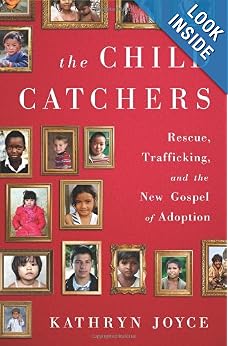
Child Catchers

It took me almost three months to finish this book.  It wasn't because it was a particularly hard read, but because it was a very frustrating read.  I don't know when I've ever read a piece of writing with such a blatant anti-Christian bias.  (My brain is simply spinning with thoughts and I'm going to try to process them here because I couldn't find anyone to read and discuss this book with me. :))

In her book The Child Catchers:  Rescue, Trafficking, and the New Gospel of Adoption, Kathryn Joyce claims to be researching adoption ethics.  I have no problem with that--in fact, I think it's something we need to be aware of.  The more knowledgeable I have become of "the adoption community" in the seven years since we first adopted, the more I have become aware of unethical actions--of downright child stealing--and I have many times experienced that pit-deep-in-the-gut feeling that something isn't right when talking with people about their stories.  We stopped pursuing an adoption of a sibling group of sisters, in fact, when we saw some red flags that made us question the ethics of the people involved.  And it's no secret that there are some for whom adoption is big business--who ruthlessly and unethically use children to pad their bank accounts while professing to be "helping the children". 


No, it isn't the topic that bothers me.  A large part of my problem with this book has to do with the author's approach.  She calls herself a journalist and she calls this book "research".  Now, we're all aware that every journalist has a bias--a worldview--from which he or she approaches a story and I suppose I should be grateful that this author is so obvious in her bias that a reader needn't strain herself trying to discern the direction of the bias, but I sat through too many classes in my pursuit of my Communication-with-an-emphasis-in-journalism degree to consider this a credible piece of research journalism when its pages drip with her bias.  If you want to write a book "exposing" the seamy side of adoption, call it such.  Don't claim to be a journalist relaying research.  Whether you claim to be a journalist or just a person with a publisher and an axe to grind, please make sure you have your facts straight.  Additionally, anytime she interviewed a professing christian (especially those she labeled "fundamentalists"), she just focused on negative aspects (and I suspect twisted stories) to support her view.  I haven't read her other book Quiverfull:  Inside the Christian Patriarchy Movement, but I've read interviews and reviews which made me suspicious of her premise in the first place, yet I still wanted to read what she had to say about adoption ethics.

I should have just waited and read Jen Hatmaker's series on Examining Adoption Ethics.  Jen makes excellent points about what desperate people will do for money, what greedy people will do for money, what mistaken attitudes prospective adoptive parents might have, and how carefully one must research the adoption industry and she does all this without plagiarizing information from the blogs of adoptive parents (true story--I contacted a fellow blogger whose words I recognized and received validation of my suspicions) while calling herself a journalist.

If you're interested in ethical adoption (and really, why wouldn't you be?), I recommend you read Jen Hatmaker's series and search other credible sources rather than wasting your time wading through The Child Catchers where you'll have to weed through a lot of garbage, bias, and out-right error to discern about 20% which is worthwhile.  I suppose it is good that Joyce wrote this book as she certainly got the conversation started, but I can't recommend it for more reasons than I feel like going into in this post.