Something has been bothering me the last couple months.
Sadly, we as a society are being indoctrinated and desensitized to sin. The last couple books I've randomly selected from "new fiction" section of my local library have shared an underlying theme. They no longer tell the reader in the synopsis or anywhere in the reviews the "social issues" a book is addressing. Authors and publishers are just weaving it through the storyline like it's normal. We are supposed to believe this is commonplace, to be expected. I've noticed it on television shows in recent years (what few shows I've watched) of course, but I didn't expect advocates of homosexuality to infiltrate my books quite so completely.
The most recent victim of this campaign to sear our consciences that I came across was the book The Absolutist by John Boyne, the author of The Boy in Striped Pajamas. I saw the common author and thought, "why not?" The synopsis described a soldier who served during World War I, and faintly foreshadowed the idea of conscientious objection and bravery versus cowardice. It in no way alluded to its true theme.
The goal, I am certain, is to make us numb to sin, to cultivate acceptance.
I try to be discerning in my reading, although I have to admit many books I have read depict sin. I prefer those stories which call what is sin sin. I prefer stories that illustrate the consequences of sin or give examples of repentance or at the very least allow good to triumph over evil.
These observations remind me to keep my thinking cap on while reading, rather than giving in to the temptation to be whisked away by a good plot or appealing characters. I want to remind parents to be aware of what your children are reading. Written words wield a mighty influence. Just because a book is published doesn't make it worth reading, especially when the goal of the publisher and/or author is to desensitize readers.
Wednesday, December 19, 2012

Tuesday, December 18, 2012
Something Light?
I have too many books started right now. It's really dumb of me to do this, especially when the end of The Fall Reading Challenge is quickly approaching and life is busy. For some reason, I'm having a hard time finishing all these parenting books and spiritually challenging books I'm reading. When I have a few minutes to read, I keep choosing something that looks lighter, easier, faster.
Then again, those words are rather subjective, aren't they?
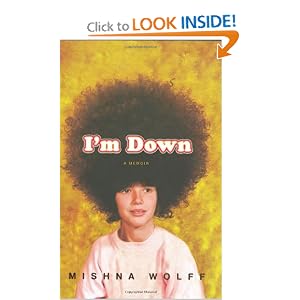 One of the books I read last week was Mishna Wolff's memoir, I'm Down. I picked it up used for a quarter and thought it looked interesting. She was a white girl raised in a black neighborhood by a father who. . .well, wanted her to be more black. She kept disappointing him because she "couldn't dance, couldn't sing, couldn't do double dutch and was the worst player on her basketball team." Then she got a scholarship to a "rich kids" school and discovered she was "too black" for that environment.
As a white adoptive mother to two African American children, I thought I might benefit from reading this book about the two cultures and people having a hard time fitting in. In the end I found it rather depressing, not nearly as funny as reviews advertised, and felt frustrated at people's pre-conceived ideas that cripple them from seeing each person as the uniquely created individual God made him or her to be.
I also remembered that I truly don't like reading memoirs because they never feel finished. I really need a Paul Harvey moment after finishing a memoir: "And now, for the rest of the story."
 The other book I read last week was a fiction novel (free on my Kindle) which looked like it would be a great suspense/action-packed type of escape. Instead, The Next Target by Nikki Arana was a convicting tale about ministering to Arab Americans and Muslims and sharing the gospel with them. The main character was a widow because her husband was killed by radical Islams and she wrestled with how to protect new converts to Christianity when their radical family members would resort to "honor killing" when they learned of their conversion.
I appreciated the way the author contrasted the two belief systems and focused on the peace and forgiveness Christ brings. I was pricked by the main character's despair over Christians not reaching out to Muslim neighbors and over another character's assessment of America as "a country that had been founded on godly principles and was now known across nations as the champion of abortion, drunkenness, pornography, and gay marriage" (132). And when Austia made phone call after phone call to fellow believers seeking a safe place for a woman who feared for her life after her conversion but was met only with excuses, I searched my heart. Would I open my home to a new believer even if it exposed me to persecution and possible death?
Even as I benefited from both of these books, neither was the "light, quick, easy" read I was looking for. Maybe I should have been reading the books on my list instead.
Then again, those words are rather subjective, aren't they?
As a white adoptive mother to two African American children, I thought I might benefit from reading this book about the two cultures and people having a hard time fitting in. In the end I found it rather depressing, not nearly as funny as reviews advertised, and felt frustrated at people's pre-conceived ideas that cripple them from seeing each person as the uniquely created individual God made him or her to be.
I also remembered that I truly don't like reading memoirs because they never feel finished. I really need a Paul Harvey moment after finishing a memoir: "And now, for the rest of the story."
I appreciated the way the author contrasted the two belief systems and focused on the peace and forgiveness Christ brings. I was pricked by the main character's despair over Christians not reaching out to Muslim neighbors and over another character's assessment of America as "a country that had been founded on godly principles and was now known across nations as the champion of abortion, drunkenness, pornography, and gay marriage" (132). And when Austia made phone call after phone call to fellow believers seeking a safe place for a woman who feared for her life after her conversion but was met only with excuses, I searched my heart. Would I open my home to a new believer even if it exposed me to persecution and possible death?
Even as I benefited from both of these books, neither was the "light, quick, easy" read I was looking for. Maybe I should have been reading the books on my list instead.
Monday, December 17, 2012
Doers and Not Hearers Only
I never thought I would wonder if it's possible to study the Bible too much.
I mean, seriously, I think most of our problems come from not spending ENOUGH time in the Word. I am always trying to learn more of God's will--and the more I learn, the more I realize how much I don't know!
Yet it might be possible to view the study of God's Word as merely an academic exercise rather than an avenue to know the Lord and be conformed into His image. An intellectual pursuit of knowledge rather than the seeking of active wisdom that "is first pure, then peaceable, gentle, open to reason, full of mercy and good fruits, impartial and sincere" (James 3:17).
As I continue to reflect on Jen Hatmaker's book 7: An Experimental Mutiny Against Excess I ponder her perspective.
Self-examination going on here. . .I'm thinking our "good land" is a place where abiding in Christ leads to being doers and not hearers only.
I mean, seriously, I think most of our problems come from not spending ENOUGH time in the Word. I am always trying to learn more of God's will--and the more I learn, the more I realize how much I don't know!
Yet it might be possible to view the study of God's Word as merely an academic exercise rather than an avenue to know the Lord and be conformed into His image. An intellectual pursuit of knowledge rather than the seeking of active wisdom that "is first pure, then peaceable, gentle, open to reason, full of mercy and good fruits, impartial and sincere" (James 3:17).
As I continue to reflect on Jen Hatmaker's book 7: An Experimental Mutiny Against Excess I ponder her perspective.
"But when the exhaustive exegesis of God's Word doesn't create people transformed into the image of Jesus, we have missed the forest for the trees. Or perhaps Jesus explained it better: "You diligently study the Scriptures because you think that by them you possess eternal life. These are the Scriptures that testify about me, yet you refuse to come to me to have life (John 5:39-40).The Lord says His Word doesn't return void (Isaiah 55:11). The Word of God is living and active, sharper than any two-edged sword. It penetrates as far as the separation of soul and spirit, joints and marrow. It discerns the thoughts and intents of the heart (Hebrews 4:12). So how might it be possible that we would indulge in more Bible studies, more meetings of the church, without being changed--without evidence of fruit and productivity--without love, joy, peace, patience, kindness, goodness, faithfulness, gentleness and self-control?
The careful study of the Word has a goal, which is not the careful study of the Word. The objective is to discover Jesus and allow Him to change our trajectory. Meaning, a genuine study of the Word results in believers who feed poor people and open up their guest rooms; they're adopting and sharing, mentoring and intervening" (Hatmaker, 24).
"We don't see the New Testament church hoarding the feast for themselves, gorging, getting fatter and fatter and asking for more; more Bible studies, more sermons, more programs, classes, training, conferences, information, more feasting for us.
At some point, the church stopped living the Bible and decided to just study it, culling the feast parts and whitewashing the fast parts. We are addicted to the buffet, skillfully discarding the costly discipleship required after consuming. The feast is supposed to sustain the fast, but we go back for seconds and thirds and fourths, stuffed to the brim and fat with inactivity. All this is for me" (Hatmaker, 172).
"Would they (the New Testament church) be stunned most of us don't feed the hungry, visit the prisoner, care for the sick, or protect the widow? Would they see the spending on church buildings and ourselves as extravagantly wasteful while twenty-five thousand people die every day from starvation?" (173).Now please don't misunderstand what I'm saying here. Of course we are to study the Word of God, to know it, to meditate on it. I just wonder if we might sometimes get our priorities mixed up until we're reading the Bible for the sake of reading the Bible rather than in order to be changed, transformed, and put it into practice--rather than being like the wise man who heard Christ's words and put them into practice. The ideal would be to not neglect the Bible reading while also "practicing the latter"--justice, mercy, and faithfulness.
Self-examination going on here. . .I'm thinking our "good land" is a place where abiding in Christ leads to being doers and not hearers only.
Saturday, December 15, 2012
Prolonging the Pain
This precious, stubborn, ornery, cutest little guy.
 He loves food. I've never seen a kid eat the way he eats.
But he hates cheese.
One day not long ago we had tuna noodle casserole for lunch. He ate his peas, he ate his grapes. Then Daddy put a bite of tuna noodle casserole in his mouth.
Tyrell, the name itself, means stubborn. (What were we thinking?!)
For 40 minutes the child held tuna noodle casserole in his mouth. It makes no sense. If I had something "yucky" in my mouth I would swallow it as quickly as possible and take a big drink. He determined to just hold it in his mouth and not swallow it.
You may remember that one of the books I am reading right now is Raising Godly Tomatoes. sigh Yes, I outlasted him, the silly little guy, and he finally swallowed his bite--40 minutes later.
 You should have seen him eat fried chicken, mashed potatoes and gravy, green beans, applesauce and lemon cake that night!
 I get such a kick out of these precious children. I'm so very blessed by them every day, the things they say, their sweet hugs and kisses, their many expressions. One of Tyrell's fun habits right now is to tell us stories about things that happened "in the past" (even if the past was just five minutes ago). He always starts his tales with "one morning." Here is one of his precious little tales:
"One morning I play game. I play game with Daddy. I play Candyland with Daddy. I move blue man. Daddy move green man."
 Priceless.

But he hates cheese.
One day not long ago we had tuna noodle casserole for lunch. He ate his peas, he ate his grapes. Then Daddy put a bite of tuna noodle casserole in his mouth.
Tyrell, the name itself, means stubborn. (What were we thinking?!)
For 40 minutes the child held tuna noodle casserole in his mouth. It makes no sense. If I had something "yucky" in my mouth I would swallow it as quickly as possible and take a big drink. He determined to just hold it in his mouth and not swallow it.
You may remember that one of the books I am reading right now is Raising Godly Tomatoes. sigh Yes, I outlasted him, the silly little guy, and he finally swallowed his bite--40 minutes later.


"One morning I play game. I play game with Daddy. I play Candyland with Daddy. I move blue man. Daddy move green man."

Wednesday, December 12, 2012
7: An Experimental Mutiny Against Excess
When I was just a few chapters into Jen Hatmaker's book 7: An Experimental Mutiny Against Excess I suspected it was going to be life changing.

Her book is frequently funny, easy to read, and challenging all at the same time. She identified 7 areas of blatant excess–food, clothes, possessions, media, waste, spending, stress–and she set about intentionally fasting from these things, devoting one month to each. 7 shares her journey (successes, failures, and growth) through this experiment.
Perhaps you tend to think of yourself the same way. Perhaps you aren't in a crazy race to keep up with the Joneses so you think you're okay. But I think if we're honest with ourselves we will realize we indulge in way more than we really NEED. (Guiltily glancing around at my bookshelves loaded with books as I type) We'll realize we are far more blessed than most people in the world and we selfishly feel a sense of entitlement to our standard of living. I echo Jen's prayer:
Her book is frequently funny, easy to read, and challenging all at the same time. She identified 7 areas of blatant excess–food, clothes, possessions, media, waste, spending, stress–and she set about intentionally fasting from these things, devoting one month to each. 7 shares her journey (successes, failures, and growth) through this experiment.
"Seven months, seven areas, reduced to seven simple choices. I'm embarking on a journey of less. It's time to purge the junk and pare down to what is necessary, what is noble. 7 will be an exercise in simplicity with one goal: to create space for God's kingdom to break through.Sometimes I can compare my standard of living to that of other Americans and feel comfortable that I am not living in excess. Jen owned more than 300 articles of clothing, for example, compared to the slim pickings in my closet (and even slimmer selection of shoes). But that's just easy--I don't really care about clothes and shoes. In other areas, we don't spend as much as many people, we don't have a bunch of media gadgets, and we have long practiced the growing and raising of our own food.
I approach this project in the spirit of a fast; an intentional reduction, a deliberate abstinence to summon God's movement in my life. A fast creates margin for God to move" (4).
Perhaps you tend to think of yourself the same way. Perhaps you aren't in a crazy race to keep up with the Joneses so you think you're okay. But I think if we're honest with ourselves we will realize we indulge in way more than we really NEED. (Guiltily glancing around at my bookshelves loaded with books as I type) We'll realize we are far more blessed than most people in the world and we selfishly feel a sense of entitlement to our standard of living. I echo Jen's prayer:
"Jesus, may there be less of me and my junk and more of You and Your kingdom" (16).I was intrigued with Jen's discussion of Mark chapter 10, especially the contrast between James and John verses Bartimaeus:
"Bartimaeus only asked for mercy.I agree with her that it's hard to know who has it more challenging in our world today. Some are physically starving and struggling, others are so physically stuffed they neglect the Lord and struggle with spiritual starvation. Too often I see us blessed Americans so distracted by the cares and stuff and busyness of our lives that we squeeze out a perfunctory attendance to a church service and grow complacent with our spiritual walk.
This is like the starving asking for food, the orphan asking for parents, the homeless asking for shelter, the sick asking for medicine; basic human needs--food, shelter, care, love. . .The poor world is begging for mercy like Bartimaus, while the rich world is asking for more favor like James and John"(89)
"I wept for all my children tonight, my Ethiopian children orphaned by disease or hunger or poverty who will go to bed with no mother tonight (they were in the process of adopting at the time of this writing and her two Ethiopian children were still not home) and my biological children who will battle American complacency and overindulgence for the rest of their lives. I don't know who I feel worse for" (22).Overall, I am glad I read this book. I got more out of the first few sections than the last half and I'm not sure if it's because a) they were most relevant and convicting to me, b) the book was a little too long and belabored the excellent message until I became immune to it, or c) I read the last half in one sitting so the last points didn't get the time and pondering I gave to the beginning. I recommend you read it and also predict that it will change you in some way.
"My hands are opening. I know my next phase of life is not going to look the same.Jen's conclusions toward the end of the book:
I'm scared" (86).
Post number two prompted by the reading of this book"After curbing my appetites for so long,I've discovered my appetites have changed" (217).
"Love God most. Love your neighbor as yourself. This is everything.
If we say we love God, then we will care about the poor.
This earth is God's and everything in it. We should love like we believe this.
What we treasure reveals what we love.
Money and stuff have the power to ruin us.
Act justly, love mercy, walk humbly with God. This is what is required" (218).
"Perhaps this is why Scripture calls us to the practice of fasting--from food, from greed, from selfishness, from luxuries. It isn't just the experience; it's the discipline. It changes us. Fasting helps us develop mastery over the competing voices in our heads that urge us toward more, toward indulgence, toward emotional volatility. Like consistent discipline eventually shapes our children's behavior, so it is with us. Believe it or not, God can still change us. Not just our habits but our hearts. Say 'no' for a year and see for yourself" (219).
Monday, December 10, 2012
Bring You Into A Good Land
I'm loving this study of Deuteronomy so much, and my favorite lesson (which keeps resonating in my head and heart) has been about the good land the Lord promised His people. Our "key verse" for the book is found in chapter six and verse twenty-three: "And He brought us out from there, that He might bring us in and give us the land that He swore to give our fathers."
He brought us out to bring us in.
Don't you think He does that still today? He brings us out of sin, out of slavery, out of false mindsets, out of vain worship and idolatry, out of vanity. But He doesn't just bring us out--He brings us into something else. Our "good land".
In the Old Testament, the Lord promised the Israelites a literal good land.
What "good land" does the Lord bring us into in the New Testament?
Beth pointed out that it is the Father's will that we be profoundly effective in the sphere of influence He has given us. The promise of material wealth in the old testament has given way to the promise of spiritual wealth in the new covenant. Christ came that we might have more abundant life. The physical productivity of the good land has given way to spiritual productivity--fruitfulness. She challenged us: Get rid of the distractions of life that are just not bearing fruit.
Yikes! What is the sphere of influence the Lord has given me? Am I profoundly effective here? Profoundly effective? What distractions of my life are just not bearing fruit? What needs pruned? What am I trying to do in my own strength rather than through abiding in Him?
Identifying whether or not you are living in your "good land" the Lord has brought you to has nothing to do with happiness. We are not talking about looking for "happy land".
This is how you know you're living in your "good land"--when you are a benefit, producing fruit. When others are blessed through you, you're in a good land.
He brought us out to bring us in.
Don't you think He does that still today? He brings us out of sin, out of slavery, out of false mindsets, out of vain worship and idolatry, out of vanity. But He doesn't just bring us out--He brings us into something else. Our "good land".
In the Old Testament, the Lord promised the Israelites a literal good land.
Deuteronomy 8:7-10A good land=a place of produce, fruitfulness, and wealth. It is a place where you will lack nothing
7 For the Lord your God is bringing you into a good land, a land of brooks of water, of fountains and springs, flowing out in the valleys and hills, a land of wheat and barley, of vines and fig trees and pomegranates, a land of olive trees and honey, a land in which you will eat bread without scarcity, in which you will lack nothing, a land whose stones are iron, and out of whose hills you can dig copper. And you shall eat and be full, and you shall bless the Lord your God for the good land he has given you.
What "good land" does the Lord bring us into in the New Testament?
I Corinthians 1:4-7Our good land today=abiding in Christ=a place where we are "made rich in every way in Him, in all your speech and in every kind of knowledge" and "you do not lack any spiritual gift". A place where we will be productive as we abide in Christ (John 15:4-11). Our promised land is not a place--it's a person. It's IN CHRIST.
I give thanks to my God always for you because of the grace of God that was given you in Christ Jesus, that in every way you were enriched in him in all speech and all knowledge— even as the testimony about Christ was confirmed among you— so that you are not lacking in any gift, as you wait for the revealing of our Lord Jesus Christ,
Beth pointed out that it is the Father's will that we be profoundly effective in the sphere of influence He has given us. The promise of material wealth in the old testament has given way to the promise of spiritual wealth in the new covenant. Christ came that we might have more abundant life. The physical productivity of the good land has given way to spiritual productivity--fruitfulness. She challenged us: Get rid of the distractions of life that are just not bearing fruit.
Yikes! What is the sphere of influence the Lord has given me? Am I profoundly effective here? Profoundly effective? What distractions of my life are just not bearing fruit? What needs pruned? What am I trying to do in my own strength rather than through abiding in Him?
Identifying whether or not you are living in your "good land" the Lord has brought you to has nothing to do with happiness. We are not talking about looking for "happy land".
This is how you know you're living in your "good land"--when you are a benefit, producing fruit. When others are blessed through you, you're in a good land.
Saturday, December 8, 2012
Dinosaur Unit Study

 |
| Easton with his friends, Joshua and Caleb, and the finished T-Rex model |


 |
| No, there's nothing wrong with Tyrell's head--he just wanted to wear a band-aid. |

 |
| Easton and Justin taking another crack at it. |
Subscribe to:
Posts (Atom)