Sunday, March 30, 2014

The Little White Horse

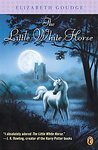
The Little White HorseThe Little White Horse by Elizabeth Goudge

Delightfully charming and fanciful.

This Carnegie Medal-winner from the mid-1900s was a fun little escape into the whimsical world of orphaned Maria Merryweather who finds her home, family, and purpose when she goes to live with her bachelor uncle.

I enjoyed the descriptive writing style and the way the author made the various characters come to life.  I especially enjoyed Marmaduke Scarlet, the dwarf and house servant whose vocabulary and general way of speaking tickled me immensely.  (Example:  "I gathered from the tone of your voice that this tea-party was to be a great occasion, and great occasions need to be greatly celebrated.  The mere suggestion of meanness, upon a great occasion, is much to be deprecated.  The bodily sustenance of the inner man as well as the aesthetic satisfaction of the outward eye should be on a lavish scale" (222).

I also thought Wrolf, the dog/lion was particularly well-done and Old Parson was simply a delight with his way of bringing the Bible to life, of knowing his parishioners to such an extent that he both commended and corrected them, and of engaging the children and creating a sense of community.

As you might expect from a children's book written in this time period, there is a good deal of moralizing by the characters discussing traits such as love, humility and courage and "having too much sense to let the spirits be dampened by minor disappointments" (135).  The language was flowing and poetic and took me both back in time and into another world where magical creatures and the resolution of a centuries-long feud by a little girl seems possible.  As a book lover, I especially enjoyed this language: 
"(The room had) no other furniture and no pictures or ornaments.  But the room did not need them because of the books, which stood there upon the shelves breathing out a friendliness that seemed to furnish and ornament the room. . .Maria had no doubt that the loving usage that had turned the books into living creatures was Old Parson's" (111).
Reading to Know - Book Club

It's been a few months since I participated in Carrie's book club, but I enjoyed this selection and likely wouldn't have read it without it being the book for March.  I'm looking forward to reading another P.G. Wodehouse, Very Good, Jeeves, for the book club in April.  Maybe I'll get to read it while in Phoenix! :)

Tuesday, March 25, 2014

Where'd You Go, Bernadette

Where'd You Go, BernadetteWhere'd You Go, Bernadette by Maria Semple

My overall opinion of this book is "myeh."  It was kind of fun to enjoy the author's satirical wit poking fun at different stereotypes, and her technique of progressing the storyline through emails, doctor's reports, notes, and transcripts of conversations was unique and interesting.  I was surprised, but this technique actually worked.

Overall, however, it just hit me as kind of ridiculous.  The book went on and on (and on), but then the ending felt really abrupt and without resolution.

As to a question a friend of mine posed, "To self reflect do women in a sense disappear into motherhood and marriage and what are the ramifications thereof?", I think that's a viable question but not one I saw presented in this book myself.  I saw Bernadette as a woman who "lost herself" because 1) she was afraid of another failure/embarrassment and 2) she had "bartered" her creativity in her desperate plea for her daughter's life--not because she had disappeared into motherhood and marriage in a sacrificial sense.

I will concede that this novel was rather clever, but it just didn't do it for me as a great read.  (As I look at my Goodreads friends' ratings, however, I find they all gave it 4's and 5's, so what do I know as I wavered between 2 and 3--two for the story, 3 for the author's cleverness?!  You may want to read it for yourself and disagree with me!)

Monday, March 24, 2014

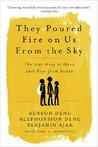
They Poured Fire on Us From the Sky

They Poured Fire on Us From the Sky: The Story of Three Lost Boys from SudanThey Poured Fire on Us From the Sky: The Story of Three Lost Boys from Sudan by Benjamin Ajak

What a powerful account!  Why do I think this is a great book to read?  As the last paragraph of the book says, "In a world where we witness war on television as impersonally as an action movie, personal accounts are necessary reminders that for someone, somewhere, war is all too real.  It has tragic and lasting consequences on people's lives, particularly children's" (311).

As horrifying as it is to imagine little boys--five years old, seven years old (my Easton is almost eight!!)--fleeing desperately across a desert while their families are killed in the village, traveling for miles and miles for as long as 14 years, I still could hardly put the book down.

This book tells the story of three of the 27,000 young boys who fled Sudan in the late 1980s and finally escaped to America as "Lost Boys" and young men around 2001.  In addition to it being a story that simply needs to be told, I think the book works because the boys take turns telling their stories in their own words.  A large part of the appeal was the oftentimes poetic and descriptive language they used such as "their mouths were full of laughter" (33) and "we could feel our bones trying to exhibit themselves to the world" (77).

There is so much in this book.  The will to survive is the predominant theme, even as the young boys walked for weeks and weeks, even as they went a couple days without water at the equator, even as little boys went three full years without any meat or milk. 

"Hunger makes you different.  It changes you.  Like the cow that sees grain on the ground and walks in without being invited and eats it.  It makes you like an animal.  War had ruined a lot of things.  I had become convinced that people were not good; people were bad" (180).

This book will put into perspective any trials going on in your life.  "And having food and raiment let us be therewith content."  I Timothy 6:8

Friday, March 21, 2014

Spring Break

We kinda took a Spring Break this week.  I didn't have it planned, but we had a very long weekend visiting friends and traveling several hours for my son to speak at a youth-led meeting he was invited to participate in and when we got home I realized my calendar was packed for the upcoming week.  In exhaustion, I declared it Spring Break. 

The truth is, I am tired and unmotivated about homeschooling right now anyway.  I am soooo ready for summer!  (Do you get tired of reading this every. single. year. on my blog about this time?!) 

It's been a great week with lots of free time for the children to play and learn in their own ways.  We spent Monday playing with cousins.  Tuesday was the Homeschool Day at the Capitol but I begged out of dragging the younger kids around all day, so stayed home with them while Alan took the older two.  The kids wrote letters to friends, listened to music, jumped on the trampoline, rode bikes, played imaginary games, danced around the house, played with puzzles,
created with Legos (lots and lots of Lego creating--he is my Lego boy!),
lost a first tooth,
 went on bike rides (hey, they rode bikes A LOT!), built with dominoes,
read books, drew pictures,
helped mommy around the house, played with friends who came up from Missouri to visit. . .
(I think I might start UNschooling.  It's been so relaxing for me and they've been so good and creative. . .  Okay, I won't really start unschooling because I'm far too uptight for that.  But I wish!)

What have I been doing?  Ummm, reading a lot.  (blush)  And working on a menu plan to start following Trim Healthy Mama (varying carbs and fats in each meal to provide only one fuel source and hopefully lose some of this weight).  Restyling hair, playing with kids, resting.

Most fun of all, my dear friend Kristina came up Thursday and helped me do some projects to get ready for Baby.  We completely organized toys and made homes for everything (again!  This is a constant work in progress around here) and turned the toy room into Baby's room.
We also had tons of fun going through baby clothes that have been gifted and handed down to us and putting them in her dresser.  Cute, cute, cute!  And exciting!  
In other fun baby news, Briana made the baby a cocoon.  This was her first project using this particular technique--knitting in the round with double-point needles.  I'm so proud of her ability and diligence to teach herself how to do something so she can create what she wants to produce.  (I'm also quite excited to see a baby in these pictures instead of dolls.)
And how adorable is this car seat cover set that my dear friend, Shela, ordered as a surprise gift for us?!  I've never seen anything like it, but IT IS EXTRAVAGANT.  So soft and luscious-feeling.  This baby will be traveling in comfort!

Next week, it's back to the grindstone!

Wednesday, March 19, 2014

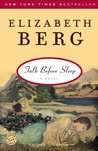
Talk Before Sleep

Talk Before SleepTalk Before Sleep by Elizabeth Berg

I don't know what it is about Berg, but she just seems to GET people.  I think I'm going to have to search out more of her books for the characterization alone.  I don't necessarily love the characters--or even like them--but they are so multi-dimensional and react like real people that I can't help but get sucked in. 

This particular book is about women's friendships.  Phew--complicated, right?  Now add in that Ruth is dying from breast cancer and it gets even more complicated.

I could chat and chat about this book.  I have lots of acquaintances, and several friends.  But women with whom I connect outside of superficial similarities (season in life, life choices, etc) and even IN SPITE of differences--they are rare.  And priceless.  Have you ever stopped to think of who you would want to be with you in the final weeks of your life as you know you're dying?  Have you ever thought of who you would be willing to put the rest of your life on pause for so you could spend those final weeks of their life with them?

Talk Before Sleep is interesting to examine the dynamics of women's friendships.  What connects different women?  Isn't it interesting how in one relationship a woman is the leader while in a different relationship she is the follower?  And what should we think about how close women friendships can affect a woman's marriage and immediate family?  (I even think of Debi Pearl's cautions regarding female friendships.)

I also found it poignant that Ruth came to regret leaving her husband.  It makes me think of a saying I recently saw along the lines of "Instead of thinking the grass is greener on the other side of the fence, water your own grass."  While at times Ann was jealous of Ruth's perceived freedom, her cute little apartment, and her "self-knowledge", she comes to realize that Ruth was lonely.  "I don't like living alone," Ruth finally concludes.  "I needed to live alone to find that out.  Funny, huh?" (pg 107).  I wish women who are ready to leave their husbands, families, etc. in pursuit of "self" could read this and rethink their options.

Finally, I want to see Sophie's Choice, which is a movie the two main characters watched that made them cry.  (I know, I'm weird like that) Or maybe read the book.  I know nothing about either one.  And I appreciated these quotes:

"She was capable of a scary kind of honesty I was ready for, although until that moment, I hadn't realized how much I'd been needing to meet someone I might be able to say everything to" (14).

"Ruth has friends like other people have wardrobes.  I mean that there's someone for every occasion" (36).

Tuesday, March 18, 2014

Not Even A Hint

Not Even a Hint: Guarding Your Heart Against LustNot Even a Hint: Guarding Your Heart Against Lust by Joshua Harris


Destry had loaned I Kissed Dating Goodbye to a couple friends from church who ended up buying all three of Joshua Harris's books.  After reading Not Even A Hint:  Guarding Your Heart Against Lust, they asked Destry if he wanted to read it because they thought it was really good.

I have to agree with them, it had some very good points and I've never read another book quite like it.  Even though Destry read it before I did, I would recommend that parents read this book before handing to their teenager.  Destry was good to come to us and ask questions or share thoughts, but it might have been nice to have had a little idea of what sorts of things were in the book to prepare me for those topics. :)

Overall, this book taught what lust is, what the Bible says about it, gives practical suggestions of how to live with purity and integrity, and most of all, it reminds us that we can't fight this battle alone. ("Even a good guideline for fighting lust, if it's carried out with man-made schemes, always ends in self-righteousness" 48.) We must rely on the Lord's power and grace and take advantage of the resources He has given us (parents, trusted mentor or friend) to hold us accountable and help us through times of temptation.

I appreciated his quote of John Piper's equation of lust:  "Lust is a sexual desire minus honor and holiness" (38).

I also thought he had some good suggestions in his guideline for creating a custom-tailored plan for fighting lust:
1. List your own top three lust triggers.  How can you avoid them?
2. What time of day or week are you most tempted by lust?  What can you do to prepare for those times?
3. Which locations are the most tempting for you?  How can you limit your time in these places?
4. What five little battles do you need to be fighting more faithfully?  Describe in detail what it looks like for you to fight-and win-these battles. (pg. 74)
I think my two favorite parts of this book were the ways he 1) emphasized developing a community of accountability who will provoke you to live in holiness and integrity and 2) emphasized the power in the Word.  "Your Bible is no lifeless book.  It has power.  When you read it, speak it, and memorize it, the Holy Spirit uses it against sin like an offensive weapon" (Heb. 4:12, II Tim. 3:16-17)(pg.150).  He strongly encourages memorizing verses to help the reader battle temptations of lust, including Job 31:11-12, Romans 8:6, Gal. 6:7-8, Rom. 13:14, Matthew 5:29-30, II Tim. 2:22, Col. 3:5-6, Eph. 5:3, I Cor. 6:18-20, I Thes. 4:3-6, Prov. 6:25-27, Ps. 101:3, Rom. 14:12, James 1:15, Prov. 5:3-5, Prov. 5:8-11, Ps. 84:10-12, Ps. 16:11, Lam. 3:24-26, Prov. 19:23, Mt. 5:8, Ps. 11:7, Is. 33:17, Ps. 119:9-11

Thursday, March 13, 2014

Rasputin and the Romanovs

After I enjoyed Carrie's recommendation of  The Kitchen Boy, I knew I would have to read the other two books Robert Alexander wrote in this trilogy.


Rasputin's Daughter was merely "okay" in my opinion.  Rasputin was a character, for sure, and an unpleasant character at that, but I got tired of reading his daughter's ruminations, discoveries about her father's activities, and fear for his murder.  I think anyone who enjoys the first book in the series will have to read this book to get the full picture, but it was my least favorite of the three (that's what Alexander gets for setting such a high standard in the other two books--he raised my expectations and made me greedy).


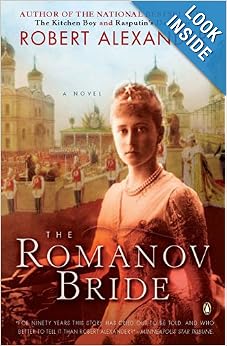
But The Romanov Bride, on the other hand, was back to the late-night-inducing quality of The Kitchen Boy.  In addition to Alexander's admirable attention to historical detail (even to the point of quoting from the Grand Duchess's historical letters, diaries, and other documents), he successfully rounds out each of his characters.  Grand Duke Sergei is a thoroughly unlikable fellow, yet through his wife's eyes, the reader can't help feeling compassion for the circumstances that influenced the man he became.  Elisavyeta herself is a joy to get to know and watching her grow was my favorite part of this book.

As Alexander told the story of the aristocracy, the world war, and the Russian Revolution, he interspersed the tale of a poor Russian man, Pavel, who became an active leader in the revolutionary efforts after his wife and unborn child were unnecessarily killed.  Pavel's struggle with bitterness, resentment, and hatred were contrasted with the Duchess's forgiveness and compassion in such a way that Pavel himself was challenged.  I'll have to agree with the review on my book which states "Alexander once again masterfully combines the power of true history and riveting storytelling to bring this fascinating and legendary period to life."

I also truly enjoyed the way Alexander sprinkled commentary about this historical time period throughout the book with ruminations by the characters such as:
It was Aleksander II, as well, who had planned to end autocratic rule in Russia by introducing a European-syle constitution.  This would have long come to pass were it not for the revolutionaries, for just days before the constitution was to be released they had blown the Tsar apart. . .The revolutionaries had believed this death would spark a great revolution, but in fact it created not a single demonstration, only widespread mourning. . .And the new Tsar came to hate any kind of revolutionary or progressive thought. . .believed that the only way to deal with unrest was by force (75).

Russian peasants, I had come to learn in my years here, were a peculiar sort, one moment all politeness, bowing, and submissive, next angry and so violent, not afraid to kill.  But such were the shadows, the hangovers, of their recent serfdom, when these poor people had been traded as not much more than slaves.  Warm, loving of family and friends, and hardworking--I had found all this in my adopted people.  All that they lacked was a proper sense of self-worth and a literate, educated manner in which to express their frustrations.  Simply, they were still so afraid of their master's whip, for without education, without intelligent words, the only way they could do battle against that whip was to resort to sheer violence itself (259).

One moment there were a hundred souls standing in line, long-suffering folk who had never complained, just poor people in felt boots and foul coats, always submissive to master and Tsar.  The next moment every last one of them, right down to the old babushkas with their scarves tied round their heads, were fiery rebels!  The crowd burst to life, surging forward, breaking every window of the bread store and piling in, frantically grabbing all the loaves. . .and then everyone was on (the shop owner), kicking and beating him, ripping at clothing and limb.  He lived one more minute, no more.  Their fury surprised even me.  Like a lid finally blown off a boiling pot, the deep Russian instinct for revenge suddenly blew wide and could not be contained (248).

How could he have done that?  Toward what goal?  He had thought he would receive satisfaction from his revenge, but all that was delivered unto him was torment.  He had thought that he had killed to keep the Revolution rolling forward, so that the sins of their masters would never be repeated, but now he saw that the fury of upheaval was doomed only to repeat itself again and again (298).
I could share a great deal more as this book has many talking points, including the Orthodox religion of the Russian people.  I found it sad to read of the icon-worship, the misunderstanding of living a life for Christ.  One point I did appreciate was the Duchess's response to a prostitute's claim of being too far gone to turn to the Lord:   "God's image may become unclear, but, my child, it can never be entirely wiped away" (214).  What a great expression--I can't help but wonder if this is one of the quotes taken from her diaries.  We each are made in the image of God and until death, it is never too late to turn to God, regardless of what is in our past.

I'll stop going on about this book now, but if you enjoy a well-told story, rich characterization, and a well-researched peek into time past, I highly recommend this series.