I'm sure glad she did.
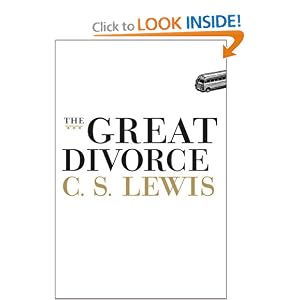
Rather like in his Screwtape Letters, Lewis uses an imaginary situation, a dream or a vision, if you will in this book, to illustrate his message. This time he's showing our tendency as humans to choose something that we hold onto at the cost of heaven.
"The choice of every lost soul can be expressed in the words 'Better to reign in Hell than serve in Heaven.' There is always something they insist on keeping even at the price of misery. There is always something they prefer to joy--that is, to reality" (71).To quote a friend of mine, "Lewis makes the case, and I think it is valid, that those who are not heirs of the kingdom would find no joy in heaven, in the reality of God's glory, in the substance of eternal goodness. That for those who are condemned, heaven would be hellish to experience."
“There are only two kinds of people in the end: those who say to God, 'Thy will be done,' and those to whom God says, in the end, 'Thy will be done.' All that are in Hell, choose it. Without that self-choice there could be no Hell. No soul that seriously and constantly desires joy will ever miss it. Those who seek find. To those who knock it is opened" (75).And what, you may ask, do some of these poor souls choose over heaven? One chooses pride, another intellectualism, another cynicism, another self-pity, another a critical spirit. . . and the list goes on.
Perhaps most disturbing and obvious of all was the mother who chose her son. She called it her love for her son, but truly she didn't even know the meaning of love and instead idolized and possessed him. Upon her arrival, she cared not in the least to meet the Lord but wanted only to be with her son. Yet without loving Him, we have no capacity to love anyone for in the end this type of love "demands to have him down with her in Hell. That kind is sometimes perfectly ready to plunge the soul they say they love in endless misery if only they can still in some fashion possess it" (115).
I highly recommend this book if you want to be challenged. It's relatively short, but Lewis has once again packed the pages full. I'll need to read this again, I'm certain. But for now, I'm left examining myself. What am I choosing to hold onto rather than allowing the Lord to sanctify me? What cheap, worthless imitation of His true goodness is filling the place of the immeasurable gifts He wants to give me?

Oh, man. I need to re-read this. I remember how bleak some of his descriptions were in this book, but I read it pre-children, and I know it would carry an entirely different weight now. And I'm wondering why it's not in my personal collection! I probably loaned it out years ago and forgot. Happens all too frequently. Thanks for the reminder!
ReplyDelete