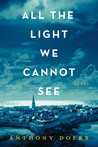
 All the Light We Cannot See by Anthony Doerr
Two teenagers during World War II, one a girl in France, one an orphaned boy in Germany. This book tells their stories as Hitler rises and falls from power.
I must admit I did not like the way the book jumped back and forth, not just between the two main characters, but also between years. That is one disadvantage to reading a book like this on the Kindle, I think, as it's more difficult to flip back and remember which year this chapter is in when you've had to set it down and pick it back up. It also just broke the book up for me making it choppy and difficult to engage in.
Having said that, there was a lot to like about it. The historical aspect of the novel was well done. The growth of the characters and the effects the war had on them was also well done. I especially enjoyed all the unique characters he gave us: a mechanical genius, a brilliant bird-loving scientist with quiet courage, a blind, brave and practical girl, a damaged-by-war veteran, an insightful young girl who sees what's coming, a gentle, music-loving giant forced into killing. . .
This book hit me in a tender spot as my 18-year-old son is seriously considering joining the armed services. I think he doesn't realize the effects war has on a person. So as I read, I highlighted several poignant passages:
"You will strip away your weakness, your cowardice, your hesitation. You will become like a waterfall, a volley of bullets--you will all surge in the same direction at the same pace toward the same cause. You will forgo comforts; you will live by duty alone. You will eat country and breathe nation" (137). . ."They are each a mound of clay, and the potter that is the portly, shiny-faced commandment is throwing 400 identical pots" (139).I enjoyed his use of language throughout the book and the many themes he explored: death, growing up, courage, conformity, friendship, loss, learning and appreciation of nature. . .
"Something in Werner's soul shuts its scaly eyes" (246).
"He has the sensation that something huge and empty is about to devour them all" (251).
"as if they ward off a vast and inevitable tidal wave of anguish only by staying forever drunk on rigor and exercise and gleaming boot leather" (262).
"Werner is beginning to see, approaching his sixteenth birthday, that what the fuhrer really requires is boys. Great rows of them walking to the conveyor belt to climb on" (277).
"Other times the eyes of men who are about to die haunt him, and he kills them all over again. Dead man in Lodz. Dead man in Lublin. Dead man in Radom. Dead man in Cracow" (498).
It was also interesting to find Verne's "20,000 Leagues Under the Sea" woven throughout the book as one of the main characters reads it throughout the story. I read that classic for the first time just last year so it was interesting to revisit it through her eyes.
Since I borrowed the book on my Kindle, here are a few other quotes I highlighted that I might like to revisit at some point:
"across the room is a miniature girl, skinny, quick-witted, an open book in her lap; inside her chest pulses something huge, something full of longing, something unafraid" (46).
"They lie on their stomachs and page through comics, feeling the pleasure of being outside of school, glancing at each other now and then as if curious to learn whether their friendship will continue to exist in another place" (220).
"Everyone trapped in their roles: orphans, cadets, Frederick, Volkheimer, the old Jewess who lives upstairs. Even Jutta" (229).
"She thinks of the whelks in Hubert Bazin's kennel, ten thousand of them; how they cling; how they draw themselves up into the spirals of their shells; how, when they're tucked into that grotto, the gulls cannot come in to carry them up into the sky and drop them on the rocks to break them" (446).
"When I lost my sight, Werner, people said I was brave. When my father left, people said I was brave. But it is not bravery; I have no choice. I wake up and live my life. Don't you do the same?" (469).