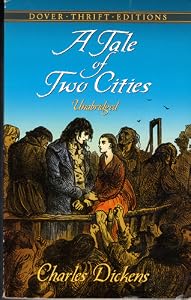
The kids and I got so much out of this great novel set during the French Revolution (which we were studying in our history lessons) and have developed quite an appreciation for Dickens and his incredible (if long-winded) gift with language. People simply do not write like this anymore.
Because I am behind in writing book reviews (or possibly I am just lazy, or then again, I might be doing so because I enjoyed them), I am going to share the kids' essays prompted by our reading and discussion of this novel and its setting.
Contrasting the
French and American Revolutions
By Briana
During the
late 1700’s, two history-shaping revolutions took place. The first was the
American Revolution and the second was the French Revolution. Though these
revolutions occurred simultaneously, the outcome of each was very different.
While the American Revolution gave birth to the freedom-based United States, the French Revolution resulted in
The Reign of Terror and massive political upheaval in France. The
fundamental similarities between these two revolutions can make it difficult to
understand why they turned out so differently. Both revolutions started as a
result of the people desiring to be free from the oppression of a king and his
nobles. Also, both revolutions were led by men of great talent who spurred the
people on. A declaration and constitution were also written for each country,
outlining what each believed. Even though these revolutions had similarities,
their differences led to their divergent results. The outcomes of the revolutions
were dictated by their history, government, and goals.
The
American and French revolutions were greatly shaped by the background of the
people who participated in them. The people of France were burdened by a history
of oppression. For decades, the lower class had been little more than slaves,
forced by the nobles to work and pay heavy taxes. As a result of this, the
people of France
were poor and starving. Americans, on the other hand, had been living in a free
new land experiencing the blessings of prosperity, plenty, and self-government.
The French were not only oppressed physically, but they were also uneducated.
There were three estates, or classes, in France at this time: the Clergy,
the Nobles, and the peasants. The peasants were largely uneducated, and spent
their days struggling to survive. By contrast, there were no distinct classes
in America,
and education was very important to the average American. There was a very high
literacy rate in the American colonies before and during the revolution. The
French people’s poverty, ignorance, and oppression motivated the peasants to
revolt. The American Revolution, on the other hand, was started by well-educated,
prospering colonists who wanted to maintain and protect their rights from the
king who was encroaching upon them. The history and education of the people
involved in the revolutions made the one a desperate enterprise, and the other
an enlightened desire for liberty.
Because the
two revolutions were driven by people with different backgrounds, two distinct
governments were established. The French set up a democracy in which every
citizen directly participated. In the reign of terror, it was the populace of Paris that influenced the
judges to execute or spare prisoners, and during the massacre of the prisons,
the people were the executioners. In America, however, the people were
not directly involved in the new political system. America set up a republic, in which
the people were represented in a legislature. Because of the indirect influence
of the general public, the American system was more orderly and organized, and
contained no mob rule. The democratic structure of the new French government
made it possible for the general populace to rule the country, and throw
moderation and responsibility to the wind, while the structure of American
government insured that liberty and justice would be given to all. The people
of France and America both established a government, but America
designed a more responsible system to protect and manage their rights.
The most
striking difference between the two revolutions can be seen in the dominant
goal each country strove to achieve with their revolution. The goal of the
French people in their revolution was revenge. The populace wanted to rid France of the
people who had oppressed and dehumanized them for centuries. The Americans, on
the other hand, desired to secede from those who would not respect them and
form a separate, but equal, nation. Because France’s goal was revenge, the
revolutionaries soon took their desires too far, and carried out revenge upon
thousands of innocent people. Violence and bloodshed became the true rulers of France,
bringing terror and destruction upon the country. America’s goal of separation caused
them to be involved in a war which cost many Americans and British their lives.
This war, however, was motivated by the desire to separate from Britain, not to
get revenge. The Americans were successful over the British in this war, and
the new nation was recognized by the world. The history-shaping results of the
French and American revolutions were determined by their different goals.
The
American and French revolutions are well-known in human history, for both had a
strong impact on the world. The French Revolution horrified the world with the
brutality and murder of those years. By contrast, the American Revolution is
remembered as the birth of a nation that has been a shining example of liberty
and self-government. Many times throughout human history revisions to countries
and governments have been necessary and revolutions have taken place. In modern
life, citizens of a country often feel the need for revisions in their own
country’s government. When those situations arise, citizens can look to the
past for guidance in handling revolutions and reformations effectively. The
background, goal and new system of government must all be taken into account. A
modern revolution could choose to follow the example of France, and ignorantly take revenge on wrongdoers,
or it could follow in the footsteps of America and strive to separate from
oppressors and form a responsible government.
(I'll try to remember to post Destry's essay tomorrow)

LOVE! I had read this a few years ago for the first time. My only disappointment was that I didn't have anyone to talk to about it! I should have also picked up some sort of study guide...I knew so little history that I know I didn't get as much out of the book as I could have. Great job, Briana! You obviously understood the book much better than I! Looking forward to reading it again in a few years with Nan.
ReplyDeleteDid you know that every Christmas in Galveston, Texas they recreate a Dicken's Christmas? Charles Dickens Grandson comes and signs autographs....my grandparents have gone and brought us back an autographed copy of the Christmas Carol. I don't know much about it...and can't figure out if that is cool or just strange! :)
Hang in there, Laura, and you'll soon be getting the opportunity to discuss these great books with your kiddos--it's our reward for homeschooling all those other years! :)
DeleteAnd we very much enjoy Dickens. Too bad Galveston, TX is so far away for we would think it cool! hee, hee