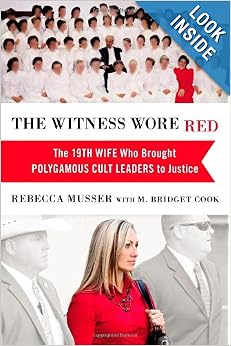
That is my summary of this account written by "the 19th wife who brought polygamous cult leaders to justice." My friend Alana recommended The Witness Wore Red with some reservations--I think she found it disturbing too.
As much as I might like to think I would never be a victim like this, I am also well aware that with different conditioning and upbringing, I might also allow myself--even worse, my daughter(s)--to be given as a child bride to a dirty old man. My inward cynicism which I try to keep pushed down is baited by stories like this, when dictatorial men rule with an iron fist and use religion to assuage their lust for power and sex--more and more sex, with younger and younger women/girls. It's simply horrifying.
The story certainly is gripping and gets right under the reader's skin. The writing, however, isn't as gripping, and I think the book could have been about 100 pages shorter. I'm also left with my usual dissatisfaction in reading a memoir--now what? Where is Rebecca Musser now? What about the rest of the FLDS cult? Has Jeffs received justice? (honestly, I'm thinking castration here. He is so, so gross.)
I found the progression of her blind acceptance to recognition throughout the book to be intriguing:
- "I looked at my FLDS role models--my mothers, aunts, and cousins--and everything they had to endure. Like most of them, I felt that I could handle anything in this life if it meant my salvation in the next" (44).
- "Even though I had seen suggestions and requests greatly influence the Prophet's behavior, it was daily ingrained in us that he was the mouth of God--the one and only man blessed with total, omniscient gifts of the Spirit. It shocked me that he had not seen what was happening. He was supposed to know everything about everyone! The thought was disturbing to me. What else did he not know? I couldn't let that thought take seed, however, or the rest of my world would violently crash down around me. Once again, I knew I had to remove all doubts from my mind" (107).
- "Not a single one of us expressed any doubt. Not only was it unsafe to do so, but we codependently bolstered one another in our blind obedience. We sang songs about keeping "sweet," never complaining, never questioning, and sacrificing our feelings to do what was right" (110).
- "All of a sudden, nothing seemed holy about the structure that must be in place for polygamy to work. Why would God put a roughly equal number of males and females on the earth if he wanted a polygamous society? This structure meant that women didn't get the time, affection, and validation they so crave. And because only a select number of male leaders are righteous enough to receive multiple wives, not only do an extraordinarily high number of young men get kicked out, but the marriageable ages of girls becomes increasingly younger as demand intensifies" (172).
- "The level of depravity that had befallen the people was shocking in and of itself. But the fact that these grown women, leaders among their sister-wives, had allowed themselves to become abusers of young children scarred my soul.. .that was my past, my training, my flesh and blood. Had I stayed, would I have fallen so far as to participate too?. . .How I wanted to believe that I would have left long before being forced to participate. But as I listened to Warren's orders and the women's responses, I knew with a deep shame that blind obedience was the very trap I had lived in for so long, the one that shackled each one of these women as boundaries were shattered again and again. I was not so different from them" (301).
- "As I learned more about choice and looked over the extensive evidence in all of the cases I had testified in, I realized that what was happening in the FLDS was human trafficking--both for labor and for sex. In mainstream society, money and lust are the currency. In the FLDS, salvation and position are the currency, the the forced acts of labor and sex are the same--the very definition of slavery" (327).
- "Perhaps one of my biggest lessons was learning the healthy difference between passive, aggressive, and assertive characteristics of behavior. To be passive means you don't stand up for your own rights. To be aggressive means that you stand up for your rights while not honoring the rights of others. . .Assertiveness means that you stand up for your rights while honoring the rights of others. It is difficult to be manipulated or to manipulate others when you are genuinely assertive" (332).

This isn't a book that I will read, but I really appreciated your honesty in your review! I have often thought the same thing when I read polygamy stories. If I had been raised a little bit differently that could have been me! I enjoyed the review, even if the book was a little disturbing.
ReplyDeleteIt keeps us humble, doesn't it?!
DeleteI went to place a hold on this only to be told I already had. I guess I did after I saw it on goodreads :)
ReplyDelete:) It's thought-provoking, that's for sure. We could do another online-book-discussion for this one. . .
DeleteYikes. I'm going to have to mull this one over before I decide whether or not to read it. It reminds me (in a smaller way) of how important it is for anyone- including and especially Christians- to ask the hard questions about their faith. She sounds so, so brave. I don't envy the road to recovery she has ahead of her.
ReplyDeleteIt wasn't a pleasant read, that's for sure. But yes, you nailed the lesson exactly--THINK!!! Don't just follow blindly, think for yourself. Christians--search the scriptures yourself!
Delete