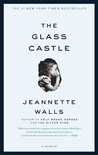
 The Glass Castle by Jeannette Walls
Fascinating! I can't stop thinking about this book. In fact, shortly after finishing it I hustled to google to learn more about Jeannette Walls--where is she now? What about Lori, Brian, and Maureen? And Rosemary?
How much of who we are is influenced by genetics, how much by our upbringing and experiences, and how much by our perspective?
Is it mental illness that leads a person to a nomadic life, an irresponsible pursuit of dreams, and neglect of children or is it selfishness or is it a worldview? (Mom accused Jeannette of being sold out: "Next thing I know, you'll become a Republican. Where are the values I raised you with?" 269) Were I to subscribe to secular psychology, I would suspect bipolar and PTSD in the father which he self-medicated with alcohol, and I would suspect co-dependency in the mother for sure, as well as possibly some bipolar tendencies and hoarding. Yet another part of me discerns their worldview and wants to credit it just as much. I can't help but wonder what someone with a very liberal worldview would do with this book.
As a home educator, I was intrigued by the children's unconventional education (learning Morse code, doing math in binary numbers, exploring the outdoors, arguing with dictionary publishers about word definitions). . .and their future successes. I was also intrigued with some of the parenting ideas that people worry too much about and do too much for their children and "children shouldn't be burdened with a lot of rules and restrictions" (59). Struggles produce strength and independence. This was taken to an extreme of course (what an understatement!). But it's still interesting to ponder to a lesser degree.
As I've gotten to know (a little bit) some people who are homeless, I was especially intrigued with the discussion of homelessness on pages 255-257. "They'd been learning the ropes. They'd visited the various soup kitchens, sampling the cuisines, and had their favorites. They knew which churches passed out sandwiches and when. They went to plays and operas and concerts in the parks, listened to string quartets and piano recitals in office-building lobbies, attended movie screenings, and visited museums." They said the city made being homeless easy. Then a professor engages Jeannette with the question "if homelessness was the result of drug abuse and misguided entitlement programs, as the conservatives claimed, or did it occur, as the liberals argued, because of cuts in social-service programs and the failure to create economic opportunity for the poor?" "Sometimes, I think, it's neither," Jeannette responded. "I think that maybe sometimes people get the lives they want. If some of them were willing to work hard and make compromises, they might not have ideal lives, but they could make ends meet."
My library copy is filled with little post it note flags on pages I would love to discuss with someone!

This is one of those I've been meaning to read for a long time (I mean, what a great title!), but it looks like I may have to bump it closer to the top of the list. Thanks again. (I mean that somewhat genuinely and somewhat sarcastically.)
ReplyDeleteYes. Yes, you really must read it. I'm hoping to read Half Broke Horses soon to try to understand her mother better. . .
Delete