Tuesday, November 26, 2013

The Atonement Child

My friend Alana chose The Atonement Child by Francine Rivers for our November book discussion.  I had read the book several years earlier and as usual, enjoyed Francine's rich characterization and the way she uses a fictional story to illustrate a rich message and drive a point home.
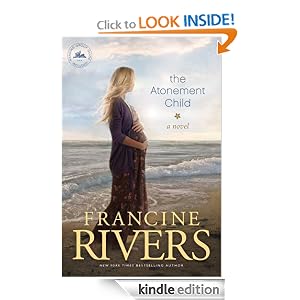
At first glance, the theme for this particular novel was abortion.  What will the main character, an innocent, sheltered Christian college girl, choose when she conceives a child through rape?  The author exposes many points of view through the counsel she receives from her friends at the christian college, her pastor-majoring-fiance, her parents, and her grandmother.  As the story unfolds, we learn of others who were faced with the same decision--to kill, or not to kill.  A married woman with children whose doctor says delivering her baby will likely kill her.  An unmarried young woman whose boyfriend abandons her and she has her whole life before her and limited resources to care for a child.  Rivers even manages to smoothly insert the experience of an abortionist doctor into the main storyline.

I think Francine Rivers once again humanizes a hot topic.  She addresses all the issues, all the arguments people use to justify aborting a baby, by introducing us to characters we can care about and letting us feel the emotions.  Not only does she introduce us to characters as they wrestle through the decision, but she also shows us the consequences of their choices.

As I said, abortion is the theme of the novel at first glance.  Yet I think there is a deeper theme that makes the book so successful--what position do you give the Lord in your life?  Because the place you give the Lord determines how you handle the trials in your life.  Some people blame the Lord in anger, some people feel like the Lord let them down and cheated them from what they deserve (and after all their good works and service too!), some people decide they have to take their lives into their own hands because the Lord must have messed up or at least dropped the ball here, and some people are so bound by lists and rules and tradition that they don't even realize they are missing the Lord completely.  Other people, however, turn to the Lord, burrow into His rest and comfort, trustingly place their hand in His and follow where He leads.

In many ways, this book is a difficult read for me.  I can't help putting my nearly-18-year-old daughter in the place of the main character, which horrifies me.  I can't imagine how broken she would be by such an experience.  I'm also passionate about life and the blessing children are so abortion makes me feel sick to my stomach.  But it's a really good book, a well-told story, and it reminds me to continually keep the Lord on the throne and to trust Him with my life.  He never promises our lives will be easy or free of trials.  What He promises is that He will be there with us through it.

Friday, November 22, 2013

For Real Friday

I had too much fun first reading Laura's blog today, and then popping over to her friend's "For Real" post to read of a mom who couldn't remember the last time she had bathed her child.  It made me laugh and like this total stranger, so I thought I would turn today's (this week's??) funk into a For Real post as well.

FOR REAL:
  • I stayed up past 1 am two nights this week to re-read The Hunger Games trilogy.  Why?  I don't know.  I realize it's pointless, they were fine to read once but twice?  really?  It's just such an interesting alternate universe and it sucks me in. . .
  • My daughter stayed up past 11 pm two nights this week also reading The Hunger Games which irritated me mightily because she was tired and slow-moving the next morning.  (Because I, of course, would never do that!)
  • I'm feeling kind of tired and crabby the last couple days (what? you think that's related to the above?  pschaw!)
  • I still don't feel like I have any friends in this church congregation.  Sometimes I think it's my problem.  Most of the time I think it's everyone else's.  (hey, we're being real here, right?!)
  • Sometimes on Sundays this song won't leave my head.  I'm just not a fan of big smiles, hearty handshakes, backslapping, and shallow conversations about nothing week after week.  Yet I'm tired of inviting people over, trying to get below the surface, and it just makes me feel lonely.
  • I want to have a really fun New Year's Eve party this year.  It's my favorite excuse for a fun party with friends and silliness and laughs.  And I'm trying to justify inviting people I have the most fun with instead of thinking about my kids and who they would have the most fun with.  But we'll probably end up going where my teens will have a good time again this year.
  • I picked a fight with my husband this week because he paid the homeowner's and auto insurance bill and the amount of it made me annoyed.  As if he's the one who chose the amount.  (You know we have two teen drivers, right?)
  • When my teenaged son is in a bad mood or we are having a little rift in our relationship, I can always make him laugh by making a farting sound with my mouth.   Then he tells me I'm the weirdest mom ever.  But at least he's smiling at me when he says it.
  • I think the worst thing about being a stay-at-home mom is the supper smells that torture me all day long.  Right now I have a beef brisket slowly cooking in the oven with garlic, thyme, oregano, onion, and sun-dried tomatoes.  It just makes me want to eat all day long.  Chips, chocolate, popcorn, whatever I can find. . .until I'm not hungry when supper time finally arrives.  Then I'm hungry after the kids go to bed.  Don't ask how those weight-loss goals of last Spring are coming along.
  • If I had it all to do over again, I wouldn't have let my son watch Napoleon Dynamite.  It is really, really, REALLY annoying to hear quoted day after day after day.
That's kind of therapeutic!  Let's be real--what are you REALLY thinking today?

Tuesday, November 19, 2013

Brain Integration Therapy

I'm so happy for Kiana's recent success with reading.  She went from being unable to remember what sound individual letters make (as recently as September) to reading six Bob books last month in order to earn her free personal pan Pizza Hut pizza through Book It. 
Despite her posed, frozen face, she was very excited and proud to get her own pizza.
As I shared earlier, we encountered some difficulties early in the school year and took a little journey of trial and error to educate mama on how to best help her.  I tend to be pretty relaxed with formal education in the early years so it might seem surprising that I was concerned about my barely-turned-six-year-old being unable to remember phonics sounds, but my gut just told me there was something different about the way her brain was working and I needed to figure out a way to help her so she would have success.

A friend of mine recommended Dianne Craft's materials and her book Brain Integration Therapy Manual.  We have implemented just a few of the techniques and I am now a believer!  In a nutshell, Craft explains that the left and right sides of the brain are separated by the Corpus Callosum which usually acts as a bridge to transfer information from the short term memory (left brain) to the long term memory (right), but sometimes this bridge instead acts as a wall.  When this happens, a child can only learn so much until her short term memory is filled up.  This is what happened with Kiana.  She learned a few sounds, but then seemed unable to remember anything else.  When I would show her a letter and tell her its sound, she would repeat it after me.  Then I would move on to review sounds she knew already, and when I came back to the "new" sound, she couldn't remember what it was.  She would tap her index finger against her temple, her face all scrunched up with effort, and say "I can't remember that one."

Craft describes four different learning gates that can be blocked when this happens.  Kiana's difficulty seems to be in auditory processing.  In addition to her struggles with phonics, she mispronounces many words (such as "emeny" for enemy and "aminal" for animal), and doesn't follow verbal instruction well.  I had thought she just wasn't paying attention, but it makes more sense now.  She is also amazing at playing Memory--which of course uses the right brain (pictures and colors) rather than the left brain (language)--she beats me every time and it's not because I'm letting her!

We have been spending about 5-10 minutes each day doing exercises to help cross that midline in her brain.  We are also using Craft's phonics flashcards which incorporate color, pictures, and humor with the phonics sounds superimposed on top of the picture because the right side of the brain stores color, pictures, and humor while the left side of the brain is the language base.  When combining all these elements into one unit, the entire brain is working together to store the information.  We have also implemented Craft's advice to hold the card up so that her eyes have to look up and to the left to "take a picture" and store the information in her right brain which she can then recall later.
As I texted to the friend who loaned me her manual, "I would never believe the change if I wasn't seeing it myself!"  This little lady is simply zooming along with reading now, full of grins and confidence.  I am so grateful we learned about Dianne Craft's work early so we won't have years of struggling before figuring out how she learns best.

Sunday, November 17, 2013

Freezer Cooking 101

One of my friends recently asked me why our husbands and kids think they need to eat every single day.  I had to chuckle at the question, as it truly does seem like half my life is spent planning meals, finding new recipes,making grocery lists, shopping, cooking, cleaning up. . .

It makes my life considerably easier when I have meals prepared ahead in the freezer.  They are nice to heat up on a busy day, or to use when I missed a trip to the grocery store and the pantry is looking a little bare, or to share with someone who has suffered illness or had a baby.  I usually try to have at least two meals frozen for unexpected events, but it's even better when I've purposefully filled the freezer with several meals.  Recently some younger friends were asking me for tips about how to get together once a month and spend a day cooking.  I was pretty happy when they invited me to spend the day cooking with them--it was just the motivation I needed.
We decided to use the method in which we each take a turn choosing the meals and doing all the grocery shopping for one month.  Jenna got this job for the first month which means for the next three months, all she has to do is show up to mix together two of the recipes.
We chose to make eight different meals (which allows us to eat two freezer meals per week) and multiply that times the four families so we made 32 meals in about 3-4 hours.  Here are the eight meals Jenna chose for this month.  She also suggested we rate them as we eat them so we can decide if we want to make them again in the future.  Her scale is 1 (never want this again) through 5 (I would eat it again tomorrow).  We haven't tried all of them yet, but I'll try to update this post with the ratings over the next couple of weeks.


We had fun chatting and chopping and I'm looking forward to another day spent cooking with them.  It's Jamie's turn to choose the menu and do the shopping next month!

Tuesday, November 12, 2013

Dorian Gray

Some books are so weird they stick with a person.  I think The Picture of Dorian Gray by Oscar Wilde is  one of those kinds of books.
Its author claims "there is no such thing as a moral or immoral book.  Books are well written, or badly written.  That is all."  At the same time, his main character encounters first an immoral man, then a book which opens his mind to a hedonistic lifestyle and it's all downhill from there.

The plot of the book centers around the beautiful, innocent-looking Dorian Gray who was the subject of a painting in his youth.  "He had uttered a mad wish that he himself might remain young, and the portrait grow old; that his own beauty might be untarnished, and the face on the canvas bear the burden of his passions and his sins; that the painted image might be seared with the lines of suffering and thought, and that he might keep all the delicate bloom and loveliness of his then just conscious boyhood" (110).  Who could imagine that his wish would come true--that his visage would remain innocent, young, and beautiful while the portrait grew ever uglier to reflect the stains on his soul as he pursued the pleasures of sin for a season.

Yet through his hedonistic pursuits, he never found love, happiness or contentment.  "That curiosity about life which Lord Henry had first stirred in him, as they sat together in the garden of their friend, seemed to increase with gratification.  The more he knew, the more he desired to know.  He had mad hungers that grew more ravenous as he fed them" (151).  He corrupted women and he led his friends into destruction until "he wanted to be where no one would know who he was.  He wanted to escape from himself" (214).

The pleasures of sin for a season, indeed.  The story was hauntingly similar to the biblical book of Ecclesiastes in some senses.  Vanity, vanity, all is vanity.  "What does it profit a man if he gain the whole world and lose his own soul?"  Even Lord Henry, Dorian's cynical mentor in sin's vices, grew world-weary and tired of it all.

Which brings me to Lord Henry himself.  He idolized youth and beauty, cared about nothing but himself and his pleasure, and held himself mockingly aloof from those about him.  While he was quite the horrid influence, I sometimes could relate to his cynicism and by turn either pondered or got a kick out of his pithy sayings such as the following: 
"But I can't help detesting my relations.  I suppose it comes from the fact that none of us can stand other people having the same faults as ourselves" (23).

"Young men want to be faithful, and are not; old men want to be faithless, and cannot:  that is all one can say" (45).

"To be good is to be in harmony with one's self.  Discord is to be forced to be in harmony with others.  One's own life--that is the important thing.  As for the lives of one's neighbors, if one wishes to be a prig or a Puritan, one can flaunt one's moral views about them, but they are not one's concern" (97).

"Women are wonderfully practical, much more practical than we are.  In situations of that kind we often forget to say anything about marriage, and they always remind us" (95).  (I insert here an involuntary chuckle HA!)

"Children begin by loving their parents; as they grow older they judge them; sometimes they forgive them" (85).

"When a woman marries again, it is because she detested her first husband.  When a man marries again, it is because he adored his first wife.  Women try their luck; men risk theirs."

"We can have in life but one great experience at best, and the secret of life is to reproduce that experience as often as possible. . .I have never searched for happiness.  Who wants happiness?  I have searched for pleasure" (224).
I must admit I host a cynic inside me as well and books like this waken her.  Combine the premise of this book with the book I am currently reading (The Atonement Child which tells of a young, innocent, sheltered christian girl being impregnated through rape) and I start questioning some of our parenting choices.  This world is ugly--just plain rotten--and someone, somewhere, sometime will delight in setting Pandora's box before my children and exposing them to temptations of hedonistic pleasures.  Someday they will experience heartbreak, betrayal, disappointment. . .Sometimes my cynical self wonders if it's even possible to adequately prepare or protect them so what's the point of even trying. Yet try to prepare them I must, ever pointing them to the Lord and Savior who stretched out His arms to claim our guilt and shame when we are drawn away of our own lusts and enticed.

An interesting and thought-provoking book indeed.  I find it interesting that it beautifully illustrates the vanity of a life spent in pursuit of selfish pleasure, even as I understand Oscar Wilde himself to have been an adherent of hedonism.  I'm quite glad I read it for Carrie's book club (even as I finished later than the deadline specified).

Tuesday, November 5, 2013

Reflections on "Enlightened" Parenting

This post is prompted by my reading of Wild Grows the Heather in Devon but I was afraid my review of the book would get way too long if I got on my soapbox about parenting styles. :)

Early in the story, little Amanda was indulged by her parents and by the end of the book she was a prodigal daughter, bringing her parents much heartache.
"Even at the young age of seven, Amanda was well accustomed to triumphs,.  Strong willed and precocious, she had walked and talked at an early age. . .Before much longer she was the acknowledged queen of the whole household.  Whether barking out orders like the little commander she was, slyly orchestrating events so they conformed to her liking, or simply charming others into complying with her wishes, she had become adept at getting her own way. 
Nor did either father or mother strenuously resist such tendencies.  Times had changed, and they were enlightened parents. . .The thought that indulging their daughter's willfulness might be detrimental to her never occurred to such modern thinkers.  For the most part, they admired her independent spirit. . .For the mother, all that mattered was that her daughter feel her accepting and unconditional love" (76).
I found it especially revealing that her parents were "enlightened parents. . .the thought that indulging their daughter's willfulness might be detrimental to her never occurred to such modern thinkers".  This story, you understand, was set in the early 1900s.  Now it's 2013 and I'm seeing this theme continued in sentiments like the following which I copied from a friend's post on facebook:


Do you want to know a little secret?  I love children--I mean seriously love children.  But children who are raised by "enlightened parents" get on my nerves in no time flat. You know the type--those children who radiate willful defiance. Such as a five year old who is writing on a white board and is told not to write on it right now, so "please give me the marker" who instead thrusts the marker behind his back while he tilts his chin and stubbornly initiates a staredown with the adult.  (The child won.  I couldn't tear my eyes away.  It's like a trainwreck happening right before your eyes!)  I know it's not necessarily that child's fault, for it's his parents' responsibility to train him, but I don't enjoy that child.

And if this continues I'm pretty sure he won't be an enjoyable adult to be around either.

It's a sad culture when sin is excused as just "being human" rather than something to be avoided--and the very reason our Savior died for us.  It's not about a "standard of perfection" but about training in the peaceable fruit of righteousness.  It's about training our children's character so they will be more receptive to the working of the Holy Spirit who is the source of joy, peace, patience, kindness, self-control and other godly fruit.
"The positive fruit of the rigorous (intellectual) training early in their lives was as evident as the negative fruit brought about by the corresponding absence of disciplinary regulation. . .We realize now that we fed the sense within Amanda that she was the center of the world and need answer to no one.  We too readily gave her her own way.  There were few restrictions placed. . .We were loving parents, but we were not thorough parents" (239)
Parenting styles produce fruit, for certain.  "Enlightened," permissive, child-centered parenting produces rotten fruit while biblical parenting produces pleasing and appealing fruit.  I believe that God's grace, thankfully, is able to compensate for our mistakes, yet we also have a responsibility as parents to follow God's plan rather than being sucked into humanistic, secular reasoning.  Why not prepare our children, from the very beginning, for the concept that their lives are not their own--they are not to rule themselves but to submit to their loving Father's Will?  How much easier that will be for them if they first have been trained to obey their earthly parents!

Let's not give in to "enlightened" thinking, my friends.  Let's persevere, even if our friends or family or the "experts" disagree or don't understand.
"Amanda's character is more important than the traditions of society, more important than what people think of us, more important than what she thinks of us" (391).

Sunday, November 3, 2013

Wild Grows the Heather in Devon

My local book discussion group spent the last month reading Wild Grows the Heather in Devon by Michael Phillips.  I would never have read it had Dian not chosen it.  I wonder if I would have finished it if I hadn't known we would be getting together to discuss it.  It's really just not a book I would typically read.  Having said that, it was rather interesting and contained some good talking points.

What I liked:
Phillips purposefully set out to examine how the embracing of christianity would affect the life of an intellectual, affluent couple in the early 1900s in England.  While intellectualism, evolution, universal reconciliation, socialism, and feminism were sweeping the world, what impact were they having on christianity?

Isn't that a fascinating premise?  In addition to the "hot topic" themes, there were other thoughtful nuggets tucked within the story.

Dying to Self:
One of the characters struggled with exchanging her independence for trusting in the Lord.  That's a struggle I could relate to; indeed, I think each of us need to grow in the area of submission.  I found it especially interesting that this character's mentor twice told her that "laying down the right to self-rule" is our very reason for being on this earth.  Ponder that one!
"There's nothing else that life's for than t' learn that one thing--how not to do what ye yerself want.  That's all this earth's for--t' teach us t' do what someone else wants" (212).
"It's not easy.  Laying down your independence and saying you're not going to rule your own life is the hardest thing in the world.  But then 'tis the only thing we're put on earth to learn.  And men have to learn it just as well as women.  'Tis the human way to salvation, as I see it--laying down the right to self-rule" (269).
Religion vs. Relationship
"When people are not dwelling in that vital center--the center of the Father's goodness--religion becomes a tedious affair. . .Many of them do not know that vital, pulsating foundation which is the mainstay of life--the center of the Father's goodness.  So they go about living a religion rather than a reality, more afraid of the Father than abiding in his love.  They fear hell to a greater extent than they are convinced of his power to give life" (246).

When reading the Bible ask the Lord "How does this apply to me?  Specifically.  What does it have to do with my daily life and my relationships with others?  What does it have to do with my attitudes, my outlook, my values, my priorities?  What does it have to do with how I conduct myself and how I think?  These are questions you have to ask.  Then you must say, 'Lord, what changes do you want to make in my life on the basis of this scriptural principle I am reading?  What growth do you have for me here?  What do you want me to do about it?" (262)

A father's loving plea to his wayward daughter:
"I implore you to hear me.  Please do not reject my words.  If at all possible, put away your youthful pride for a moment and listen to this exhortation.  It is simply this:  There is no greater measure of maturity and character than the capacity to listen to the counsel of others about oneself" (396).

Appropriate Stages:
(Catherine) "I like being fourteen too.  It's a little like being halfway between a girl and a woman.  I don't want my life to change any faster than it should.  I want to enjoy every age as much as I can" (422).
I really liked this quote even though it was a minor moment in the book.  Too often I see people (especially teenaged girls) chafe at their current season, anticipating the next season to such a point that they don't enjoy where they are or even learn the lessons the current moment has for them.  How I love it when young people live the attitude Catherine expressed above!  I think it's a great way of learning contentment and is much more mature than the child who thinks they are ready for the next season and proudly wishes away the time they are experiencing.

I think I'll save my thoughts on the book's example of parenting philosophy for another post.  This is one of those books that I don't really recommend--it's the first in a trilogy that I'm not planning to continue reading--but yet there were enough good little nuggets that I'm rather glad I read it anyway.  My primary complaint about the book is just that it was so slow, a fact the author warned the reader about in the introduction.  This is not an action-packed book, it is just the slow unfolding of ideas and belief in a family's life.  Another reader might thoroughly enjoy the series.