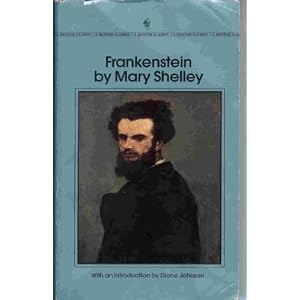
But something I've enjoyed even more has been the additional insights my teens have shared from our reading. Destry, for example, pointed out how the creature started out loving man with a truer sense of love which sought man's best but deteriorated to a selfish shadow of love which sought to use. He saved the life of a drowning girl and helped the Delacey family by cutting wood and scooping their snow. He longed for the companionship of man and wanted their love. After being rejected and persecuted, however, he despaired of being loved and demanded a female counterpart to his monster. Destry observed that at this point he was no longer seeking to give and receive love, but rather was selfishly seeking an equally miserable creature to satisfy his own desires.
Briana, on the other hand, was especially struck by how frequently the characters allowed their emotions to dictate their actions. She noted the negative consequences that resulted from this lack of self-control such as the creature killing people in fits of anger and Frankenstein "giving in to his despair" and becoming despondent and sick. Considering how many times over the years I have counseled her to take captive every thought and bring it under obedience to Christ and to practice self-control rather than giving in to her emotions, I found it very interesting that she noticed this theme in the book.
Briana also contrasted the sanctity of life with Frankenstein's lack of respect for life as he carelessly created without any forethought or sense of responsibility for that life. His prideful attitude made him think he was somehow above the laws of nature which God himself set in motion. Life is sacred; it is not common and should not be treated as such. Creating new life should only be undertaken with serious contemplation and that life cannot then be cast aside simply because it is not convenient or what was expected.

I've said it before and I'll say it again--I'm having a blast learning with my teens! I got much more out of this book this time than I did the first time I read it.

Huh! I've never read this and can't honestly say that I've ever wanted to. You have made me Officially Curious.
ReplyDeleteOoooooh, Carrie, I wish we could read it together!! I'm not saying it's the greatest book ever, nor did I (obviously) agree with every theme, but it was definitely thought-provoking and (I think) well-written. I was fascinated that Shelley wrote it as something of a "contest" due to a challenge of Lord Byron when she was only 19!
DeleteThere's a book called The Deadliest Monster by Baldwin, I believe, that compares Frankenstein and RL Stevenson's Dr. Jekyll and Mr. Hyde in terms of worldview and a Christian perspective. It's very good, if you haven't seen it.
ReplyDeleteYES! That's exactly what we're doing, Sherry! We're reading Jekyll and Hyde now and The Deadliest Monster is coming up next. So glad to hear your recommendation.
DeleteExcellent review! I finished reading Frankenstein for school earlier this year, and had pretty much the opinion of it: http://inkslingerblog.wordpress.com/2012/01/27/book-review-frankenstein/
ReplyDeleteAlso, I'd like to second Sherry's recommendation of The Deadliest Monster. It's fabulous. :)
I very much enjoyed my peek at your blog, Corey! Thank you, too, for recommending The Deadliest Monster, now I'm looking forward to it even more.
DeleteI can't wait to read Frankenstein again. My oldest really enjoyed it and you are right, there is so much to discuss!
ReplyDeleteWell, you wouldn't find me reading this book(you know me:)), but I do think your big kids are really really smart!!!!!!
ReplyDeletechuckle, Oh, c'mon Marc, surely I can turn you into a reader one of these days. . . :D
DeleteYour teens have some good insights, and a good teacher as well. Looking into The Deadliest Monster -- thanks to those who mentioned.
ReplyDeleteSo great to hear from you, Amber! :)
Delete